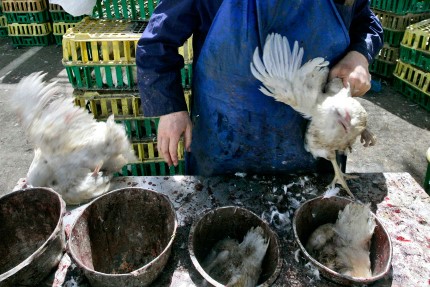
There has been much talk about claims by ultra-Orthodox consumers, who make sure to buy poultry from Mehadrin farms, that the prices are exorbitant.
Years ago, the 'Movement for Government Fairness', through attorneys Mordechai Eisenberg and Nechama Tzivin, filed a lawsuit - which is about to be filed again soon in accordance with the updated circumstances and prices - with the Tel Aviv Rabbinical Court against the Kashrut Committee of the Haredi Orthodox Church, the Kashrut Committee of Rabbi Landau Bnei Brak, the Kashrut Committee of the She'erit Yisrael Badatz, and the Kashrut Committee of Rabbi Avraham Rubin Badatz Mehadrin - for price gouging.
This painful issue has not yet been resolved, and needy families continue to suffer. In the meantime, Eisenberg and Tzivin have won a number of petitions filed with the High Court of Justice against the Chief Rabbinate Council, the Ministry of Religious Services, and the Prime Minister's Office, among other things, regarding the training of kashrut supervisors, the termination of the employment of the supervisor by the business owner (removing a conflict of interest between the supervisor and the supervised), the indication of "foreign milk powder" on dairy products, and the signature of a city rabbi on kashrut certificates on behalf of the religious council in his city.
 Want more news, videos and stories? Join the Haredim 10 WhatsApp channel >>
'The 'Movement for Government Fairness' came on its own behalf, and also and primarily on behalf of a broad public, a public of consumers of fancy kosher, a public that from a halachic perspective can only rely on poultry marketed with fancy kosher. Chicken is recognized as a basic product - until not long ago, its price was under the supervision of the Ministry of Food and Drug Safety - and in the language of halachic law, "a thing that has life in it." Chicken is not a luxury product, and on the contrary, when they want to point out a family living in poverty and deprivation, they emphasize that "the family eats chicken only on Shabbat.".
Now, against the backdrop of the Central Halacha Committee conference, which is being held today under the auspices of the Continuing Education Department of the Chabad Rabbinical Court in the Holy Land, and the Binani Institute for Halacha and Rabbinical Studies, with the participation of rabbis from all disciplines, attorneys Mordechai Eisenberg and Nechama Tzivin found it appropriate to raise this important and regrettable issue, in order to bring the conference participants to the attention of the plight.
In their opinion, producers, marketers, and traders of the Mehadrin poultry sinned in two ways:
A. In the laws of fraud and rescission of contracts arising from fraud in commerce.
B. In the rules of proper commerce which do not permit unreasonable profit even if there is no fraud involved.
•
The lawsuit that was prepared states: "The subject of this lawsuit is the excessive price of poultry with a high kosher certification, which exceeds the prices of poultry with a 'rabbinical' kosher certification by a variable amount, to the point of doubling the price. A price increase of such a rate, for a basic commodity in times of economic hardship, is unjustified even considering the additional costs of the high kosher certification.".
The plaintiffs request that the court order the establishment of maximum prices for Mehadrin poultry, as part of the supervision of kashrut and by virtue of the court's authority "to determine prices" (Rambam, 14:1).
The remedies requested by the plaintiffs from the Honorable Court:
A. That the court will set a maximum consumer price for Mehadrin poultry, in such a way that those involved (slaughterhouse, marketer, store) will not profit more from feasts (20% on the foundation).
B. That the court orders the kashrut committees to enforce the price determined by the court, within the framework of providing kashrut and supervising slaughterhouses and producers.
C. Alternatively, the court orders the kashrut committees to set a maximum price for the consumer, and to publish it publicly.
D. Alternatively and in addition, that the court appoint an objective professional expert to examine the costs of producing and marketing the Mehadrin poultry.
E. Alternatively, that the court orders the defendants to publicly publish the rate of the additional cost of the Mehadrin's kashrut.
F. Alternatively, that the Honorable Court grant permission to contact the Commissioner for Trade Restrictions at the Ministry of Trade and Industry (who is the authority authorized by law to inspect monopolies and cartels' prices), with a request that the Commissioner inspect and determine whether the price of the Mehadrin poultry is a fair price.
The lawsuit also stated: "These kashrut committees (the defendants) do their job with the utmost care and dedication, and the plaintiffs do not blame them for the high prices. Quite the opposite is true. The production and/or marketing factors exploit their monopolistic power and the general public's lack of knowledge, which believes (mistakenly) that the price increase is due to the costs of the fancy kashrut. This is when the additional direct costs of Mehadrin kashrut beyond "rabbinical" kashrut are relatively insignificant.".
The plaintiffs claim that exploiting this ignorance of Mehadrin kosher consumers (most of whom are low-income families with large families) to increase the price per kilogram is deceptive, and therefore the prices of Mehadrin poultry are fraudulent.
In the lawsuit, the plaintiffs detail a variety of issues such as poverty and distress at this time, and that, unfortunately, it would not be an exaggeration to say that among the Haredi public there are many (too many) families who are literally hungry. The need and obligation of the courts to take into account the distress of the general public, and in this regard, the plaintiffs rely, among other things, on:
Here is the book of Teshuvot and HaNagatot by Rabbi Moshe Sternbuch, the Ramad's sign: "In addition to this, the house of din is charged with ensuring that the price of meat does not rise, at a time when many of those in need cannot afford to pay, and therefore whoever wishes to be strict about inspecting an animal while it is lying down should take care to arrange for an animal or two to be inspected every week, strictly speaking, but there is no reason to order all animals to be inspected in this way at the public's expense, .......""
Halachic issues in fraud, the prohibition of foreclosure and its severity, the power of a court to prevent foreclosure, the definition of "foreclosure" in the matter of the prohibition of foreclosure, and the reference of the Antitrust Law (Sections 29A, 30) regarding the authority vested in the Antitrust Commissioner to prevent harm to the public through unfair pricing.
Indeed, in recent years, blessed initiatives have arisen, the largest and most significant being that of the Chabad Kollel. In addition, rabbis have initiated the establishment of many charitable organizations to support the poor.
Eisenberg and Tzivin say: "We are confident that the esteemed and brilliant rabbis, the conference participants, will also discuss the issues that were briefly mentioned in this article. All for the benefit of the Mehadrin kosher consumer public, and I hope that the need to go to the courts, to file a circular of this lawsuit and other lawsuits on the subject of kosher, will be eliminated.".