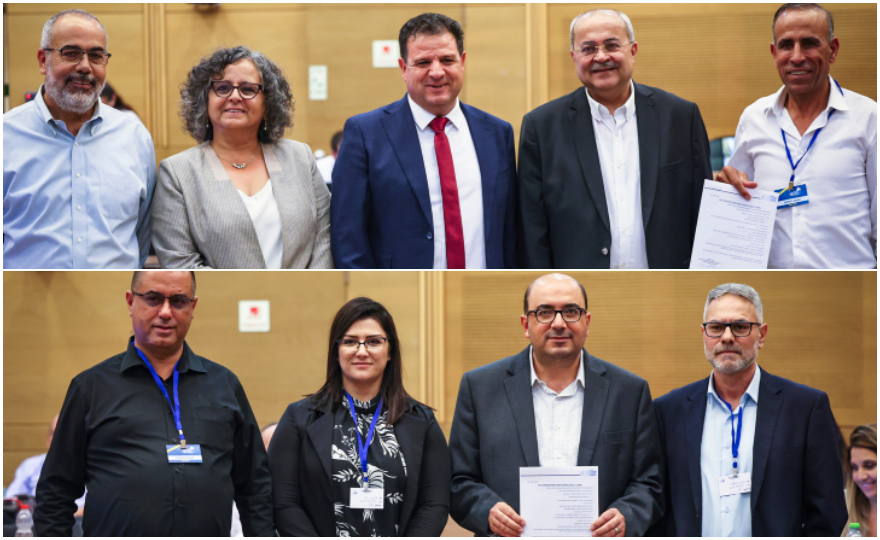
Joint chairwoman Ayman Odeh told 'Kan News': "We wanted unity, but there is no doubt that the most interesting list in the elections is the Hadash-Ta'al list.".
Ahmed Tibi said: "We wanted to be together, unfortunately it's not happening." Balad Chairman Sami Abu Shehadeh said: "We are running alone - and that's final.".
MK Matans Shehadeh, No. 2 in Balad, claimed in response to a question from Galts: "We agreed to compromise. But Tibi and Odeh decided to submit a list alone." Is this good for Jews? The distribution of Arab votes into three separate parties - Ra'am, Hadash-Ta'al and Balad, increases the chance that one of them will not pass the threshold, which will bring Netanyahu's bloc closer to the 61st mandate that would allow the formation of a right-wing government. On the other hand, the separation of the extreme Balad from the joint party will make it easier for Yair Lapid to rely on them to form a government, if Netanyahu does not achieve 61. However, it is difficult to see Lapid and Gantz forming a government that will rely on Ahmed Tibi, Ayman Odeh and Ofer Kassif. Arab affairs commentator Jacky Khoury wrote this evening in Haaretz: "The disintegration of the Joint List and the separate running of Hadash-Ta'al and Balad is good news for Likud Chairman Benjamin Netanyahu, who came significantly closer to achieving a majority of 61 MKs in the next Knesset. "The reason for this is twofold: First, Balad's chances of passing the threshold and entering the Knesset are zero, and therefore it is expected to "burn" tens of thousands of votes from voters who oppose Netanyahu; second, the split itself is expected to keep the voting rate in Arab society low, and likely lower it even further. "The split is also expected to lead to an increase in the voices in Arab society calling for a boycott of the elections, and there are activists in Balad who made such voices this evening. Such a boycott would further harm support for Hadash-Ta'al, could also harm the GNA, and would accordingly improve Netanyahu's chances of forming the next government. However, the disintegration of the Joint List is expected to lead to increased activity by Zionist parties - on both sides of the political map - in Arab society, who will try to attract Arab voters. Also, although the surprising move significantly strengthened Netanyahu's chances of returning to the Prime Minister's Office, it provides Yair Lapid with reason for optimism: if Hadash-Ta'al still manages to reach five or six seats on its own, the Yesh Atid chairman will gain a possible coalition partner, devoid of the core of Balad's opposition.If, instead of investing a month of effort in the imaginary union between Meretz and Labor, Lapid had paid attention to what was happening in the Arab sector, perhaps he wouldn't have found himself facing a broken trough tonight.
— Amit Segal (@amit_segal) September 15, 2022
Lapid is starting to remind me of Bennett. He fell in love with the position, and forgot that in order to stay in it, you have to roll up your sleeves and do a lot of politics.
— Daphna Liel (@DaphnaLiel) September 15, 2022
Elia and Kotz in it. Balad's withdrawal is good for the right only if they run to the end. But if they withdraw and the votes are overwhelming for Tibi and his friends - Lapid has a coalition with the joint party (if Netanyahu doesn't bring 61). The one who prevented this option was the extremist Balad.
— Yaakov Rivlin (@arivlin1) September 15, 2022
Pollster Shlomo Filber responded: "In the end, the Arabs always save us from ourselves. In this case, it is relevant to both the right and the left. Tomorrow, everyone will explain how the move works specifically to their advantage." MK Uriel Bosso of Shas welcomed the joint breakup: "Profit and salvation will come to the Jews from another place." MK Orit Struck of the Religious Zionist faction welcomed: "All the workers of Evan will say goodbye. To say your kindness in the morning, and your faith at night.".In conclusion: The split in the coalition could be an opportunity for a new list that is ready to do business with the center-left government, or, conversely, lead to disappointment that will erase the Arab parties from the political map in Israel. We have to wait and see how the Arab public will react, and the reaction will be greatly influenced by how the leaders of the center-left bloc will treat the new situation.
— Muhammad Majadla (@mmagadli) September 15, 2022
 Join the Haredim 10 Facebook page >>
 Join the X page of Haredim 10 >>
 Want more news, videos and stories? Join the Haredim 10 WhatsApp channel >>