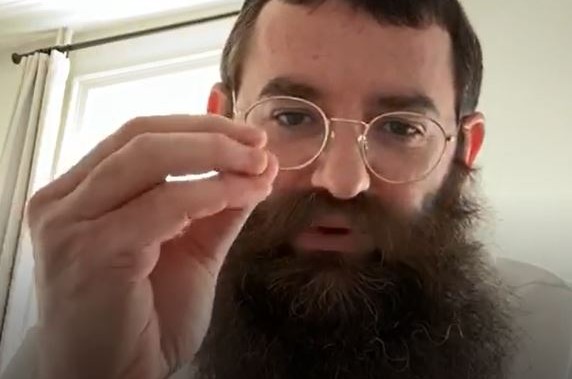
As a child, I grew up in a Chabad village, as its name suggests, a village where everyone is Chabad Hasidim. It is a wonderful place to live. Then and still today, a place of Torah and kindness.
They are all Chabad members, so I almost never got to be among Jews who were not Chabad followers. We had one special one in the village who wore a shtreimel on Shabbat that stood out among the Kneitch hills, and he is also a Chabad follower.
It wasn't until I was 17 that I went to study at a Chabad yeshiva in Jerusalem, and then suddenly I became aware of the wide and wonderful diversity of the Jewish people, the different and wonderful foods that flowed from all the exiles to the Holy City, and of course the special customs of the different communities.
 Want more news, videos and stories? Join the Haredim 10 WhatsApp channel >>
I saw then for the first time how Chabad customs often differ from those of other denominations. It was then that I also understood the importance of observing customs. The love and connection to Chabad customs that I had instilled in my parents' and elders' homes also grew stronger and became a solid pillar in my life.
One of the most striking points of difference is undoubtedly the joy on Shabbat among the Egyptians - the period of national mourning for the destruction of the Temple.
I came from a Chabad village where joy is heightened on these Shabbats - and Chabadniks know how to rejoice, and I saw communities where they sing "Lecha Dodi" in dirges and people wear less dignified clothing because of mourning.
For a curious Jew like me, it was incredibly fascinating.
I remembered that the Rebbe would increase the joy on those Shabbats, and in his talks he explained his leadership in a kind of calculation of one and another. Since on Shabbat one should not mourn, and since one should not diminish the joy lest it be considered or seen as if we are diminishing due to mourning, then one should rejoice.
And why rejoice more? Here the interiority of the Torah comes in and teaches thus: Shabbat is the representation of the future redemption in our lives, to the point that the future redemption is called 'a day that is entirely Shabbat.' A Jew who observes Shabbat emerges from a week of secular materialism and ascends at the moment of lighting the candles to a dimension of spirituality and holiness, just as at the moment of the arrival of the true and complete redemption soon in our day, we will emerge from six thousand years of material exile and enter the seventh spiritual millennium.
Well, if we rejoice every Shabbat because it is a kind of world to come, then in order to bring redemption into our lives on the Shabbat of the Intercession of the Egyptians, we need much more joy than on a regular Shabbat.
How wonderful are the diverse customs of our people.