Before the start of the Tisha B'Av fast, the sad news of the murder of Avraham Wals, a Toldot Aharon follower who was replacing an employee at the 'Atra Kadisha' site when an Arab terrorist driving a tractor decided to kill him was published.
While listening to the wailing and lamentations of Tisha B'Av night, I wondered whether to go to the funeral or not. And before you ask, I don't attend funerals on a regular basis. But a few weeks ago, I already attended one funeral of a person I didn't know. It was the last journey of Shawn Carmeli, a lone soldier, a Golan fighter, who fell at the beginning of the ground operation in Gaza. I came to the funeral along with many thousands out of gratitude for the man who immigrated to the Land of Israel and volunteered for the IDF to protect us and risk his life, and of course out of the feeling that a lone soldier should not walk alone on his last journey.
In any case, as the chairman of Gesher, I decided to go to the funeral together with a friend and traveling companion - our friend Rabbi Shmuel Chaim Pappenheim, a relative of the murdered man. We thought there would be precision in the timings - but that was not the case! We arrived among the first and saw the Hasidic crowd arriving. There were Jerusalemites, Satmarites, all Hasidic Jews, a lot of Toldot Aharon, and Lithuanian Haredim. After that, I realized that there were also non-Haredi participants, but they were behind.
 Want more news, videos and stories? Join the Haredim 10 WhatsApp channel >>
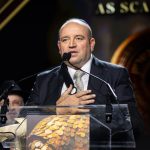
After a long wait, the eulogies began. The first to speak was the Gav"d, head of the Haredi Eda, Rabbi Tuvia Weiss. He was followed by Rabbi David Schmidl, head of the Atara Kadisha, his father-in-law Rabbi Yaakov Hanun, and of course the Rebbe of Toldot Aharon, who spoke by phone from his vacation spot in Austria.
The headlines of the following day naturally revolved around Hanun's obituary. A man known for his deep zeal, certainly in relation to the history of Aaron, but also towards other zealous factions, to the best of my understanding. Harsh things were said by him. He did not pass up the opportunity to attack the infidels and heretics (a group to which I apparently belong) and, as befits a view originating from the Satmar approach, he made it clear that the source of the troubles in the Land of Israel is provocation of the Gentiles, and even indirectly accused the Zionists of the murder of his son-in-law.
I didn't understand the obituaries right away (unfortunately, I don't understand enough Yiddish), and perhaps that's a good thing, but it's clear to me that these are very difficult things for a Zionist ear and probably for many Haredi ears.
The Gabd's eulogy
Here is the place to note a few more things from the obituaries, which did not receive any media coverage. The Gab'ad, of course, praised the deceased, and specifically praised the fact that he had preserved graves, since in the culture of the Haredi community this is considered preserving the walls (in the broad and non-political sense of Neturei Karta). More surprising was that, while expressing deep sorrow about the situation in the Land of Israel, he mentioned, along with the murdered man, the IDF soldiers who fell in Gaza. Although the explicit name was not mentioned, he used their exact number and called them young men and not soldiers.
It seems that even the head of the Haredi community is influenced by the atmosphere of the last two months in everything related to national unity and identification (even if it is minimal). As someone who belongs to the national religious public, I can state that we have witnessed a major change in the official Haredi press's attitude towards IDF soldiers when they receive coverage in the sector's media, in the form of mentions of names, photos, and in the newspaper 'Mishpacha' they even conducted an interview with the national religious brigade commander, Ofer Winter.
The Gabbad also mentioned the issue of the Interim Period. He claimed that in general he is against the Interim Period, and that anyone who is seriously immersed in Torah study must continue and persevere. He emphasized that during times of trouble for Israel, it is certainly forbidden to observe the Interim Period, another issue that has come up in the general Haredi public following the events of the last two months.
The Rebbe's eulogy
The Rebbe of Toldot Aharon referred to the current difficult period for Israel that requires personal soul-searching from each and every one. If the Gabbad repeated 'Natura Karta' many times, then the Rebbe repeated 'Klal Yisrael' numerous times. He emphasized that we must strengthen ourselves in general and strengthen the connection to Klal Yisrael in particular. It was interesting to ask the rabbi what he meant by this? From previous conversations with Toldot Aharon followers, I have a strong feeling that the current Rebbe's view is relatively moderate within the extreme Haredi world.
Among my Haredi friends, I felt a clear sense of displeasure at the invitation of Rabbi David Schmidel to deliver the eulogy. Was Yaakov Hanun, the father-in-law of the murdered man, the head of an Atara Kadisha – a body involved in quite a few violent incidents, and identified with the kind of zealots who expelled a soldier who came to pray in Beit Shemesh? It was sad to see on a common stage the Gav"d and the Rebbe of Toldot Aharon (who are usually victims of fanatical bullying) alongside people like Rabbi David Schmidel and Rabbi Yaakov Hanun, who are in a different place despite the "apparent" resemblance between them that is visible to the untrained eye.
So why did I decide to go to the funeral anyway?
I originally came to pay my respects to a Jew named Abraham Wallace, whom I never knew. He may have been a zealot, and of course I have no idea if he was involved in any acts of violence. Obviously, I wouldn't go to a funeral for just any Toldot Aharon, and despite the sharp differences of opinion that existed and remain, this man was murdered because he was Jewish.
This is the simple truth, for which I went. Just as the terrorist did not distinguish between Jews and Jews, in the situation that has arisen, we must be blind to the views of the murdered.
In retrospect, it was not easy to hear some of the obituaries. Because of the situation, I choose to listen more to the calls from the funeral for self-examination and to strengthen the bond within the Jewish community. I hope that in the future the Haredi public will find the strength to eradicate violence within itself and moderate some of the opinions.
May we hear good news, salvation, and comfort.