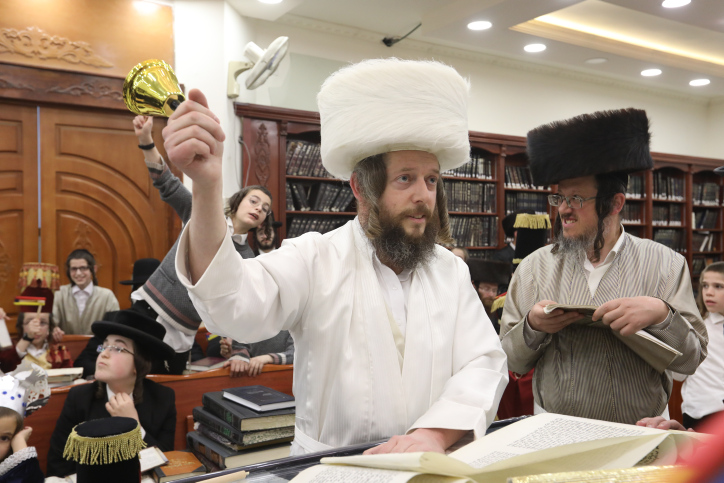
When the decree of destruction plotted by the wicked Haman is announced, Mordecai and Esther act on two parallel axes. Mordecai orders Esther to risk her life and go to Ahasuerus uninvited, and plead with him on behalf of her people. At the same time, Esther asks him to gather all the Jews and declare a three-day fast.
Enter: Registration for daycare for the 2012 school year is moving online
 Want more news, videos and stories? Join the Haredim 10 WhatsApp channel >>
Purim imparts to us a great and central foundation in the perception of Judaism. Some tend to separate faith from the life of this world. They think that these things contradict each other. When they encounter a problem, they react in one of two opposing ways: some will say, 'Everything is from above,' and in any case, all we need to do is pray; and some will say, 'We need to act in the ways of nature,' and therefore all we need to do is invest all our attention in earthly-natural activities.
The Book of Esther teaches us that there is no contradiction between these two axes of action, and that they should be combined with each other. We must pray, awaken in repentance, correct our actions – and at the same time act in earthly and natural ways. If there is a sick person in the family, we must go to the doctor, and at the same time pray and seek healing from a physician of all flesh.
Mordechai Shilav
When Haman's decree was announced, Mordecai could clearly state that it stemmed from the wicked Haman's hatred of the Jews, his envy of them, his arrogance and conceit, the frivolity of King Ahasuerus, and his tendency to accept bribes ("ten thousand talents of silver").
Ostensibly, all of his activities should have been focused in these directions.
But Mordechai understood that natural causes, by themselves, were still powerless to inflict such a terrible decree on the people of Israel. He knew that the decree was only possible because the divine protective wall that protects the people of Israel was damaged. He also assumed that the reason for this was, as the Sages say, because they "enjoyed the feast of that wicked one"; the mass participation of the Jews in the feast of Ahasuerus, which amounted to turning their backs on God and His Torah.
Mordechai combined the two axes of action. He sent Esther to work to repeal the decree in earthly ways, and at the same time worked to repair the spiritual breach. He called for repentance, fasting, prayer, and a cry to God. He was certain that when the people of Israel corrected the spiritual cause of the decree, it would also yield success on the earthly and natural levels.
A challenge for believers too
This combination is also a challenge for believing Jews. Often these two directions are perceived as two kingdoms that do not touch each other. During prayer and the observance of the commandments, we think about God, the Almighty, but when we move on to physical life, it seems that we must act solely based on pragmatic, logical, realistic considerations; not on the basis of faith.
The story of Purim teaches that spiritual life and material life are intertwined, even though we do not always see a connection between them. We must act in the ways of nature, because God wants man to become a natural instrument for divine blessing, but at the same time we must pray and strengthen ourselves on a spiritual level, in order to attract the abundance of blessing from above. Happy Purim