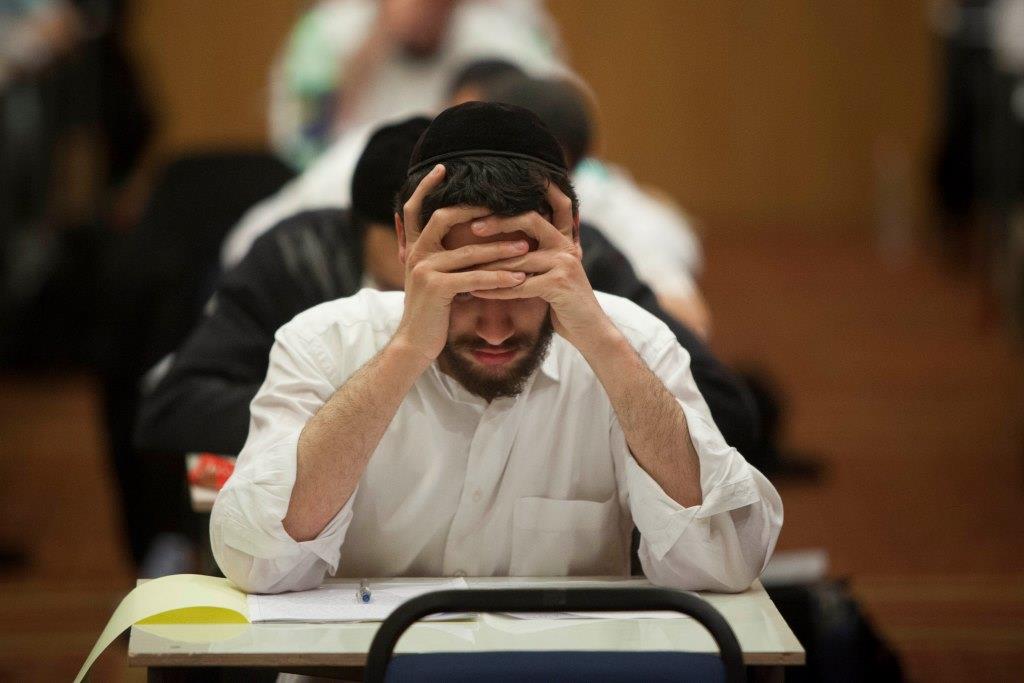
High Court judges are expected to hear today (Tuesday) a petition by religious and ultra-Orthodox students against the decision of the Council for Higher Education (CHE) that prevents them from registering for segregated academic tracks, because according to the CHE definition, they are not "Urdu.".
It's worth checking: You may be entitled to a lot of money from National Insurance.
The decision discriminates, in scandalous conduct, against graduates of Chabad and Sanz institutions, in relation to studies at academic institutions operating in the Haredi sector, because these Hasidic institutions are formally defined as institutions affiliated with the HaMamad stream by the Ministry of Education – and are not defined as Haredi.
 Want more news, videos and stories? Join the Haredim 10 WhatsApp channel >>
Graduates of these institutions claim that, although there is no doubt that they are Haredi, the Council of Religious Education forbade the Ono Academic College, for example, from allowing them to study in segregation, because they do not meet the Council's criteria determining "who is Haredi.".
More on the topic:
These definitions and decisions also affect those who have repented and have not studied at Haredi institutions, as well as seminaries for girls that are not officially defined as Haredi institutions – and as a result, they are not allowed to study on the separate campuses.
The first petition against the NLC was filed three and a half years ago. Only a year and a half ago did the High Court of Justice order the NLC to explain, in response to the petition, why the definition of 'who is Haredi' would not change.
The official position of the Council for Higher Education, currently headed by the Minister of Higher Education and supplemented by Ze'ev Elkin, prohibits gender-segregated studies, and permits the existence of a number of such tracks only for those who are defined as "ultra-Orthodox," according to the criteria established by the Council, and even then only for undergraduate degrees.
The petition claims that the Council of Ministers is prohibited from preventing institutions from accepting students based on social and religious backgrounds, and that it does not have the authority to decide for institutions who is "ultra-Orthodox" and who is not.
The petitioners claim that the Academic Affairs Council should focus only on its role according to law: to oversee the academic level of the institutions and degrees.
The High Court will also hold a hearing against the Council of State's decision to limit the operation of segregated study tracks in academia.
The petitioners further claim that segregated tracks do not constitute discrimination, because they do not impose anything on anyone, and offer equal conditions to women and men.
""The Israeli legislature has explicitly stated in the Student Rights Law that segregation on religious grounds will not be considered discrimination in higher education," the petition claims.
The petitioners also believe that the restrictions set by the Council of Ministers stem from a concept that seeks to educate the Haredi public and determine for them what the correct lifestyles are - and that there is no legal basis for this.