At the end of Shavuot, Rabbi Shalom Greenberg, a Chabad emissary in Shanghai, China, turned on his phone to check what messages had been received.
It's worth checking: You may be entitled to a lot of money from National Insurance.
One of the messages was from Israel: 'A Jew in Suzhou, about 60 miles from Shanghai, was found dead, alone in his apartment. Can the rabbi help with burial arrangements?''
Although a major city in eastern China's Jiangsu province, with a population of about 10 million, Suzhou does not have a Jewish community. The few Jews who live there travel to Shanghai for their Jewish needs.
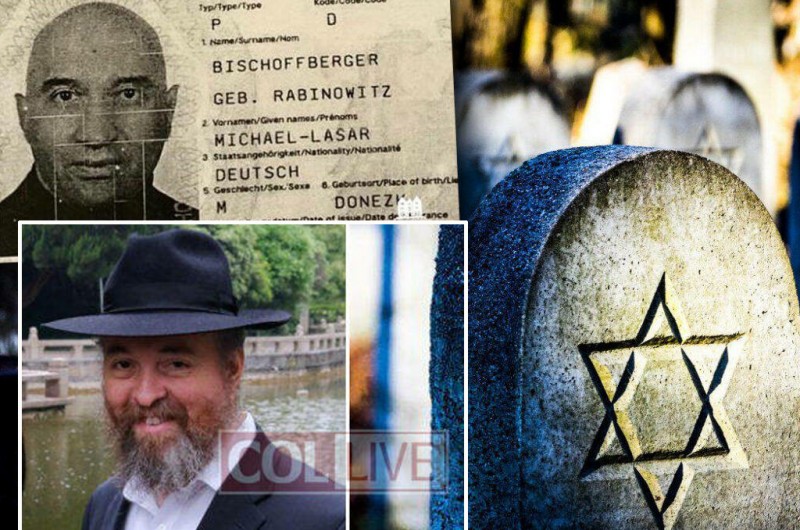
Michael Rabinowitz was born in the city of Donetsk, Ukraine. He later moved to Germany. A few years ago he moved to Suzhou, where he taught private music lessons. Now, two and a half weeks shy of his 61st birthday, he has suffered a cardiac arrest. His sister - his only relative - was thousands of miles away.
Although China has historically been home to large Jewish communities, there are no longer any Jewish cemeteries in China, so Rabbi Krynberg, who has served as a missionary in and around Shanghai since 1998, has had a similar experience in the past.
Rabbi Greenberg called Vicki Fishblitz, Michael's niece, and she took the necessary steps to have the deceased brought for burial.
It wasn't long before Vicky was back on the phone. She and her mother, Anna Rabinowitz, encountered the first of what would prove to be many obstacles on Michael's final journey.
Michael changed his name three times during his life, and the Suzhou authorities wouldn't release his body without a birth certificate to prove it was him. But the only copies of Michael's birth certificate were in the municipal archives of Donetsk, where Michael was born - and in his apartment.
Although most had left China when the pandemic began, there was still a Jew in Suzhou—the only one as far as Rabbi Greenberg knew. A few months earlier, Ed Frommex had needed a Yahrzeit candle and called the rabbi. Now the rabbi needed him.
Without a moment's hesitation, Ed agreed to accompany the police to Michael's apartment to get the birth certificate of a Jew he had never met.
""I will find the money""
But things quickly got complicated. Michael was a German citizen, having lived in Germany from the early 1990s until moving to China a few years ago, and only the German consulate can confirm his citizenship. Consulate officials informed the family that their request to transfer Michael's body had been denied by Chinese authorities. Because of the pandemic COVID-19, China did not allow the transport of corpses between provinces.
At the same time, Anna learned that the cost of transporting Michael's body to Israel would be $20,000, an amount she could not imagine raising.
Anna and Vicky were, therefore, ready to give up.
But Rabbi Greenberg did not give up.
He advised Anna to make arrangements for Michael's burial in Israel and to send him the documentation. He also told the family to contact an international funeral transport company with experience in moving to and from China. Rositas, a company from China, agreed to represent the family and asked them to sign a contract.
Anna turned to Rabbi Greenberg again: How could she sign a contract that she knew she couldn't afford?
""Send me the contract and I'll find the money," was Rabbi Greenberg's response.
""To be honest, I didn't know where I would get the money," the rabbi told theLubavitch.com. "But I thought that if we didn't get anywhere with the authorities, there would be nothing to pay for. And if it got to the point where G-d found a way for us to transfer him to Israel, G-d would also find a way for us to pay for it...""
International crisis?
It was June 8, 15 days after Michael's death.
Rabbi Greenberg approached the Israeli consulate in Shanghai with a contract proving that Michael would be buried in Israel and asked for their help. The consul, Limor Gadi, moved quickly. He had the burial documents translated from Hebrew to Chinese, notarized documents that were passed on to every Chinese official they knew.
But nothing moved.
Then Rabbi Greenberg called another emissary - Rabbi Yehuda Teichtel, Chabad emissary and Chief Rabbi of Berlin. Rabbi Teichtel made several calls, and was soon transferred to Frank Hartmann, Commissioner for Crisis Management at the German Federal Foreign Office, who reports directly to the German Foreign Minister.
Rabbi Teichtel's efforts were effective. Hartman's office contacted the consulate in Shanghai, suggesting that they work with local authorities before this became an international crisis.
""I think the local officials were quite surprised to get a call from the Foreign Ministry," said Rabbi Greenberg. "They didn't understand how seriously Jews take their burial rituals.".
Suzhou officials promised to find a province from which Michael's body could be flown to Beijing - and from there to Israel.
""A Jew in Australia""
Now that they were starting to see some movement, Rabbi Greenberg realized he would have to make good on his promise about the money. He reached out to the WhatsApp group of Chabad emissaries in Asia, asking if anyone knew of an organization or person who might help cover the costs.
One of the emissaries, who asked to remain anonymous, connected Rabbi Greenberg with a Jew in Australia, who he said might be able to help.
Greenberg contacted the man - and was stunned by the response: "Send an invoice and the money will be transferred to the account within twenty-four hours.""
The amount was close to 22,000$.
On June 19, Michael's body began a 2,000-kilometer journey to Chengdu, from where it will be flown to Beijing.
""The logistics were tremendous," said Rabbi Greenberg.
When Michael's body left, Rabbi Greenberg flew to the United States to join his wife and children, who had left China in early February because of the pandemic. However, when he arrived in the United States, he discovered that Michael's journey was not yet over.
The suitcase was heavier than the baggage allowance allowed on flights between Chengdu and Beijing. Following further negotiations, the matter was resolved.
On June 22, 29 days after his death, Michael's body arrived in Beijing, where El Al did not accept his death certificate - which stated that the cause of death was cardiac arrest - as proof that he was free of the coronavirus.
Rabbi Greenberg contacted Yehuda Meshi-Zehav, chairman of ZAKA. "The only option he will have in China is to burn. We must find a way to bring him to Israel," pleaded Rabbi Greenberg.
By Monday, June 29, Meshi-Zehav had obtained all the necessary permissions and arranged for Michael's body to be transferred on a July 2 flight to Israel.
However, on the morning of July 2, El Al pilots announced that they were on strike. All flights were grounded.
Working together, Rabbi Greenberg and Israeli Consul Limor Gadi were able to pass on the necessary paperwork, and the coffin was loaded onto a Turkish Airways flight, which left Beijing on July 5 for Tel Aviv with a connecting flight in Istanbul.
45 days, four rabbis, the German Foreign Ministry, an Israeli consul, an Australian philanthropist, two airlines and a host of assistants who dedicated hundreds of cumulative hours in six countries on three continents, brought Michael to his resting place in Pardes Hanna Cemetery.
""This is a testament to the Jewish people," said Rabbi Greenberg. "None of those involved received any personal benefit, only unnecessary headaches. And yet each one of them - whether it was someone who searched the apartment of a Jew he had never met, or the El Al baggage manager who assured me that whenever the coffin was ready to travel he would personally make room in the baggage - stepped forward and said, 'Here I am - I am here, and I will do everything I can to help a Jewish person.'""
 Join the Haredim 10 Facebook page >>
 Join the X page of Haredim 10 >>
 Want more news, videos and stories? Join the Haredim 10 WhatsApp channel >>