1.
How many times have you heard a journalist, from the mainstream secular media, talk about Judaism, about Torah, about commandments - and nod in agreement with every word? And more than that: be filled with great optimism that there is hope, that things can be better here?
 Want more news, videos and stories? Join the Haredim 10 WhatsApp channel >>
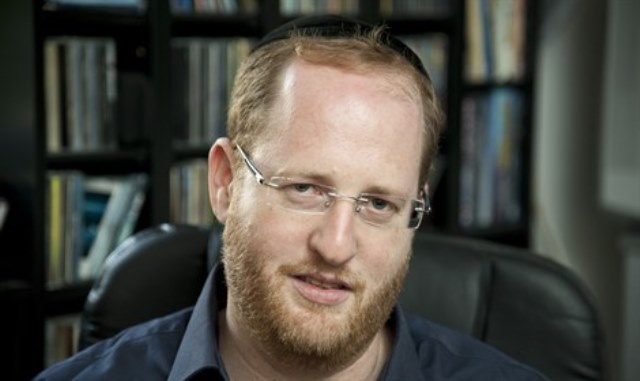
I had such a refined moment this week. It was on the Channel 7 website, but the speaker, Assaf Lieberman, comes from completely different regions. He is from Tel Aviv, a graduate of Galei Tzahal, and a member of the Public Broadcasting Corporation. The topic of conversation with him was "Hamakom," the center for Jewish studies that has been operating in the heart of Tel Aviv for the past few years.
It sounds like this: "Are you a student of 'The Place'?", began the interviewer Yoni Kempinski, and Lieberman replied: "In the days of Corona it's a bit problematic, but yes, I'm proud that you call me that.".
How did his connection with 'Hamkom' begin? "There was one Yom Kippur when my neighbor, from the central Tel Aviv building where I lived at the time, came back from synagogue. We are secular people who are a little interested in Judaism, so sometimes we talk to each other like light drug users, and ask: 'Do you have a place? Do you have directions to a synagogue? Do you have a place that is friendly to people like us?' So he 'organized' me... He told me about 'Hamkom'. I was interested and saw that there were Gemara classes there, and I said: Wow, that's interesting. So I came.".
""What does it mean to you to study Gemara, is it for the head or for the soul?" asks Yaffe Kempinski, and Lieberman answers: "It's interesting, because I grew up in a very, very, very, very secular home. Very. Religion was something very threatening. Let's just say, my father's biggest fear was that the child would someday repent. It really was like the biggest catastrophe that could happen. In the Jerusalem neighborhood where I grew up, I lived in a building where everything around me was becoming more and more religious, even ultra-Orthodox.
"Ahead of Yom Kippur, one of the Haredi neighbors welded the bike shed shut because he didn't want anyone to ride their bikes on Yom Kippur, and my father broke the lock on Yom Kippur and released the bike. It was all about the sense of siege by us secular people against what would later be called 'religion.'".
2.
He brought a piece of childhood memory here now. A movie scene. A fanatical Haredi welds the lock of the public shelter or whatever it was, to prevent all the children in the building from taking their bikes and riding, and then the secular neighbor, at the height of the holy day, breaks the lock and suddenly releases all the children's bikes. He opened a gate for us while the gate was locked. After such a formative experience, I would probably run away from anything that smells of Judaism, or of bicycles.
But not Lieberman: "Just a few years ago, when I went to the United States for a study trip, I discovered that cleaning up the personal and political noise and sediment from the past is very interesting to me, and something I really lack in my background. First of all, trying to connect and trying to glean something from the Jewish treasures that I missed during my life. And also trying to understand something about things that I always thought I didn't connect to, from the spiritual worlds, trying to see what I'm able to connect to on a religious level.".
What a beautiful term this is, "noise clearing." I have to start using it. After all, our entire discourse on Judaism and Torah and commandments and faith and Shabbat is constantly filled with background noise: religiousness, exclusion, heart, recruitment, conversion, religious coercion, the Women of the Wall, the Supermarket Law. So much noise. And that's just from the recent period. If we go back a few more years in the public discourse surrounding Judaism in the country, we will remember additional background noise: daylight saving time, the Mishnah, the Bar-Ilan Highway, the Pig Law, the recruitment of girls, where is Yosla? You can spend your entire life just dealing with this cacophony. And you can stop for a moment, do a 'silence', or even just turn it down a bit, listen to yourself, to your life (and even there you need to do some noise clearing so as not to remember your converted neighbor), and realize that in fact all this noise has been deafening your ears all these years and you have missed a lot of good things.
3.
""But as a media person who hears, and also utters, the word 'religion' many times, didn't that deter you?" Kempinski doesn't give up.
""In what respect?", Lieberman asks back. "Maybe they're trying to get you to repent," Kempinski explains, and Lieberman laughs.
""Oh, look, let's put this story of conversion aside. I don't want to treat this word either positively or negatively. Neither with disdain nor with over-seriousness. But on my personal level, not on the political level, if someone thinks they can convert me, then fine. Come on. I'm calling on all viewers, whoever can show me the light and lead me to some divine revelation and show me something I haven't seen yet that will lead me to conversion - then come on. Please. I'm open to any attempt, and unlike my past and my childhood, I don't see conversion as such a terrible thing.".
""And when your friends hear about 'the place' and what you're doing there, they ask if they're trying to get you to repent?" Kempinski asks. "There's no such conversation," Lieberman replies firmly. "People who hear that I'm studying Gemara get excited, want to come and ask where it's done. In the end, people are interested. At the very least, people like knowledge and like to delve deeper. I don't live in an environment where they say to me: 'What, are they going to get you to repent?' Maybe my father still does a little bit, but among friends - it's the exact opposite.".
Wow. This is already a real sensation. Mila Assaf Lieberman, with his special openness, studies Gemara despite his very-very-very-very secular background. Very. But he claims he is also surrounded by friends who hear about Gemara class and their reaction is not anti and fear, but on the contrary, interest and curiosity. Who are these friends who love to delve deeper, and why do we hear all day long precisely the lovers of superficiality, those who only hear Judaism and immediately shout in horror "religion"? We must not let them take over our consciousness.
How do I always say? We have to clean up that background noise!
4.
""Did studying the Gemara influence you as a media person?" Kempinski asks Lieberman. Sorry to be pushy, but I think it clearly did. What's the question anyway? It's hard to find someone whose regular study of the Gemara hasn't made him think more, ask more questions, without taking basic assumptions for granted. And when it comes to journalistic work, let alone as an interviewer, these tools you receive from the Gemara make you an upgraded media person.
It's interesting that Lieberman hasn't thought of it (yet). "Not on my radio show," he replied, then added: "Maybe unconsciously. But it did open up a lot of avenues for me to do media things related to this issue. What is 'this issue'? It's a wide world of content that I can't put my finger on. But the issue of faith is very interesting to me. What do people believe? How is it expressed in their lives? Everyone who wears a kippah is necessarily a believer? You know, I have quite a few religious friends who I sometimes text and they send me back the wonderful WhatsApp message: 'I'm in prayer'... Now, as a secular person, when you text me while praying, what does that mean? After all, no one would text: 'I'm in meditation.' If you're in prayer, then you're praying, right?""
What a profound insight into our attitude towards prayer. A insight that can only come from someone who looks at the Torah and the commandments with a curious and new eye from the outside. One of the most fascinating things about our generation is seeing this encounter between the Torah and those who encounter it and tell us what it is like.
I remember in the yeshiva looking with a somewhat skeptical look at the Rosh Yeshivah who always said, "We say every day after prayer, 'And give us our share in your Torah.' What does that mean? It means that every Jew has his own special part in the Torah. And Reuven's part is not like Shimon's part. There is a part of the Torah that awaits only you.".
In those days I thought he was just trying to strengthen Reuben or Shimon (or her friends). But in the last generation you can see with your own eyes how accurate this is.
5.
""Finally, what page are you holding, what tractate?" asks the interviewer.
A smile apologizes: "Because of the coronavirus, I haven't gotten to the Gemara in a few weeks. You caught me. I got to other texts, but I admit that I haven't opened the Gemara in a long time. I don't know if it's permissible to say that in this context. I hope to return soon.".
Oh, with this Corona. So they've closed 'the place' now too? Too bad. Wait, why don't they actually move to study Gemara there in the capsule format? What, only yeshiva students get it? What about Assaf Lieberman and his friends? No, someone has to pick up the gauntlet and break the lock.
• The column is published in the newspaper 'Bisheva''