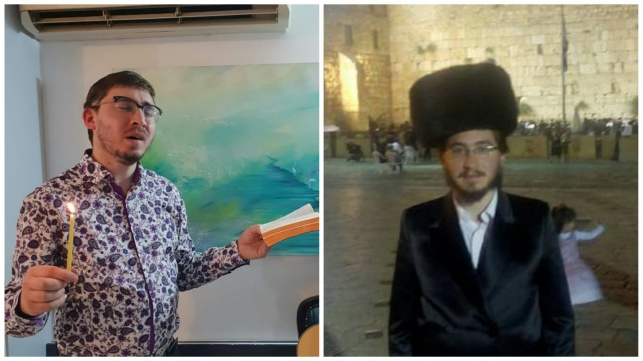
Yehuda Abramczyk, 30, is what is commonly called a "new Haredi.".
Until four years ago, he was a full-fledged Gur Hasid, living in the city of Arad. In recent years, Yehuda has chosen a new way of life, as part of which he realizes his artistic inclinations as a musician and creates Israeli music with a special taste.
Yehuda says: "Today I am defined as a modern Haredi, but I was not one until 4 years ago. I was one of the senior abrachi shtibel of the Gur Hasidim in Arad.
 Want more news, videos and stories? Join the Haredim 10 WhatsApp channel >>
""My wife is a very strong Haredi, for all intents and purposes: she only has a kosher phone, she is not willing to learn to drive, and she dresses according to the strict rules of the 'hardcore' Haredi. And most importantly: our home is completely Haredi. The children have no access to the Internet, there is no radio, and there are no newspapers - except for 'Hamodei', to which we subscribe.
""Our Shabbat meals are with Torah readings and zemirot. We do promotions for children on Torah study, washing hands, and the like. Our education is excellent, we invest in children. They are gentle and God-fearing, some even have long Hassidic wigs.".
He began writing at the age of 17, mainly songs with a religious orientation, and only in recent years has the world been exposed to new content in music that leads him into new realms.
Yehuda's songs recall the Hasidic atmosphere he grew up with, with exposed lyrics that deal with love and longing with surprising openness, without the filters he grew up with.
'"Dear Soul" is the fourth single in the project, which he dedicates to his wife, who walked a long way with him on their significant journey, from the mainstream of Gur Hasidism to the big, free world.
In the lyrics of the song, he promises her that the day will come when he will tell his children about everything she has done for him and for them.
At the climax of the song, a choir joins in singing "Ashet Chail" to the famous melody of Rabbi Naftali of Rofshitz, zt"l, from 250 years ago.
The song was arranged by Ohad Darshan and featured musicians Oren Tzur, Avihai Katsav, and Benny Weil.