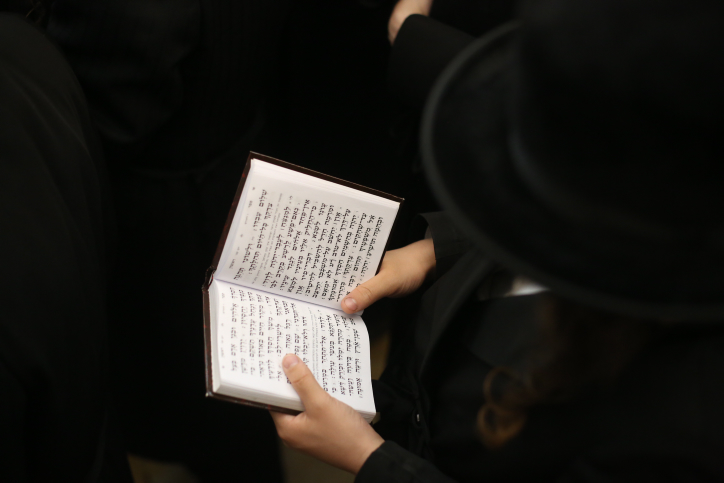
The son went to yeshiva, and now he asks us to buy only fancy kosher food. The daughter has grown stronger, and when gossip starts around the table, she asks to change the subject, so as not to speak slanderously.
How do these sentences sound to you? Are they said as a critical complaint or as an expression of pride in children who have become more God-fearing? - It depends very much on the parents.
Some parents will feel joy and contentment at the sight of their children adhering to the values of the Torah and the mitzvot more than they do, and there are parents who will see this strengthening of their children as a criticism of the parents and their lifestyle.
Making compromise an ideal
You won't find parents complaining that their children are too successful in their studies; that they are too kind and good-hearted; that they are too moral; that they are too attached to the tasks assigned to them.
On the contrary, parents are proud of such children. Naturally, parents always want their children to have more than they have.
The Sages determined that parents are not jealous of their children. On the contrary, parents who see their children achieve greater achievements than themselves are filled with pride and satisfaction. Hence, the fact that the sons do not achieve greater achievements than their parents is what disturbs the peace of those who complain about the strengthening of faith and the observance of the mitzvot among the youth.
The attitude towards children actually reflects the parents' general attitude towards the Torah and the mitzvot. We are not perfect, after all. We all live in a gap between our faith and knowledge and the degree of their application in everyday life. We are usually much stronger in theory than in practice. And here the question arises, how do we relate to this gap in our lives.
The right approach is to simply acknowledge the fact that we are not perfect and that we do not always manage to fulfill all the requirements. Such an approach gives rise to a desire to correct, improve, and better adapt our behavior and lifestyles to the ideal model we believe in.
Those who see things this way are happy to see their children succeeding more than they did in overcoming the weakness of human nature and becoming more God-fearing and more steadfast in their faith.
But there are those who turn weakness into an ideal and imperfection into the desired model of behavior. The compromises they have made between the demands of the Torah and their personal weaknesses have become a way of life for them; a belief in compromises, in half-truths. Such a person may feel uncomfortable when their children do not want these compromises and prefer to adhere to the Torah and its demands more completely.
Fathers' hearts for sons
During these days of the month of Elul, we all take stock of ourselves, try to make good decisions and mend our ways. In some communities in Israel, we already say Selichot every day, asking the Creator of the world to forgive our sins and extend a hand to us so that we can repent.
Do we seriously mean the words that come out of our mouths? Is it truly our desire to become stronger, to rise, to be more complete in the Torah and its commandments?
Therefore, let us be proud of our children who serve as an example to us, and may the prophetic calling be fulfilled in us: "And he will turn the hearts of the fathers to the children" - through the children, the fathers will also turn.
 Join the Haredim 10 Facebook page >>
 Join the X page of Haredim 10 >>
 Want more news, videos and stories? Join the Haredim 10 WhatsApp channel >>