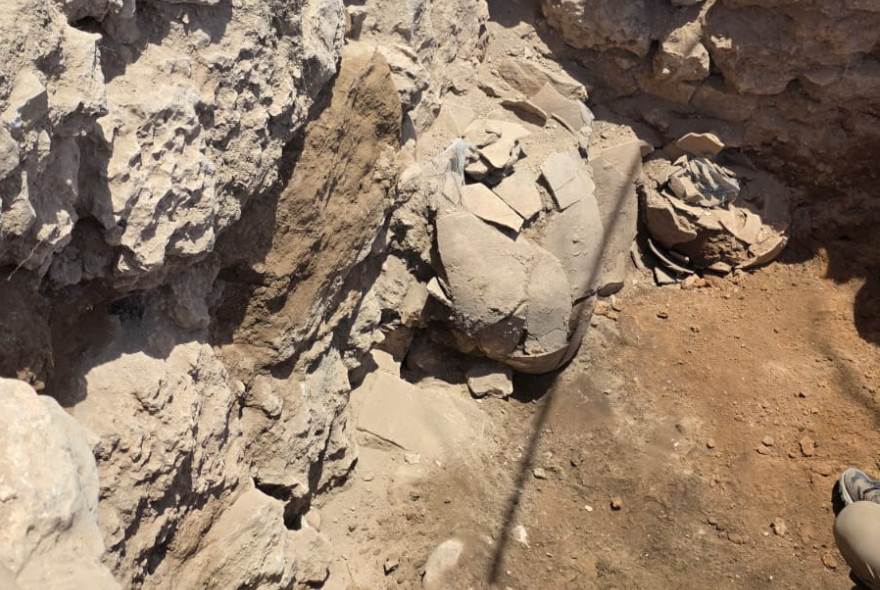
The archaeological excavation team currently working at the Ancient Shiloh tourist site has uncovered three large and impressive storage jars that are thousands of years old, near the area where the Mishkan stood during biblical times. The find was discovered as part of the annual excavation season led by the Ancient Shiloh tourist site and the Mishkan Shiloh Association, in cooperation with the Archaeology Division at the Ministry of Heritage.
The excavations, which in recent years have become one of the most prominent archaeological research projects in Israel, attract researchers, students and volunteers from around the world to Shiloh every year. The expedition is led by Dr. Scott Stripling, one of the most prominent researchers in the field of biblical archaeology. This year, in the midst of an ongoing war, dozens of participants from the United States and other countries arrived to take part in uncovering the ancient history of Shiloh.
The jars were discovered during deep excavations carried out by archaeologists at an excavation site that had previously uncovered about 10,000 animal bones, numerous Late Bronze Age pottery vessels, and gold and silver offerings. The goal of the excavation was to reach the bedrock and complete the understanding of the stratigraphic sequence of the site. During the excavation, the three jars were uncovered in a particularly early layer from the Middle Bronze Age, below the Late Bronze Age finds and below the Iron Age layers.
The jars are now expected to undergo careful excavation and scientific testing to help determine their exact age and use. The initial assessment is that these are storage vessels used to store agricultural produce, including grapes, wine, olive oil, and other products that were part of daily life in the region thousands of years ago.
The impressive find comes just days before the Ancient Shiloh Wine Festival, which will be held on Friday and will host dozens of wineries, workshops and tastings. Among the main events at the festival will be a special workshop by Prof. Shibi Drori, one of the most prominent researchers in the field of wine in Israel, who will deal with the connection between the archaeology of the Land of Israel and the modern wine industry. In recent years, Drori has led groundbreaking research in which ancient grape varieties were located and reconstructed through genetic research of archaeological finds, and from which local wines were even produced. Some of these varieties are also used today to produce wines in the region, including at the Givaut Winery operating in Binyamin.

The head of the excavation team, Dr. Scott Stripling, said: "This is a particularly exciting find. We set out to explore the oldest layers at the site to better understand the history of Shiloh, and along the way we discovered three impressive storage jars that have been preserved for thousands of years. Now we can explore what was inside them and perhaps learn new details about the daily lives of the people who lived here thousands of years ago. Every year we come here with researchers and volunteers from around the world to uncover another chapter in the story of Shiloh, and this year too, people chose to come here despite the war because they understand the importance of this special place.""
Heritage Minister Amichai Eliyahu said: "Anyone who wants to understand who this land belongs to, all they have to do is get down on their knees and dig. Every layer of the soil of Shiloh tells what cannot be denied: the people of Israel lived here, worked here, produced wine and oil here, thousands of years before anyone even dreamed of inventing a Palestinian people. We will continue to develop and excavate our history, in Shiloh and throughout Judea and Samaria, and reveal to the people and the world this evidence that constitutes an undeniable Jewish title deed.".
Head of the Binyamin Council and Chairman of the Yesha Council Yisrael Gantz said: "Ancient Shiloh is one of the strongest proofs of the deep roots of the Jewish people in this land. While there are those who try to distort, deny or erase our history, the land itself continues to speak. Time after time, findings are uncovered here that tell the story of our ancestors who lived, worked, prayed and built their lives in this place thousands of years ago. The jars that have now been uncovered join a long line of testimonies that connect the past and the present. We are not only telling the story of Shiloh and Binyamin, Judea and Samaria – we are the continuations of those people who lived here in the past, cultivating the land, building, planting and developing the land. This is a story of an unbroken historical continuity, and it will continue for generations to come.""
Head of the Judea and Samaria Archaeology Division, Bnei Har Even: "The Judea and Samaria Archaeology Division is accompanying the excavations at Shiloh as part of a broad program of exposing and preserving heritage sites in Judea and Samaria. Each excavation season adds a layer to what we know about this place, and Shiloh, where the Tabernacle stood for centuries, is one of the most important sites in biblical archaeology. The jars uncovered this week are further evidence that the sites in Judea and Samaria are of global importance, and that the archaeological work here is far from over.".
The CEO of the Shiloh Sanctuary Association, Kobi Mamo, said: "There is something exciting about the fact that, precisely in the days before the Ancient Shiloh Wine Festival, thousands of years old jars that were probably used to store grapes and wine are being uncovered here. This discovery is not related to the festival and was discovered as part of the annual excavation, but it illustrates the special historical continuity of Shiloh. From the vineyards and wines of ancient times to the leading wineries that operate here today. Prof. Shibi Drori's workshop at the festival, which will deal with ancient grape varieties that were reconstructed from archaeological finds, also expresses the unique connection between archaeology, research and the renewed settlement in the area.""
 Join the Haredim 10 Facebook page >>
 Join the X page of Haredim 10 >>
 Want more news, videos and stories? Join the Haredim 10 WhatsApp channel >>