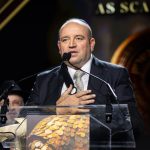
Shaarei Chesed Neighborhood – Jerusalem, 2007
At that time, he returned from Johannesburg, South Africa, where he served as chief cantor for about 15 years. I met with him in the courtyard of the famous Gra Synagogue. We arranged to talk about cantor business, but before we started talking, he set me a small condition: "I recently finished my book on the Shas. Please, before we start talking about cantor excerpts, I must share with you a topic that I have discussed at length in my book, and which has been bothering me a lot lately. You are certainly familiar with the famous Rashba on the inverted Sfiqa. Perhaps you can help me understand a point in it?!""
•
 Want more news, videos and stories? Join the Haredim 10 WhatsApp channel >>
He is a cantor with many years of experience, has won many awards in the fields of cantorship and music, has released two CDs of the best cantorial repertoire, combined with his own melodies, and has a special lyrical tenor voice. But above all, his real occupation is Torah study.
Do you already know who this is?
Of course, the cantor Rabbi Ben Zion Wolfa, son of the rabbi of the city of Rishon LeZion - the gaon Rabbi Yehuda David Wolfa.
He studied at the Kol Torah, Kamenitz and Sloboda yeshivas, and is the author of the book 'Beloved Zion - Newell's and Commentaries on the Shas'. He currently serves as the rabbi at the Rishon LeZion Yeshivas. On the other hand, he is considered a student of the greatest cantor teachers of our generation - cantors Shmuel Baruch Taube, Yitzhak Eshel, Naftali Hershtik, Chaim Peipel, Maestro Eli Yaffe and Raymond Goldstein. He served for 15 years as a cantor in Johannesburg, South Africa, won the Lustig Prize for cantorship, published two CDs and even composed many cantor pieces.
A few hours before Shavuot, we went on a short tour with Cantor Ben Zion Wolpa, along the narrow path between Shtikel and Shtibel; Shtikel Rashba's to Shtikel Yosela; and between the prayer pillar and the Beit Midrash hall.
The basis from the Gemara
""You should know that in the world of cantorship there are many scholars," he says. "For example, pay attention to something interesting: There are some very famous cantor pieces whose musical basis actually comes from the traditional melody of Mishnah and Gemara study, such as Cantor Yossele Rosenblatt's tunes 'Rabbi Yishmael Umer' and 'Amer Rabbi Elazar', or such as 'Akavia Ben Mahallel Umer' or Harshman's famous piece 'Alo Devarim'. These tunes are based on a mode (scale) whose basis is the melody of the study. And the composers' intention was to continue the melody of the study on the text that originated from the Mishnah.
""The more you live in the depth of the Gemara, the more you gain an understanding of the depth of the interpretation of the words of the prayer," says Wolfa. "Cantor Naftali Hershtik told me many years ago that there was a rabbi in Tel Aviv who told him that he knew the legendary cantor Leibel'a Glantz from his town abroad, and when Leibel'a was a 15-year-old boy, he was tested on 500 pages of Gemara! Now do you understand where Leibel'a Glantz's innovations and depth in cantorship come from?"
""I once sang Yosla Rosenblatt's 'Breich Shemya' to my father. At the end of the section, Yosla extends and invests a lot in 'Yaha Reva Kadmech, datpach Libai in the Torah.' When my father heard the section, he was very impressed, and immediately he said to me: 'We hear most clearly that the person who composed the section was a man who loved and studied Torah.' Indeed, Yosla was a God-fearing Jew, a true Jew of the past, and hence the great meaning he invested in 'Yaha Reva Kadmech, datpach Libai in the Torah.' There are things that only a scholar can understand.
""The Rambam explicitly wrote that he who knows the Holy One, blessed be He, more than others, has more reverence for God than others. Likewise, he who knows the Torah more can better interpret the prayer and express it in a different way.".
The story of Rabbi Baruch Ber
• Were there any great men of Israel who heard cantorism and were connected to this music?
""Certainly. Quite a few great Jewish figures were considered fans of cantorship and music, and there were even those who composed moving melodies and prayer pieces. My brother told me that he heard from Rabbi Chaim Shlomo Leibowitz, Rosh Yeshiva of Kamenitz - grandson of Rabbi Baruch Ber Leibowitz - that when they were in Vilna, Rabbi Baruch Ber once took him especially to hear the cantor in the Great Synagogue in Vilna, yes! Rabbi Baruch Ber, the genius of the ages, went especially to hear a cantor's shik'el in Vilna.

""There is another famous story about Rabbi Baruch Ber Leibowitz, who was known as a musician and composer of melodies. Rabbi Baruch Ber was a student of Rabbi Chaim Brisker, he was a great follower of his rabbi Rabbi Chaim and devoted himself completely to him. They once said to him, 'In one thing you are greater than your rabbi, you know how to sing and Rabbi Chaim does not know how to sing.' Rabbi Baruch Ber answered them: 'Perhaps I know how to sing better than the rabbi, but the rabbi understands poetry better.' Also famous is Rabbi Moshe Shmuel Shapira, who composed many melodies, and also known is Rabbi Yitzhak Yeruham Diskin, also one of the greatest Lithuanians who was great at playing.
""For several years I was privileged to hear the prayers on the High Holy Days of Rabbi Moshe Tikoczinsky, zt"l, the overseer of Slabodka. Although he was not a 'great musician' and from a musical point of view the prayer was not that musical, his interpretation of the words was nevertheless special and amazing, and I don't remember ever hearing a prayer leader like him.".
As the extent of proficiency, the extent of understanding
""In terms of the concept of understanding, there are those who first compose the melody, and then look for the words for it, and there are those who sing the words and the melody comes out of the words. Even in this part of the person who plays the words first and the melody comes out of that, the question is to what level he understands the words he says, and what depth of interpretation he gives to it.
""Because the more Torah-oriented a person is, the more he understands the depth of prayer, as it is in everything, then he has more to express.".
""There are certain works that I have composed, in which I have repeated certain words in the work according to different understandings that can be understood in depth in the words. Not to mention that one must understand the plain text in order to know how to punctuate the sentences, and this is one of the most important things. A prayer leader must know how to punctuate the sentences and words correctly," he emphasizes.
""In this regard, I have heard from great men that redemption is delayed because we do not know how to pray correctly, and the intention is in terms of the punctuation of words and the correct reading, which without paying attention can lead to terrible distortion.".
• Do you have an example?
He immediately pulls out and explains: "For example, in the Shabbat night prayer in 'And He can... that which God created to do,' some use the punctuation 'that which God created to do' instead of 'that which God created.' Someone told me that in a Hasidic village, a Hasidic man was praying in front of the pillar, and mistakenly said upon hearing our voice, 'Before You, our king, is empty,' and Rabbi Eliyahu Lupian stopped in the middle of the recitation of the Shatz and said: 'Abomination and blasphemy.'".
Hazan is the real thing.
• How does cantorship connect with someone who does not observe Torah and mitzvot?
""Cantorship is the real thing!", he says firmly, "Even those who treat it as a musical genre should know this. When I won the 'Lustig Prize' for cantorship named after Yitzhak Lustig, I was interviewed by Galei Tzahal. The interviewer asked me: 'Tell me, what is a cantor, isn't he a disappointed opera singer?'"
""I told him that I think it's exactly the opposite. An opera singer, in the end, whatever it is, is playing a game, and the best singer is the one who best succeeds in getting into the character he plays in the game, but a cantor is actually the only artist who doesn't play any games. It's not like it's the real thing!"'
Cantor Rabbi Ben Zion Wolpa, who is skilled at combining Torah study, prayer, and cantorship, is without a doubt a true cantor.