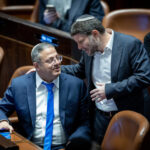
 Benjamin Netanyahu expressed support for Rivlin too little and too late, but here are some reasons that could sweeten the pill for him now, as he tries to reconstruct in his mind what happened here and why every other option failed: First, it's nice to cuddle up to a president outside the political system, but in practice it turned out that there simply are no such impressive candidates. You can sit in the Prime Minister's Office and go over and over the entire list of contacts on your cell phone, from Nathan Sharansky to Stanley Fischer, but the bottom line is – there simply hasn't been a single personality in Israel or the world who would convince half the Knesset.
So we're left with the politicians, and among them there's no doubt that Rivlin is the most unpolitical politician. No, he's not perfect, but yes, he has more of a soul than the others. For example, in the rare ability to unite supporters from Meretz to the ultra-Orthodox parties, from the Jewish Home to the Arab parties. Or in ideological loyalty, compared to the path of Meir Sheetrit (first "Likud" then "Kadima" and from there to "Hatnua") and Dalia Itzik (from "HaAvoda" to "Kadima").
This week, the Knesset mentioned that even Fuad Ben-Eliezer started in Aharon Abuhatzeira's "Tami" party, moved to Ezer Weizman's "Yachad" and only from there did he end up in the "Labor" party. Ruby's biography is much more boring: a Likudist, for better or worse. He doesn't have to be in the Knesset at any cost and in any party, but he has to be in the Likud.
 Want more news, videos and stories? Join the Haredim 10 WhatsApp channel >>
Another important consideration is the fear of some kind of "affair," of "Moshe Katsav 2." Yair Lapid said after the founding of his party that a young relative told him that she needed to prepare a background paper, and he told her: Don't bother, get into politics and they'll prepare one for you. That's true. In recent months, the resumes of all the candidates have indeed been investigated in an attempt to find dirt. It seems that Rivlin has the least chance of embarrassing the position of president of the state again.
And finally, and Netanyahu knows this deep down, this is about choosing a president for a Jewish-democratic state. Rivlin is truly connected to the two words around that hyphen.
 Monday, 11:30 a.m., "Heichal Shlomo" in Jerusalem. Waiting for the Pope. Chief Rabbinate Director General Oded Wiener gives instructions regarding the true God: "Please turn off your cell phone, or at least silence it. We want to get started.".
Francis wanted to come to the Holy Land as a pilgrim. The Israelis and the Palestinians listened and answered him together: Pahhhh. In 48 hours, he visited too many places and met too many people, heard too many speeches and received too many gifts. On the Israeli side, they literally gave him a concentrated "discovery" project. Maybe that's why the person who was chosen as Time's Person of the Year didn't use his famous personal charm here at all. He was too tired.
Yossi Ben Gal, the director general of the Heichal Shlomo Museum, stands alert at the entrance. Out of 4,000 exhibits in the venue's catalog, he had to choose a few items in recent days to present to the Pope. "We worked very hard on this," he tells me, and takes me on a tour that is a kind of rehearsal for the guest. "This is a menorah that stood until the outbreak of World War II in the Great Synagogue of Warsaw," he begins. "Before the Nazis bombed the place, the community rabbi managed to smuggle the menorah out and sell it for a large sum of money, which was intended to help Jewish refugees escape Warsaw. The person who purchased the menorah for a large sum of money was the Christian Countess Margaret Wenner-Gren. About 20 years later, she came to Israel and decided to return the menorah to its place, and gave it to us. There is a clear allusion to the Pope in this menorah and its story. The Jewish people expect to receive their treasures back. The next work is by the painter Shmuel Hirschenberg. In the painting we have here, we only see a praying Jew, but Hirschenberg also painted the famous painting 'The Eternal Jew,' a horrific work depicting Jews fleeing from Christians. In other words, here in front of us is a painting that is pleasant to look at, but in the background there is an open score by the painter with the Christian world. The third work is called 'Shabrei Kippur.' This is a modern work by the Israeli artist Israel Rabinowitz. He found the fragments of this menorah in the debris that was taken out of the ruins of the Jewish Quarter, and he deliberately presents it shattered. The artist emphasizes its fragility and his attempt to mend the fragments. The fourth work is called 'Thirst for My Soul.' This is a huge mural that expresses the human longing for holiness. The artist is a young Haredi, Shanina Towson, and the message here is completely universal.".
I look at the small, informative exhibition, and then the Pope arrives. Speeches, handshakes, photos, exchanging gifts, and on, quickly, to the ceremony at the presidential palace. The Pope didn't even have time to glance over.
 This week's Torah portion is the "Nashua" portion, and it is always read close to Shavuot, the holiday of the giving of the Torah. This week, on the eve of the holiday, Rabbi Dr. Jonathan Sachs, one of the most important Jewish speakers in the world and unknown in Israel, visited Israel. He is not only a rabbi and a doctor, he is also a Lord, an honorary title that indicates his closeness to the British royal family, where he served as the kingdom's chief rabbi. In a short lesson, Rabbi Sachs explained his feelings on the eve of Shavuot: "I want to talk about the Torah, about the time and the place. Let's start with time. It is said that the Torah was given to us with a great voice that 'will not be repeated.' Some commentators say that the intention is that it was a one-time event. Since then and to this day, no such voice has been heard again. Some say that from then until now this voice has not ceased for a moment. How do you reconcile the two approaches? It's simple. Some refer to the written Torah and others to the oral Torah. The written Torah, the Bible, is indeed final, but the oral Torah, which we continue to develop in each generation, is infinite. This is our eternal conversation with the Creator, in which we essentially transform the most ancient text into an innovative text. This is the Jewish saying regarding time, and now we will talk about place. Globalization is a new thing for the rest of the world, but for the Jewish people it is an old idea. We went out from Israel to all corners of the world and thus became the only global people. We had no normal characteristic of a nation: no government, no language, no place, no culture. How did we survive all over the world? By the Torah. The Torah is the first Internet, it is the first virtual community, it managed to connect us all over the globe for thousands of years.
""In recent generations, we have seen Jews return to the Land of Israel from 150 different countries in exile and reunite there. This is literally a second Exodus from Egypt. You could call it a 'second Passover.' But we have not yet seen a second Shavuot, a holiday of receiving the Torah anew. It is beginning. There has been a great deal of interest in Judaism in the last generation, and even on Shavuot, people who do not define themselves as 'religious' are interested in the Torah and studying it, and it is once again becoming something shared, topical, alive. After a second Passover that we have already experienced, I would like to see a second Torah reception." President, Pope, Rabbi
 Jewish status:
""The concept of 'Torah' rose in the eyes of the people to an unfathomable height. In the imagination of the people, the Torah became almost a second reality, an abstract and more sublime reality, standing alongside or even in place of actual reality" (Chaim Nachman Bialik at the opening ceremony of the Hebrew University, 1925)
• The column is published in Yedioth Ahronoth.'