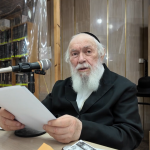
The event: The funeral of the great generation, Rabbi Wasner, during which two young men were trampled to death.
Date: 15th of Nisan, April 3
In recent days, I participated in the annual 'Partnership Conference' to strengthen the sacred institutions of 'Toldot Aharon' in our Holy Land.
At the event, which took place in great splendor and splendor in the event halls of Ma'ale Ha-Hachamisha in the Judean Mountains, the rabbi officiating, Rabbi Gabriel Shisha, spoke about the preparations on Rosh Hashanah night when saying "Lashana Tovah" - how careful one must be not to be pushed around and not to enter into danger, God forbid, which immediately brought me back to the main event of the year: the Passover sacrifice disaster in Ishvabata Darbi, Maran Posk Hador Rabbi Shmuel Wasner zt"l.
Although it was clear to me from the beginning that this year's event was about 'turning into mourning from our illness.'.
The joyful days of Passover were suddenly changed with the passing of the wise and righteous man, who was unique in his generation in his love for every Israeli - the founder of 'Shevat HaLevi', zt"l, and continued with his tragic funeral that cost the lives of two dear ones, including his son-in-law, Yitzhak Samet, may God have mercy on him.
Suddenly we returned to that terrible tragedy, from which we have not yet recovered, and we have not yet digested the intensity of the shaking and the soul-searching that followed the tragedy.
•
There is no doubt that consciously and unconsciously there is a renewed perception of the danger of the push, and great attention is being paid to orderly organization so that such disasters will not occur again, God willing.
It is true that at the time, on the margins, nonsense and nonsense were heard from all kinds of "sages" in understanding the motive for pushing, and they even based their nonsense on witty Hasidic statements praising the persistent Hasidic pushing.
In my opinion, the response to their words is anchored in the words of the Netziv in his introduction to the Pentateuch, who writes that the thing most hated about the Holy One, blessed be He, is 'crookedness for the sake of heaven.'.
Indeed, the public's reaction to that tone of disdain for human life returned sanity to its rightful place, and I felt that greater emphasis was placed on the excellent preservation of human life and consideration for the public - which transcend any mannerisms of Hasidism, whatever they may be.
Between urgency and urgency
The serious event of the Passover sacrifices and the 'culture of urgency' occurred during a very difficult time within Haredi Judaism, when the tendency for discord and division of hearts is found in every community and every circle in Haredi Judaism, and even spills over into acts of savagery and acts of violence.
We saw this year what happened with the sadistic incitement campaign of the Haredim; we saw what happened in the Shas movement with the division of camps; what is happening in the 'Urdu community' with two opposing halachic approaches, with the parties in dispute riding on this with their pitiful cruelty; what is happening within the public of the 'Degel HaTorah' party with the Bnei Baraki and Jerusalemite camp; what is happening within 'Agudat Yisrael', and between it and Degel HaTorah; and so on within the courtyards and camps inside - how much is the desecration of God and how much is the insult, as the sages say in Tractate Yoma: "What do people say about him? Woe to so-and-so who learned Torah, woe to his father who learned Torah, woe to his rabbi who learned Torah - so-and-so who learned Torah, see how corrupt his deeds are and how ugly his ways are," and Maimonides has a precise definition of the punishment of those who blaspheme God, may God protect us.
It is allowed to plan
It is possible to point to a traditional Haredi norm at the root of the problem: there is a classic perception of the actual inability of man to plan or prepare for the future.
Although there are quite a few Jewish sources that emphasize that the individual must think and plan his actions in advance - popular perception says that these plans, especially in material areas, both on the individual and the general level, do not prove themselves, and for the most part have nothing to do with reality.
This is because mystical explanations for reality and the fatalistic perception of the future have become very strong, regarding forces that are above nature. Under these circumstances, "the miracle becomes popular," repeatedly.
In contrast to this view, Rabbi Shimshon Raphael Hirsch, who is known to have combined in his teaching "what is great and holy in observant Judaism... and what is true and good in human-civic education," declares in his educational perspective that the goal of God's covenant with our forefather Abraham was to build a healthy nation, one that serves God in all areas of life, not only in thought and emotion, but also in strength and courage.
It lays down a foundation and educational rule for "long-term planning" of education. This planning should include not only the personal inclinations of the student, but also the administrative and moral norms within the events that we see as a goal in life.
We won't pay double.
It is appropriate to have professional elements from within Haredi society (and there is no shortage of such), in the many areas relevant to a system of this magnitude, and to hold a dialogue with the internal systems regarding transparency and integrity, in order to avoid creating procedural distortions.
The strength and support for this task should also be taken by influential factors within Haredi society, but it should also be based on the recognition and endorsement of the general system.
This is the conclusion we believe is required today from the Haredi public.
If we don't take ourselves into our own hands, we will all pay a very heavy price. The behavior that has accompanied the system until now must be put to an end, otherwise we will pay double.
Not only will we lose points in our public legitimacy as an ultra-Orthodox community, but these consequences could have a devastating impact on our survival as a healthy and complete Torah and faith-based life.
 Join the Haredim 10 Facebook page >>
 Join the X page of Haredim 10 >>
 Want more news, videos and stories? Join the Haredim 10 WhatsApp channel >>