When Moshe Sheinfeld called to invite us to give a lecture at his student club, I thought it would be something in Givat Ram, Jerusalem, or at most at the University of Haifa. But then he said where the lecture would take place: in Kaunas.
Kaunas? The famous city in Lithuania? An Israeli student club in Kaunas?
""When you come, you'll understand everything," he said.
 Want more news, videos and stories? Join the Haredim 10 WhatsApp channel >>
A few weeks later, a young Haredi man was waiting for us on the main street of Kaunas, near the fountain, along with his wife Rachel and their sweet children.
During our short walking tour of the boulevard, they stopped every few minutes at a cafe or restaurant, greeted an Israeli student sitting there and even gave him a hug. I didn't understand how they recognized them, to me they looked just like all the people sitting in the local cafes, but the Seinfelds simply caught their eye, time and time again: "Hey Yaniv," "Hello Yael.".
The students sat there, eating non-kosher food, with their non-Jewish friends, but it was clear that there was a deep connection between them and this couple.
Most of them ended the conversation with "see you tomorrow.".
And when "tomorrow" arrived, I understood what everyone was waiting for.
On Friday, when Shabbat spreads its wings over Kaunas (and, by the way, this happens around 9:30 at night), about a hundred young Israelis, all medical students, suddenly gather from all corners of the city, from all universities and all rented apartments, to be together for Shabbat dinner.
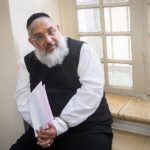
Sheinfeld performed the kiddush, and the meal lasted three to four hours, with songs and conversations well into the night. He and his wife are there for the students even on weekdays, offering a community center with kosher food, lots of Torah lessons, and a listening ear.
""Aren't they afraid that you want to convert them?" I asked him, and he laughed: "Convert them? Who talks about that anyway? I'm here first and foremost to prevent serious assimilation. We at the club give a sense of home and together create a Jewish, Israeli and communal atmosphere, but there is one rule: no non-Jewish partners. For some students, this is very difficult, unfortunately.".
During our three days in Kaunas, we discovered how assimilation is not some distant danger that threatens young people who grew up in the dying diaspora, cut off from all ties to their Judaism and the State of Israel. Assimilation is a tangible problem that affects the best of our Israeli youth – and it begins the moment they leave the country, to study or work abroad.
Why not, really? How do you explain to a young secular Israeli who goes to live abroad for a few years that he must, in fact, be a racist? What is the difference between us and the nice Gentiles who study medicine with us in the same class?
Sheinfeld doesn't argue with them on the subject, just tries to strengthen Jewish identity, hoping that a little light will dispel a lot of the confusion. Year after year, a real community is forming there.
And this Israeli student community in Kaunas already had days of prayer. Today, the Sheinfeld family is alone there, but about two years ago another couple was sent from Israel to boost the activity - Shimi and Michal Gross. Later, they would become famous as the parents of the two girls who died in the pesticide disaster, and of the two children who ultimately survived, thank God.
The students remember them and the days of hope and concern for the fate of their children. The beautiful and pastoral photos of the children published in the newspapers at the time of the disaster were taken here, in Kaunas. When the students told me about it, I remembered that I really wondered then where children from the Givat Mordechai neighborhood were taking pictures against a background of red European fallen leaves.
Friday, may heaven and earth and all their host be blessed. I look at the Israeli students placing a hand or a napkin on their heads during Kiddush, and think to myself that after such a glorious Jewish history, what I actually see here in front of me is "the Jewish community of Kaunas.".

 Rabbi Israel Salanter, Rabbi Yitzhak Elchanan Spector, the Grandfather of Sloboda, all these glorious names and many more, all come from here, from the city I am now in. Kaunas was the capital of the Lithuanian yeshiva, and the land where the Mussar movement grew.
It sounds fascinating, but at home, in front of Wikipedia, you can learn much more about all this than on the streets of Lithuania. In vain we wandered around the Jewish ghetto, searching for a sign that would explain what happened here. On one old building we suddenly found an inscription in Yiddish, "Slavabadker Yeshiva." No one even bothered to translate it into Hebrew. And who would bother? There were only a few Jews left in the whole city, elderly and unorganized.
You know the joke about the Jew needing two synagogues, one to pray in and one to never set foot in? So it's true here too, unfortunately, but in an even more extreme version: There's one synagogue, but no one even comes to it, because maybe the other one will come.
About a quarter of a million Jews were exterminated on Lithuanian soil. There are more than two hundred locations identified as extermination sites, most of them in forests and ravines. But only in recent years has a memorial - symbolic and inadequate - begun to appear on the ground for all this horror, and also for the bustling life that existed here before. And it's frustrating. Most of the houses stand exactly where they were seventy or eighty years ago. You walk through the streets, knowing that perhaps every old house has some historical story created within it - and there is simply no documentation (who knows, maybe the shoemaker's shop was right here, who told Rabbi Israel Salanter, "As long as the candle is burning, it can be repaired"?).
Only after strenuous research, which included sending photos from Kovno to Bnei Brak on WhatsApp, was I able to identify one house. The grandchildren and great-grandchildren of those who hid there helped me complete the details.
It turns out that several rabbinic families lived near the Slobodka Yeshiva at the time in a single wooden house, which still stands. Rabbi Avraham Grodzinski, one of the heads of the yeshiva, immigrated to Israel to establish the branch in Israel, stayed in the city of Hebron to establish the place, and then returned to Kovno at the request of his students.
During all this time he continued to write about the human soul, spread the moral system, and write in the journal 'Tevuna' published by the yeshiva students. When World War II broke out, he worked to save as many Jews as possible and greatly helped the poor refugees who flocked to the city, even though he himself fell ill at the time.
When the Nazis occupied Lithuania, he hid in that wooden house together with rabbis and yeshivot heads, and there he continued their Torah study, in secret. One day, Nazi soldiers broke into the house and murdered several of the rabbis. They took one of them, Rabbi Elchanan Wasserman, the 14th, from that house to his final journey. Rabbi Wasserman left there with his head held high and walked with his family and students.
On the way to their execution, he spoke about the commandment of sanctifying God: "Apparently, in heaven, they see us as righteous, for they want us to atone with our bodies for all of Israel. We must repent now, immediately on the spot, because time is short... We must remember that we will truly be sanctifiers of God. We will walk with our heads held high, and God forbid, let no improper thought arise, which is a form of idolatry that invalidates the sacrifice. We are now fulfilling the greatest commandment: sanctifying God. The fire that will burn in our bones is the fire that will reestablish the Jewish people.".
Rabbi Grodzinski was saved that day because he was lying in the attic. He was later hospitalized due to his illness, and on 22 Tammuz 5774 (July 13, 1944), the Nazis set fire to the hospital, burning to death hundreds of Jewish patients there, including the rabbi.
And all of this happened here, in this house, which stands before us exactly as it did 75 years ago. But, as mentioned, no sign tells the story. Only an elderly Lithuanian neighbor who looks suspiciously at the curious tourists taking pictures of the house. Her dog comes out of the kennel in the yard and starts barking. You'd think how many Jews this dog's grandfather had his jaws set on.
 On our way home, we arrived in Vilnius, where the airport is located, and discovered that we had about two and a half more hours in the capital of Lithuania.
Nick, a local Jewish guide, took us on a short historical tour, and of course I started researching him about himself.
""As a child in the communist Soviet Union, I remember only one Jewish thing: every year in the fall, my father would make an effort to go get matzo, and then we would eat them. Without a Seder, we would just eat them every year during this week, and that was it." That was all he knew about his Judaism. His surroundings, on the other hand, bothered to remind him of it a lot. "I remember once in elementary school, a girl tried to open the door, and the handle broke in her hand. She automatically shouted: 'Oh, what a Jewish handle!' That was the atmosphere.".
Today, Nick is much more connected to his Judaism.
He leads us to all the sites of "Jerusalem of Lithuania," from the grave of the Vilna Gaon to the local Chabad house. As we stand in the Jewish ghetto in front of the sign that describes the destruction, devastation, and cruelty, I suddenly hear Hebrew behind me.
An Israeli group.
In ten seconds of meeting them, they gave me perspective and context for everything I saw, from the destruction to the building, from the past to the future: It turns out that they are not tourists, they are here for work. Farmers who came for meetings at the Lithuanian factory from which they buy land.
Why buy land here, I ask, and one couple answers me: We are the Adler family from Ganei Tal. After the expulsion, we reestablished our settlement and our nursery, and now we have come here to buy dirt, which goes straight to the Land of Israel.
• The column is published in the newspaper 'Bisheva'.'