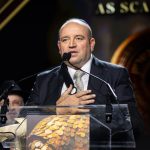
What made Rabbi Dr. Aharon Lichtenstein so important, and so unknown to the general public? An extraordinary mix of qualities and circumstances. Here is a modest and partial attempt to list some of the characteristics of the rabbi, who passed away this week at the age of 81:
 There are much better-known rabbis, who are constantly exposed, who come up to comment on the radio, who Google tells us a lot about, but it is doubtful whether they had the same impact as him. So it is true, most Israelis asked themselves who he was when his passing was announced on the news this week, but in the end, the world of learning and education does not really make headlines. A person teaches Torah day after day, week after week, year after year, quietly, laboriously, with dedication, and raises generations of graduates. Not a single press release is distributed when he arrives at the Beit Midrash every morning.
When Rabbi Chaim Sabatu approached him to write a book of conversations (which became the bestseller "Mabkeshei Fenich"), Rabbi Lichtenstein told him: "To talk about my faith? After all, it is the holy of holies of man." Not everything is talked about, not every moving experience is promoted to a status, not everything is photographed and documented. Stable empires are built slowly.
 Want more news, videos and stories? Join the Haredim 10 WhatsApp channel >>
 And at the head of this educational empire stood two. In a rare instance, the "Har Etzion" Yeshiva was headed by Rabbi Yehuda Amital, the late, and by his side was Rabbi Lichtenstein. They worked in harmony, without intrigue or business dealings, and succeeded in this mainly thanks to humility.
It seems that a phenomenon of this magnitude should hang around with assistants and secretaries, and behave as if he were elevated above the people. Rabbi Lichtenstein was far from all of this.
One of his students once told me that he entered the dining room with a friend named Aharon and asked: "Aharon, what time is it?" Rabbi Aharon Lichtenstein, who heard this, immediately turned around and said simply: "Two.".
He also instructed his students to focus on the simple human experience, life itself. Everyone knew how much he played and learned with his children and grandchildren.
His student Dr. Yitzhak Brand once said: "He talked to us about the considerations that need to be considered when choosing a profession in life, and he said that one of the main considerations was how much free time I would have to be with the children and educate them. I was very surprised at first, but the surprise was replaced by amazement and a deep understanding that this was the thing.".
 He was a simple Zionist, in a sector where it is not so simple. Although he educated thousands, he was always considered an oddball in his community. He immigrated to Israel from America in the 1970s, and could have stayed there and headed larger and more important yeshivahs.
But he joined the pioneering and challenging enterprise in Gush Etzion because of his Zionist vision, because of the desire to be part of what is happening here.
Within the national-religious sector, which is based mostly on the concept of Rabbi Kook and its various interpretations, he presented an alternative. Not mystical and redemptive Zionism, but natural Zionism, one could almost say casual. The Jewish people immigrate to the Land of Israel, what could be healthier and more normal than that? "Is the Messiah waiting around the corner? I don't see that yet," he once said with a smile. "This is a long process that requires a lot of investment on our part.".
 He was a center-left man. In this, too, he was very different from most religious Zionist rabbis. His student, Prof. Aviad HaCohen, sought to emphasize this week that it was not the desire to "get out of the territories already" that motivated him. "His courageous stand did not come from joy, but from recognition of the value of peace and the importance of saving lives. But he felt pain for every part of the Land of Israel that was handed over to foreign sovereignty.".
The rabbi himself said during the Hebron Agreement: "It is impossible for a believing Jew to identify, from a moral standpoint, with elements in the state who see the return of Hebron as a release from some burden. This is the amputation of an important organ.".
 Torah was the main thing for him. In fact, there is a certain injustice in presenting any other characteristic of him. To study and teach Torah, that was the reason why he got up in the morning.
""You in the media will be excited about the fact that he had a doctorate in English literature, and you will say that he was a leftist, and that he received the Israel Prize for Torah literature," one of his students told me this week, "but all these special things are just the surroundings. This is a scholar, persistent, diligent, a man for whom the Beit Midrash was the main thing. He espoused, first and foremost, the basic Jewish ethos, of a Jew who leans on the Gemara and tries to learn through it what the Holy One, blessed be He, is telling him and what he should do.".
The rabbi's demanding texts on Torah, faith, and prayer are not what you would expect to hear from a Harvard graduate. He demanded that 18-year-olds, first of all, before going into the army and also upon their return from the army, devote themselves to Torah study.
""I didn't believe that there were such living people in our world, scholars of such stature," said his student Rabbi Chaim Navon. "I studied with him for more than a decade, and the closer I got to him, the greater he seemed to me.".
 ""Bennett is a brother" or "Lichtenstein is a brother"? Ostensibly, the difference between him and Naftali Bennett is supposed to be in the political realm. Rabbi Lichtenstein, as we have already said, was a moderate leftist. Bennett is a hard-rightist. But in fact, the real difference is cultural. They present two different spiritual alternatives to religious Zionism. Bennett is aimed at Israeliism. He does not come to quibble over the Gemara and scrutinize Halacha, but rather to suggest a direction that is more national than religious. His world of images comes less from the Jewish bookcase and more from the APC and the stretcher.
And Rabbi Lichtenstein? Not interested in stars like Eli Ohana, but wants to spend another three hours trying to understand another line of Rashi or Maimonides. This picture of the two of them, during Bennett's visit to the yeshiva, illustrates the story: one is firm, unapologetic, with his hands on his hips with great self-confidence. The other is bent over, with his hand in the air, in a perpetual Jewish fidgeting motion.
Who will be the cultural hero of the sector, who will the young look up to, the cool young man or the learned old man? Time will tell.
 This week's torah is "After the Death of Saints." What should be said after the death of Rabbi Lichtenstein? What was he, an American or an Israeli? A great rabbi or an academic? A man who cries with emotion when a student comes to tell about a problem and prays with great emotion, or analyzes an issue with coolness, sharpness, and clarity? A conservative or a revolutionary?
He sent his students to the paratroopers, but also told them that they were the successors of the mythical Volozhin yeshiva in exile. He was well-versed in Western culture and quoted works by heart and with admiration, but he told his students that there was a certain risk in choosing the academic path.
""I studied at Harvard for four years," the rabbi said in the past, "and if they asked me what I learned there, I would answer this way: I learned that the world is complex and that man is complex.".
 Jewish status:
 ""Our father Abraham was concerned with the moral level of the inhabitants of the Land of Israel. What would be the answer if we asked ourselves: What would be the reaction of our father Abraham if he were to come to some of our places today?" (Rabbi Aharon Lichtenstein)
• The column is published in Yedioth Ahronoth