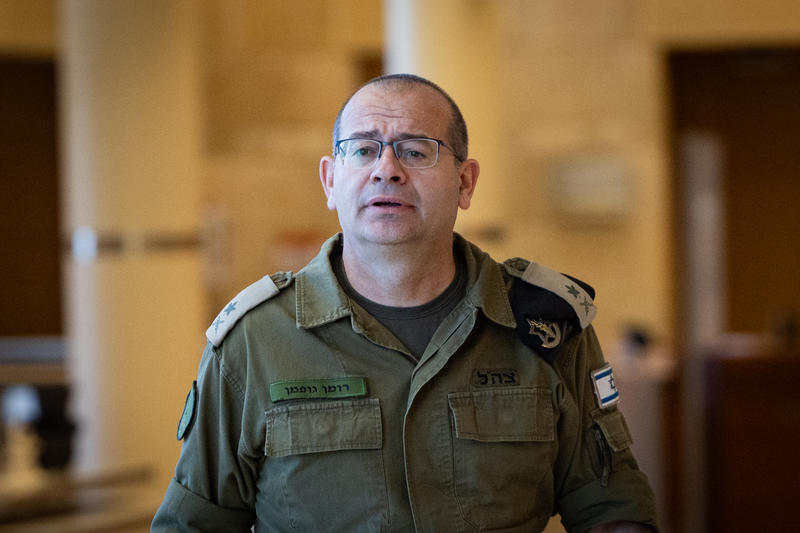
After his appointment was confirmed for the second time: During the closed discussion in the 'Grunis Committee' that dealt with his suitability for the position of head of the Mossad, Major General Roman Goffman addressed retired judge Asher Grunis directly, describing the feeling of severe harm he felt as a result of the allegations and accusations leveled against him.
Moti Castel revealed the dramatic quotes this evening (Tuesday) on Channel 14.
 Want more news, videos and stories? Join the Haredim 10 WhatsApp channel >>
“If I have been given this unique, even exciting, opportunity, I cannot help but respond,” said Goffman. “Since I grew up, immigrated to Israel and found and built my Jewish-Israeli identity, and later as an officer in a series of roles - it all boils down to one thing: my confidence in looking into the eyes of my subordinates, leading them and sending them on dangerous missions, and also judging them and educating them.”.
During the discussion, Goffman said that after the Grunis Committee's opinion was published, he met personally with Mossad officials to deal with the crisis that had arisen around it and to allay concerns within the organization. "The Mossad is a large organization, which means that there will still be people who will have doubts. We are facing very big challenges.".
Goffman later moved on to a direct attack against outgoing Mossad head Dedi Barnea, claiming that the letter he wrote against him was based, he said, on incorrect information and caused him serious harm in the international arena as well.
“I’ll tell you why I’m embarrassed,” Goffman told Judge Grunis. “The head of the Mossad writes a letter that is based on facts that are not facts, and this letter does me harm on an international level. You understand that the heads of organizations around the world who read the letter, what do they think of it? By the way, some of the people I know have distanced themselves a bit. The head of an organization writes something like this...”
In another part of the testimony, Goffman directly addressed the allegations made against him regarding the 'Al-Makis affair' and the accusations that he knew his identity and even "abandoned" him.
Goffman rejected the comments and asked to present his moral and command worldview to the committee. “I am speaking to you, Your Honor, because in the end, your position regarding the purity of my morals is what underlies my ability. I want to tell you what is at stake here. I am putting aside for a moment the role of whether I will be appointed or not. This turbulent journey is not as intense as this, I have already experienced upheavals, but not like this. Not even in a position with the Prime Minister. When I immigrated to Israel, they were already trying to make me illegitimate, the group I wanted to belong to. But to cast doubt on my moral purity?"
Goffman added: "I don't know how to look my friends, my subordinates in the eyes, and send them away without them being sure that I would do it in their place. Chastity is not an external discussion; it's something worth blushing for, getting excited about, and crying for. And that's exactly what I do.".
He later provided a personal description of the events of the October 7 massacre, when he left his home and went down to fight in the south, even though he didn't have to - while refuting the claim that he was capable of abandoning a man under his command.
""On October 7th when I picked up my driver, I thought about his mother. I said, 'I'm going to hell now, I'm not taking him with me.' This is a very bad tactical decision! This is what went through my mind in the most extreme situation, so to say that I abandoned and abandoned a boy?
""It was clear to me when I went in there that it was not safe for me to return. I looked at the ranks of the lieutenant colonel, I said, 'Now they will kidnap me,' but since I saw civilians already burned in cars, I said I had no right to make a different decision. But I didn't make it.".