
Data from a mandate survey conducted by Shlomo Filber and published this evening (Thursday) on Channel 14 shows that the Right-wing bloc is increasing in mandates since last week and stands at 66 mandates.
According to the data, Likud is the largest party with 35 seats. It is followed by Gadi Eisenkot's Yeshar party with 12 seats, one seat less than last week. The Joint List also drops in seats and receives 11 seats.
Shas with 11 seats, like last week, while Bennett drops one seat and receives 10. Yair Golan's Democrats drop, receiving 8 seats.
 Want more news, videos and stories? Join the Haredim 10 WhatsApp channel >>
Avigdor Lieberman's Yisrael Beiteinu with 9 seats, and United Torah Judaism with 8 seats. Otzma Yehudit strengthens this week to 8 seats.
The list is closed by Religious Zionism with 4 seats, and there is a future that also passes the threshold after falling below it a week ago, and now stands at 4.
The Blue and White party led by Benny Gantz does not pass the threshold and receives 1.21% of the vote.
The division of the blocs grants 66 seats to the right-wing bloc, 43 to the left-wing bloc, and 11 to the Arab parties.
On the question of suitability for the premiership: Netanyahu leads with 53% support. Gadi Eisenkot is followed by 20%, Naftali Bennett is in third place with 16%. The other candidates receive significantly lower support: Avigdor Lieberman with 6%, Yair Lapid with 4% and Benny Gantz with only 1%.
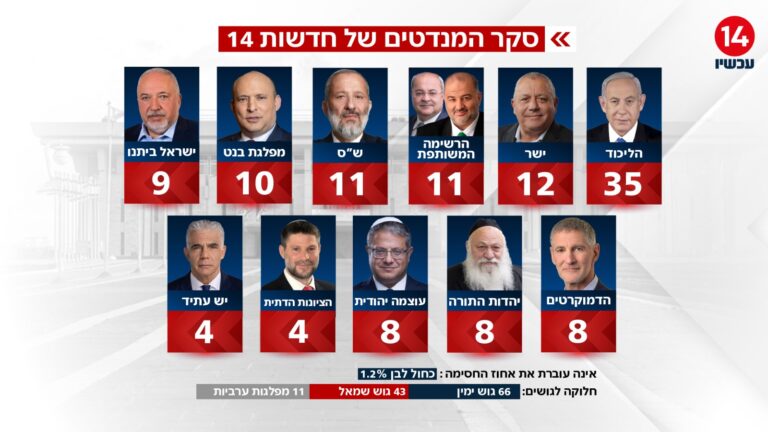
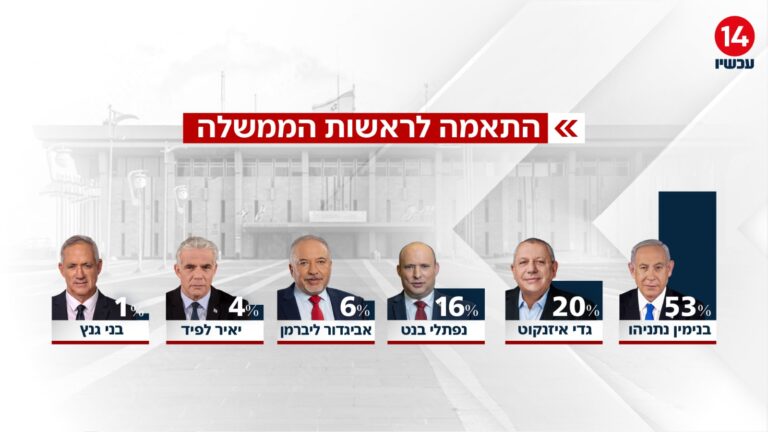
Photo: Flash90
The survey data also shows that in the strategic arena facing Tehran, the Israeli public does not have much hope in the naval blockade imposed by President Trump. According to the data, half of those surveyed (50%) believe that the blockade is failing to achieve the war goals of Israel and the US, while only 39% see it as an effective tool.
Despite doubts about the effectiveness of the blockade, the Israeli public is demonstrating extraordinary determination regarding the possibility of a frontal confrontation: an overwhelming majority of 82% respondents support Israel joining the US in an active war against Iran, should diplomatic efforts and negotiations fail.
Only 151% of the public opposes such a move.
On the Lebanese border, the public mood clearly leans toward a radical solution rather than partial arrangements. 76% of Israelis believe that the IDF should return to fighting in Lebanon until the goal of completely disarming Hezbollah is achieved, with only 21% of those surveyed preferring to avoid a return to heavy fighting on this front.
In the southern arena as well, the public position remained rigid in the face of Hamas's refusal to disarm. 78% of those surveyed called on Israel to return as soon as possible to the path of fighting and subduing the terrorist organization, and only 18% of the public opposed the resumption of fighting for the purpose of subduing it.,
The survey, with the participation of 958 adults from the general population, was conducted today, April 23, 2026. Data analysis: Shlomo Filber.