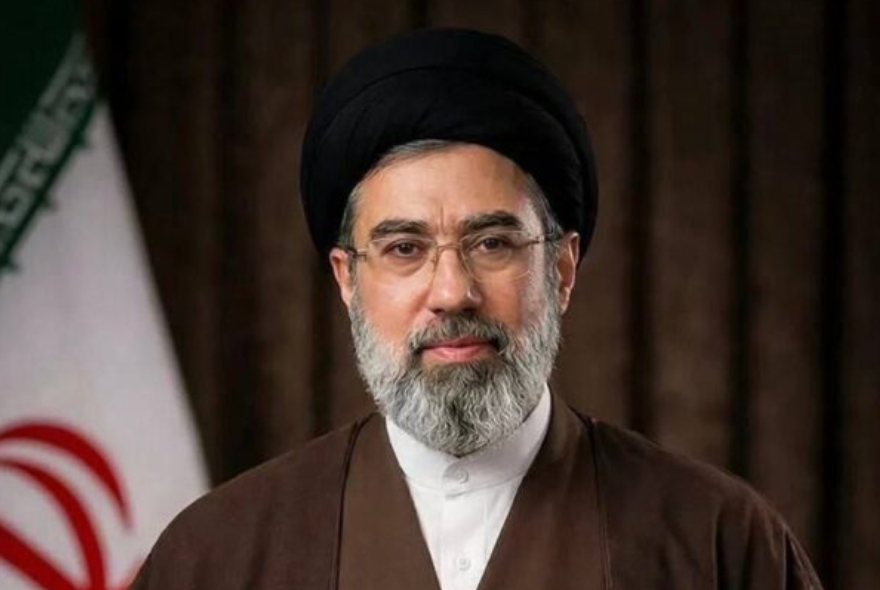
New details were revealed today (Thursday) about the condition of Iran's new Supreme Leader, Mojtaba Khamenei.
According to a report in the New York Times, Khamenei is much more seriously injured than reported, and lives under an extreme security regime - for fear that Israel will track him down and eliminate him.
According to the report, access to Khamenei Jr. - who was injured in the deadly attack in which his parents, wife, and son were killed at the start of "The Roar of Hari" - is quite limited and he is surrounded mainly by senior medical staff treating the injuries he sustained in the bombings.
 Want more news, videos and stories? Join the Haredim 10 WhatsApp channel >>
According to The New York Times, his leg has been operated on three times and he is awaiting the installation of a prosthesis. His hand has been operated on and is undergoing gradual rehabilitation.
He also suffers from severe burns to his face and lips that make it difficult for him to speak, and is expected to undergo plastic surgery.
It was also reported that the President of Iran, Massoud Pazakhian, a heart surgeon by profession, and the Minister of Health are personally involved in the treatment.
The report claimed that despite the serious injuries, Khamenei remained "mentally sharp and engaged.".
Due to his difficult physical condition and the fear of showing weakness, Khamenei has not yet recorded any visual or audio messages. His communication with the world and with senior regime officials is carried out using a primitive but secure method.
The messages to him are delivered only by hand, in envelopes, through a chain of couriers who travel along main and side roads, in cars and motorcycles - all the way to the hiding place. The instructions he conveys to his men also return the same way.
In addition, Revolutionary Guard commanders do not physically visit the leader, so as not to 'draw' Israeli intelligence to the exact location.
Due to the situation he finds himself in and the fear for his safety, he has effectively delegated various powers to the generals, at least for now, but reformist factions, not just extremists, are also taking part in the political discussions.
The report describes Khamenei's associates - Hossein Ta'ab, Mohsen Rezaei, and Mohammad-Baker Qalibaf - as the 'triangle of power' of decision-making in Iran.
And so, while Khamenei recovers from his injuries, the country is effectively run by a 'board of directors' of extremist generals. According to the sources, Khamenei functions as a 'chairman of the board' who approves their decisions, but rarely opposes them.
According to the report, the senior generals of the Revolutionary Guards are the determining voice in the decision-making process. The key figures at the top are the commander of the Revolutionary Guards, Ahmad Ahidi, the head of the Supreme National Security Council, Mohammad Bagher Zolkadhar, and the extremist military advisor, Yahya Rahim Safavi.