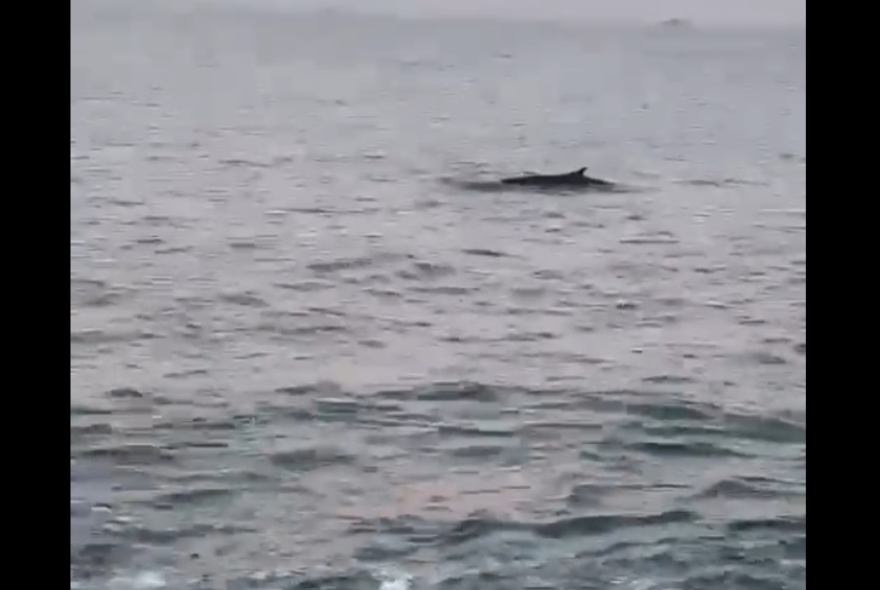
While the world is celebrating International Earth Day, a day dedicated to raising awareness for protecting the environment and ecosystems, a vivid reminder of the importance of protecting the sea and its inhabitants was received this morning (Wednesday): a whale was seen swimming in front of the Ashdod breakwater.
The video sent to the Delfis association shows a whale about four meters long.
Based on its length and body structure, as seen in the video, Delphis researchers estimate that it is one of two species: a minke whale or (less likely) a hollow-nosed whale.
 Want more news, videos and stories? Join the Haredim 10 WhatsApp channel >>
The researchers are consulting with colleagues from around the world who have experience in identifying both species, whose presence near the coast of Israel is relatively rare.
The Delphis Association adds that the hollow-nosed whale (Ziphius cavirostris) is one of the most mysterious marine mammals in the world. It is found in the eastern Mediterranean and even in Israel and is being studied as part of a deep-sea whale project led by Dr. Aviad Sheinin and Yali Mevorach at the Maurice Kahn Marine Research Station at the University of Haifa.
The Ziphius usually lives at depths of over 1,000 meters and is considered a champion diver - with recent records showing that it is capable of staying underwater for over two hours at a time. Its appearance near the coast is very unusual, and is usually associated with distress.
According to Dr. Mia Elser of Delphis, the only whale of the Ziphius species - a deep-water species - that arrived alive near the coast in the early 2000s, arrived exhausted and in poor physical condition.
In contrast, the humpback whale (Balaenoptera acutorostrata) is one of the smaller and more common species in the false whale family. In the last decade, there have been more and more reports from the Mediterranean Sea, including the coasts of Israel, of young individuals approaching the shore - sometimes as part of exploratory behavior, and sometimes due to the abundance of food found in shallow areas.
According to Dr. Aviad Sheinin of Delphis, head of the apex predators department at the University of Haifa's Maurice Kahn Marine Research Station, the body of a young female whale of this species was found in March 2020 on the coast of Tartus, Syria.
The Eastern Mediterranean is considered a relatively sparse area of large whales, but in recent years there has been an increase in sightings - possibly due to climate change, shifting food sources, and also an increase in awareness and reports from the public.