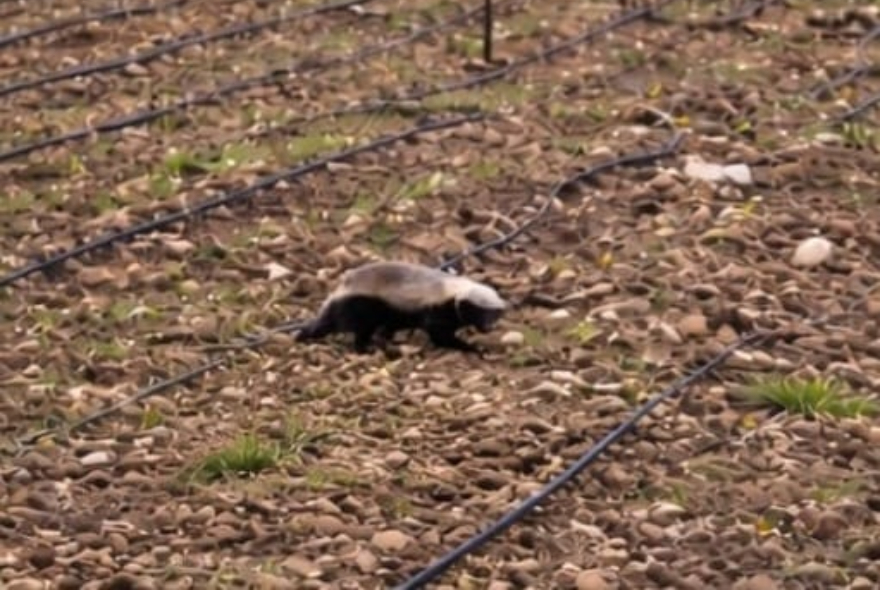
A big surprise occurred in an agricultural field in the north of the country, when D. - a farmer who has lived in the area most of his life - received a picture of an animal from one of his employees who was in the field that he was unable to identify. D., who himself could not identify what animal it was, contacted the regional Nature and Parks Authority inspector - who helped him identify the rare animal as a honey badger.
The last time a badger was seen in our area was in August last year, when the animal was seen in the Mount Dov area by IDF soldiers.
""The honey badger is the rarest predator in Israel," says Ezra Hadad, a Green Patrol inspector at the Israel Nature and Parks Authority. "The honey badger is currently in serious danger of extinction, and is in fact on the verge of disappearing from the country.
""Over the past few decades, entire populations have become extinct from large areas of the country, partly due to deliberate harm by beekeepers, who fought it with harsh measures such as poisoning and killing, due to the damage it caused to hives. In recent decades, very few definite sightings have been reported, mostly from the south of the country, in the Negev and the Arava.".
The Israel Nature and Parks Authority adds that the honey badger is a medium-sized predator, which is particularly recognizable from other mammals thanks to its unique and striking fur color - its upper half is grayish-white and its lower half is black.
The honey badger is known as a particularly hardy species, with a reputation for fearlessness and an impressive ability to adapt to a variety of conditions. It is characterized by a compact and muscular body, sharp claws and strong jaws that make it an effective hunter. Despite its relatively small size, it excels in extraordinary strength and agility, and has been recorded in many cases attacking animals much larger than itself, including lions and hyenas.
Its fur is unique and easy to identify: a prominent white stripe from head to tail, while the rest of the body is black. In Israel, its distribution is fragmented. In the past, in the 1970s, four separate subpopulations were identified in Israel. In the Judean Lowlands, from the Latrun Shaar Hagai area to Lachish, in the eastern Upper Galilee, in the Hula Valley and the Golan, in the northern Arava, around Hatzava.
Dr. Amit Dolev, Northern District Ecologist at the Israel Nature and Parks Authority: "The field worker was very lucky. Seeing a honey badger in our region is a very rare and unusual sighting that you don't see here every day. This is an animal that has always been here in very low numbers. This is the limit of their distribution in the world - honey badgers are more common in the African region.".
""We don't know where this badger came from into the field - but we are very happy to see evidence of this special animal here with us. It is important to remember that the honey badger is a protected wild animal, do not try to touch it or approach it.".
The honey badger is distributed throughout most of Africa. It is not found from the center of the Sahara Desert, but is found in western Asia, Ethiopia and Somalia in the east, and Nigeria and the mountainous parts of southern Morocco to the borders of the Sahara. They are found throughout the Middle East, including Israel and northern Syria to Turkmenistan and southwest to Kazakhstan, and east to India and Nepal.
In the long term, the honey badger is not common anywhere.
 Join the Haredim 10 Facebook page >>
 Join the X page of Haredim 10 >>
 Want more news, videos and stories? Join the Haredim 10 WhatsApp channel >>