1.
Driving on Highway 232 is like shivering every meter. Thinking about October 7th, about the bodies that were dumped here on the sides of the roads - and crying.
Now everything is pastoral, green. But a look to the side, to the west, reminds us of the real threat, the Gaza Strip spread out across the entire horizon. Right now there is the Yellow Line, a few kilometers under Israeli control, ruins of destroyed houses. But the day President Trump says 'enough', Israel will be forced to withdraw and return to the outposts in the envelope, and the pastoral settlements that lie around here will once again become exposed in a turret.
Less than a kilometer separates Kibbutz Nahal Oz and the outpost next to it from the Strip and the Gaza Strip. Too little to protect their lives when a dark day comes, as befell us over two years ago. There is strict security at the entrance to the kibbutz. The residents, it seems, are tired of being turned into a daily museum. They want peace and privacy.
""This is the situation in other settlements in the area," a soldier from the nearby outpost explained to me.
Driving on the road from Sderot south, along the eastern side of the Strip, was considered a real danger before October 7th. At any given moment, an alarm could sound, and at best, there were a few seconds to escape somewhere. In other words, there was really nowhere to go.
A little after Kibbutz Mefalsim, I see in front of me the 'Monument to the Watchmen'. Those who were, it seems today, exposed in a turret, so close to the enemies beyond the fence. The further south I go, the more the roads fill up with IDF armored personnel carriers. I just wonder where they were on that black day.
Today I made my way to Gaza to check whether there was already a 'complete victory.' I made my way to the border safely, without alarms, without fear, and some would say that this is part of the victory. In the grove next to the Nahal Oz base, soldiers and men were sitting and eating lunch. It's not certain that this was the situation here before the Simchat Torah disaster.
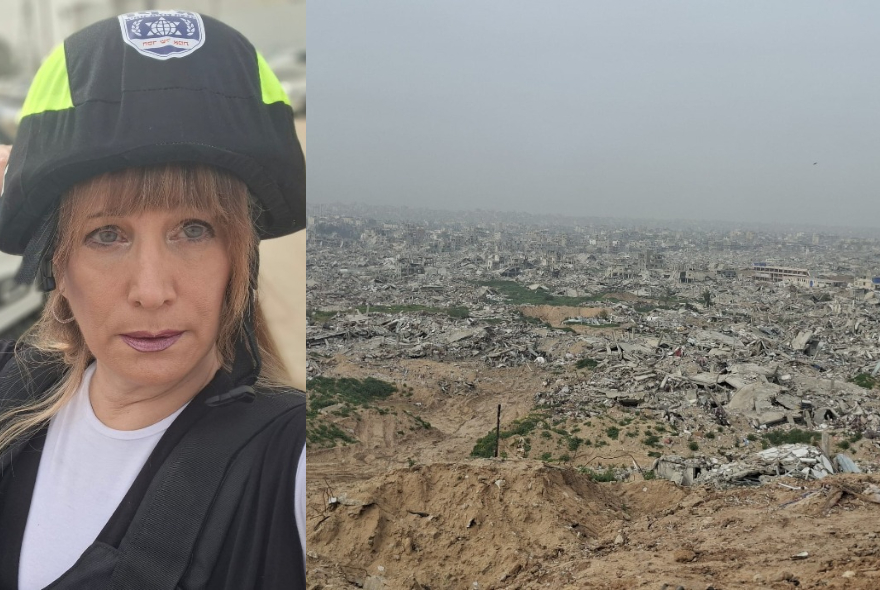
But it was only when I stood on a hill deep within the Yellow Line and looked out at the houses that stand on the edge of Gaza City that I realized how false the silence that surrounds the encirclement and the border is. Temporary.
If you will, perhaps the calm before the storm.
2.
Naturally, I can't say exactly where I was going to photograph the strip. I'll just say that it was an IDF outpost that was built in an improvised manner inside the Yellow Line. Even the food made an impression. Huge boxes of a variety of foods, of all kinds, colors, and species. "The days of the Loaf box are gone," one of the soldiers tells me. "There's some food here, some-something.".
No one here is willing to promise that there is no tunnel under our feet. They are not allowed to talk about the tunneling issue, I just imagined at every moment the Hamasnik emerging from the thick of the earth pulling out a Kalashnikov. The vest and helmet are not sure they will be useful in a face-to-face fight.
But don't be afraid, we'll try to concentrate on the positive part of the tour.
The ruins. As far as the eye can see, wherever you look, everything is destroyed. Pieces of walls, fragments of furniture, I could almost swear a child's toy doll was staring right in front of my eyes. But wait, before you feel sorry for his destroyed house, remember: "Hamas mixed in with the crowd, behind every inhabited house stood a hostile organization, under the floorboards were hiding places and weapons caches, tunnels from side to side, and the civilians were just an impressive backdrop." This is exactly the explanation I was given. No one here is deluding themselves.
Now, by virtue of the agreement, the guns are not roaring, but there is activity all the time. And also alertness. "For every action they take, even the smallest, we respond accordingly," was the explanation.
And yes, there is work all the time.
3.
The black kippah on his head immediately stood out to me. I recognized him as an ultra-Orthodox soldier in a battalion that is not defined as ultra-Orthodox. I approached him. His name is Molly Boymel, he is a retired major, and until recently he was an assistant to David Zini, who founded the Hasmonaean Brigade. A graduate of a Haredi yeshiva who has come a long way in the IDF and is trying to help on the path to integrating Haredim. You may remember his name from the demonstrations near Rabbi David Leibel's house in Bnei Brak; Zini arrived there with Boymel.
Battalion Commander Alexandroni, Lt. Col. (ret.) M., told me that Boimel is not the only Haredi serving in the unit, there are others, and of course there are also religious-nationalists and Haredi-nationalists.
""Up to the yellow line, ruins, from the yellow line, houses," says M.
Are there no built-up areas within the yellow line? None? All rubble? - I asked him.
""We destroyed everything, thank God, that's what it's called," he says. And somehow it sounds religious to me, at least traditional. But he's not, according to him.
We are looking over the entire area, we won't specify which places exactly we saw, everything was destroyed in plain sight. "Except for the central camps," which were not destroyed, also because they suspected there were kidnapped people underneath.
Wherever there are houses, the IDF is prepared and alert. "We detect every activity, we are highly experienced and highly combative, and from our perspective, throughout the Gaza Strip, every house had weapons and everyone was a Hamasnik or a Hamas supporter or a Hamas emissary. From our perspective, Hamas is still in control, one day we will get there. As of now, we have returned all the kidnapped, God willing, we were partners in the actual return of the last kidnapped person, and in the next stage, which will come soon, I hope, we will destroy every trace of Hamas. That is still ahead of us, but it will come soon, Amen, I hope.".
I mean, there's no 'complete victory' yet, I remind him.
And he, with impressive diplomacy, it should be noted, replies to me. "Blessed be God, the Jewish people have been blessed with patience. We are making progress slowly, but we are with eternity. Victory will come. The redemption of Israel.".
One of the officers reminds us that we are now 'under an agreement.' It's not like Trump is now allowing us to reoccupy Gaza...
""That's right," admits M., "in the end we are within the limits of an agreement, we are meeting the limits, the reality is a little different, the rules of the game are different, and we are working as much as we can to protect the residents of the surrounding area within the framework of the agreement. This is the reality.".
4.
Would you like to say something about recruiting Haredim? I'm trying to sneak a question in.
""I can say that I don't care about that, it's none of my business," he replies, again, diplomatically. "Do you see this area?" he asks, pointing towards the yellow line area. "This is my area of responsibility and I do everything within it, I don't deal with politics, not with recruitment, nothing.".
And the need for soldiers?
""In my battalion, thank God, almost 100 percent of the soldiers enlisted. Even those who didn't come explained to me in advance why they couldn't come. The enlistment percentages are amazing. We have enough manpower to meet the missions. Beyond that, both Ketoni and I choose not to bother with it.".
But inside the battalion I saw Haredim...how are they getting along?
""A thousand - we are all Jews, and those who are not Jews are also in the right spirit. We get along, respect each other and get along. There are people who guard the borders, there is respect, there is a 'joint service' order, we work within the framework of the orders, there is a lot of mutual respect and we are all for a common goal, all together for the success of the mission.".
An IDF spokesman couldn't have put it better than you.
 Join the Haredim 10 Facebook page >>
 Join the X page of Haredim 10 >>
 Want more news, videos and stories? Join the Haredim 10 WhatsApp channel >>