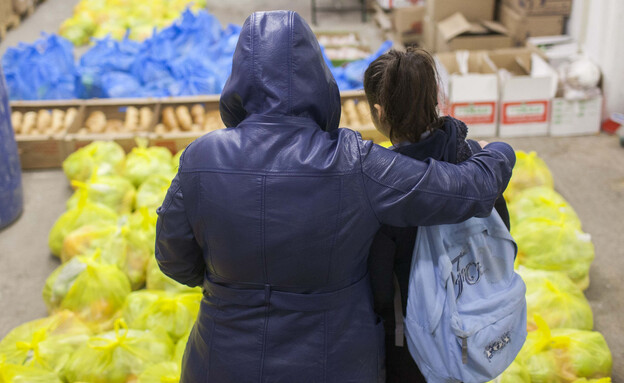
The National Insurance Institute published today (Friday) the official poverty report for 2024, which indicates a continuing deterioration in the economic situation of Israeli children, against the backdrop of the war, the cost of living, and the slowdown in economic growth.
According to the report, in 2024, about 2 million poor people lived in Israel, including about 880,000 children - more than a quarter of all children in Israel.
The report also shows that Israel ranks second among OECD countries, after Costa Rica, in the rate of child poverty expectancy - 28%. This is an increase compared to 2023, when the rate was 27.6%.
 Want more news, videos and stories? Join the Haredim 10 WhatsApp channel >>
The overall poverty expectancy in Israel remained almost unchanged compared to 2023. Among individuals, there was a slight increase from 20.6% to 20.7%, while among families, there was a slight decrease from 20.2% to 20.0%.
The poverty line in Israel in 2024 stands at NIS 3,547, an increase of NIS 229 compared to 2023, and anyone whose income is lower than this amount is defined as poor according to OECD country indicators. The poverty line for a couple stands at NIS 7,095, and the poverty line for a couple with three children stands at NIS 13,303.
The report indicates a continuing trend of poverty among children in Israel: in 2024, approximately 281% of Israeli children were defined as poor. One of the main implications of this is the ongoing damage to children's human capital, educational achievements, health, and future earning capacity.
In addition, the report shows that families with children were directly affected by the consequences of the war, including due to the absence of parents from the labor market due to reserve service, evacuation from their homes, layoffs, damage to small businesses, and a decrease in the income of the self-employed.
As part of the lessons learned from the Corona period, the National Insurance Institute made transfer payments and grants, which prevented a dramatic worsening of the situation. According to the report, without state intervention, the incidence of poverty among the population would have jumped to 31.5%, and the incidence of poverty among families would have reached 34.5%.
Among the elderly, the report notes that approximately 158,700 people live in poverty in Israel, and the poverty expectancy rate among this population is higher than the average in OECD countries.
Despite the real increase in income and the rise in the poverty line, the report indicates that 28.11% of Israelis live in food insecurity for economic reasons, including about a million children.
It also shows that about 261% of Israelis cannot afford healthy food, a figure that indicates the depth of the hardship beyond the official definition of poverty. However, this is a decrease compared to 2023, when the rate was 33.41%.
Social disparities remain significant: According to the report, 65.11% of the poor come from the periphery and from disadvantaged populations, including Arab and ultra-Orthodox families - a rate almost double their share in the general population.
Compared to 2023, the incidence of poverty decreased among Arab families from 38.1% to 37.6%, and among Haredi families from 33.0% to 32.8%.
One of the most striking points from the report is the distribution of poverty: in Tel Aviv and the central region, poverty rates are much lower than the national average (14-15%), while in the south and north, poverty rates are much higher (21%-22%).
In the Jerusalem District, poverty rates climb to 36.5%. The poorest city is Modi'in Illit – where the poverty rate reaches almost 50%. Poverty rates in districts and localities are of course affected by the composition of the population living in them, as poverty rates are particularly high among ultra-Orthodox and Arab families.
While in the non-ultra-Orthodox Jewish population, 111% of the population lives in poverty, in the ultra-Orthodox and Arab populations, poverty rates are approximately 38% – and among children, the rate is close to 50%.
The report also shows that in 2024, approximately 27.81% of households in Israel were unable to make ends meet and cover all expenses. Approximately 91% of the population forgone medical treatment due to financial difficulties, and 4.71% forgone a hot meal at least once every other day.
Among certain population groups, the figures are higher: about half of the Arab population and about 291% of the Haredi population were unable to finance all monthly expenses.
The report notes that the relative stability in the incidence of poverty in 2024 encompassed many populations, with some recording an increase and some recording a decrease in ranges of up to 0.4%. However, the incidence of poverty by economic income recorded an increase in all population groups, except for families where the head of the family is a senior citizen.
Rabbi Mendi Blau from Chabad Israel, the operator of the National Food Security Initiative, said in response to the report's data: "Every line in the severe poverty report is heartbreaking. Within poverty, we need to pay attention to two very, very disturbing figures, which are an increase in the severity of poverty and the depth of poverty. In other words, the poor have become poorer.
""In studies we have done in the past, we found an overlap between people and families living in deep poverty and those suffering from severe food insecurity - and therefore this sign of a fairly significant increase in the depth and severity of poverty indicates that within a short time we will also see a significant increase in families suffering from severe food insecurity.".
""Along with this, we also have an optimistic light from the fact that the Food Security Initiative - the most effective tool to combat the phenomenon of food insecurity, increased the number of families receiving assistance from the National Food Security Initiative from 25,000 families to 42,000 families in 2026. We hope that this will be a solution or significant assistance for those suffering from severe food insecurity, and we call on the state to continue to expand the initiative, which has proven to be the ultimate solution for families suffering from severe food insecurity in Israel.".