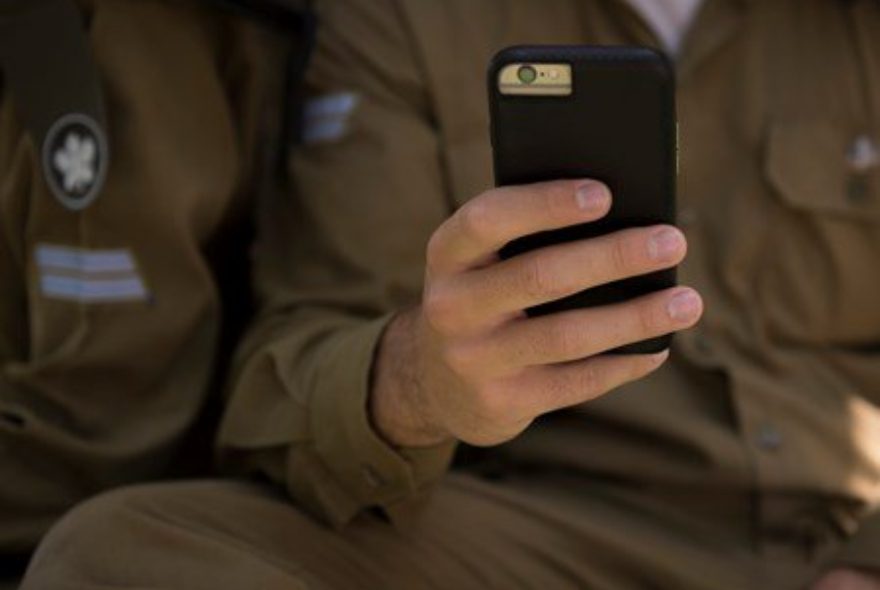
The IDF will begin to routinely monitor the accounts of all regular soldiers on social media - as part of renewed preparations to prevent the disclosure of sensitive information to the enemy.
According to a report in Galei Tzahal, the new system - 'Verpius', is based on artificial intelligence technology and is designed to scan the public accounts of approximately 170,000 soldiers.
 Want more news, videos and stories? Join the Haredim 10 WhatsApp channel >>
The system will analyze texts, images, and videos uploaded to social networks and will alert in cases where there is concern about the disclosure of security details.
The IDF notes that if a sensitive posting is discovered, the soldier will receive an automatic notification with a demand to delete it, and in serious cases, a telephone inquiry will also be made with an information security officer.
The system will soon receive the required legal approvals, and is expected to begin operating in early December.
However, the Morpheus system has two main caveats: it will focus only on open accounts that are not defined as private, and it will not track reservists - due to legal restrictions regarding the privacy of civilians.
Over the past four months, a pilot version of the system has been running, tracking 45,000 soldiers. According to IDF sources, thousands of cases were identified in which soldiers were required to delete sensitive content.
The IDF admits that the new initiative "stretches the boundaries of privacy and restraint of force," but emphasizes that this is a necessary move in light of the damage caused by information leaked to social media - and allowed Hamas to establish a comprehensive intelligence system prior to the October 7 attack.
As already reported on Galei Tzahal, soldiers have been revealing sensitive information on social media for years, Hamas collected the pieces of information - and built a Gazan 'tank force' of the Nuhba, who were trained to drive a tank and operate a Merkava Mark 4 tank.
In investigating the failure, the IDF was astonished to discover that Hamas had managed to disable tanks in the encirclement, and attempted to take control of them and drive them to Gaza - after the terrorists recognized a secret button on the tank, which, when pressed, disabled the tank for a certain period of time.
It was a mystery that lasted months: How did Hamas know the secret button, and manage to gain such intimate knowledge of the Merkava Mark 4? Only months into the war, in early 2024, IDF forces reached an underground tunnel in the central camps known as the 'Pentagon', and there they discovered the secret: Hamas had been collecting intimate intelligence on the Merkava Mark 4 tanks for years (and not just on them, of course), and managed to obtain highly sensitive information, on the basis of which it planned parts of the attack in the envelope.
Hamas gathered the intelligence from the social networks of IDF soldiers.
By tracking tens of thousands of soldiers, he put together the puzzle piece by piece, and obtained valuable information: photos and videos, some of them seemingly cryptic, from bases, from outposts, from the armored training base in Shizfon; training videos of soldiers on tank drills, and using the sensitive and valuable information that Hamas obtained from the networks and the documentation in Shizfon, he built a complete plan: a force of Nuhba terrorists was trained and coached over a long period of time to be "tankers" - they had life-size models of Merkava tanks, and there was also advanced simulator software that trained them on how to operate the tank.
In the attack plans that were discovered, on the Hamas terrorists who were captured or eliminated on the day of the massacre, and also later in the war in the material seized inside Gaza, the IDF revealed how exposed it was: how Hamas knew every internal gate in the outpost, every technical detail in the tank, and every weak point in the obstacle.
Quite a bit of the information, as mentioned, was obtained from a lack of attention to information security on networks.