Did the war make Israeli society more traditional? The Israeli Society Index of the JPPI - the Jewish People Policy Institute - focused on this question this time, and it seems that the strengthening of traditionalism in Israel is not just a feeling, but an existing fact.
The findings indicate a significant increase in the preservation of tradition and belief in God, especially among young, traditional, and religious people, alongside a shift to the right in political leanings.
On the other hand, among secular people, there has been a certain decline in the observance of tradition and faith.
 Want more news, videos and stories? Join the Haredim 10 WhatsApp channel >>
The report was prepared against the backdrop of the widespread public debate surrounding the preservation of tradition in Israel, which is evident in the public sphere: the controversy surrounding the placement of tefillin near schools, the popularity of traditional songs, the wearing of religious symbols on military uniforms, and more.
The survey examined the beliefs, customs, and attitudes of Jews and Arabs, with special emphasis on the attitudes of young Jews aged 18-24, to whom a significant portion of the reports refer.
These are the main findings:
An increase in the preservation of tradition
According to the findings, the war period led to changes in the extent to which Israelis observed tradition. For many of them, the change came in the form of more frequent observance of religious practices.
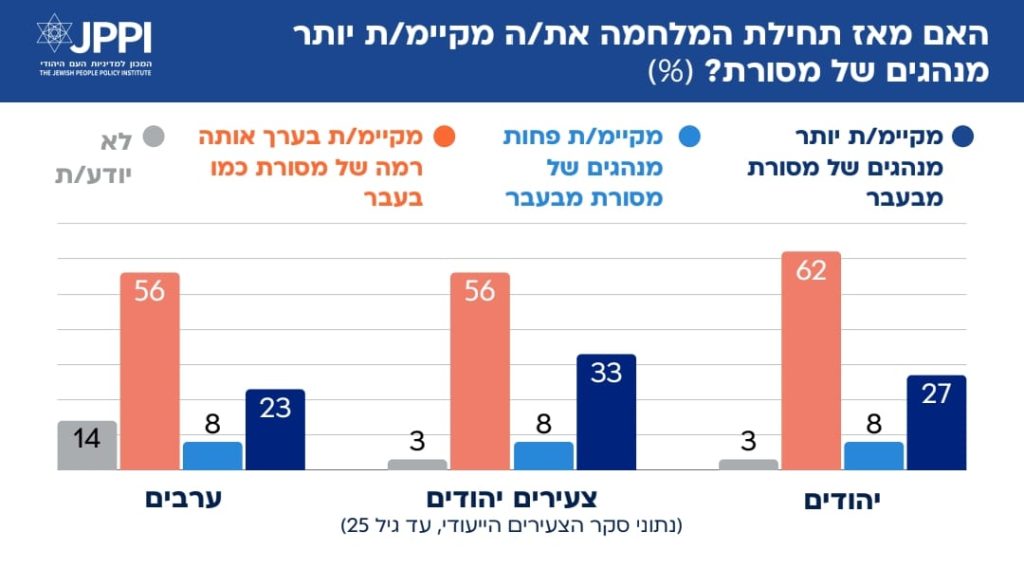
A quarter (27%) of respondents indicate an increase in the observance of customs. This trend is even more pronounced among young Jews up to the age of 25: a third of young people (33%) indicate that they observe more traditions than in the past.
Among the Arab public, about a quarter of respondents (23%) noted an increase in the observance of traditional customs during the war.
The increase in the observance of Jewish tradition following the war is mainly reflected among those who initially described themselves as somewhat traditional or religious. The stronger the respondents' religious identity, the higher the proportion of those who report that they observe more traditional customs.
As mentioned, the data regarding the entire Jewish public is mainly expressed among young people up to the age of 25:
Among young people who define themselves as 'traditional, non-religious', there is a very significant increase in observing customs - 37% of whom indicate an increase in observing religious customs, and among young people who are 'traditional, somewhat religious' the increase is even greater - with 51% of whom reporting observing more religious customs following the war.
More religious practices are observed
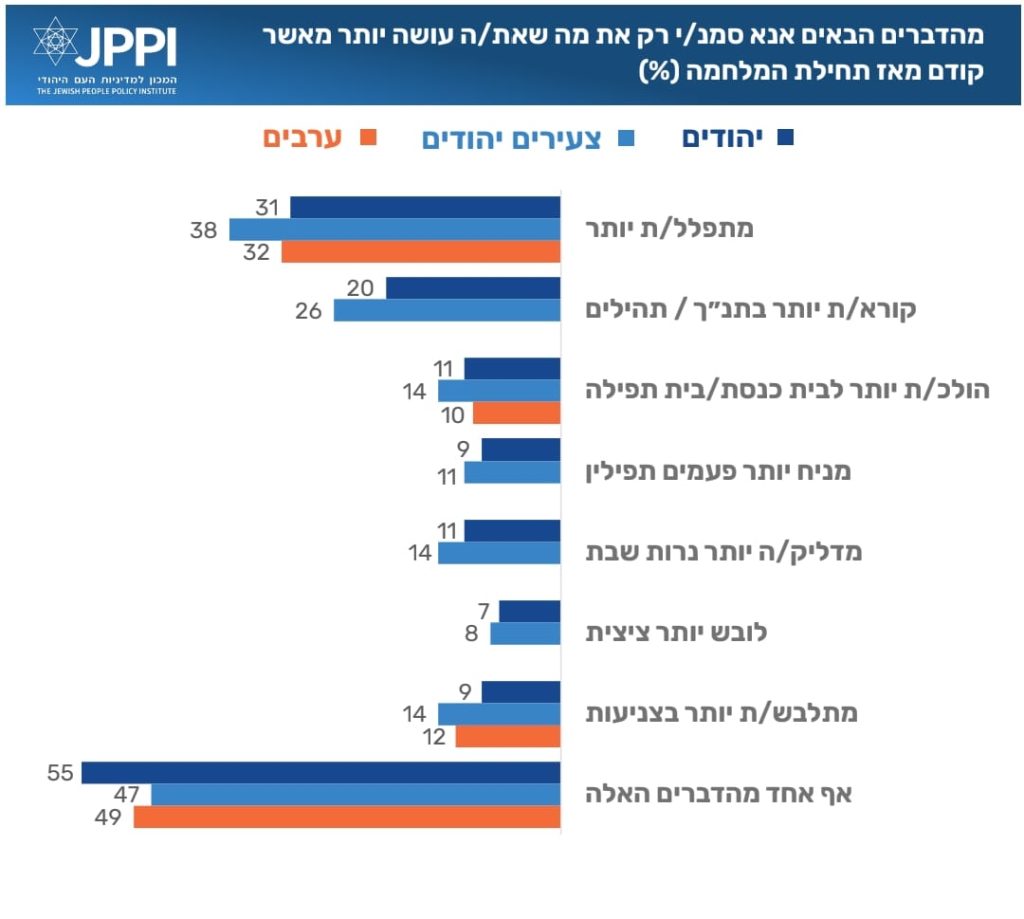
31% of Jews report that they pray more since the war. 20% reported that they read more in the Bible or Psalms.
About a tenth of Jews reported that they had increased their practices such as going to synagogue (11%), lighting Shabbat candles (11%), wearing tefillin (9%), and dressing modestly (9%).
Among young Jews, an even more significant level of "strengthening" in observing customs is evident - 38% of them testified that they pray more since the war, and about a quarter (26%) of them read the Bible more.
141% of young Jews say they go to synagogue more, light more Shabbat candles, and dress more modestly.
Among 'non-religious traditions' almost half (43%) report a change, mainly an increase in participation in prayer (42%), reading the Bible or Psalms (23%), and lighting Shabbat candles (20%).
Among 'traditionalists who are somewhat religious' and among religious people, the proportion reporting an increase in the level of observance of customs is even higher: over half of them pray more, and about 421% read more from the Bible or Psalms.
In Arab society, a similar trend of increasing observance of customs is also evident: prayer (32%), adherence to modesty (12%), and going to church/mosque (10%).
Believe in God more than before
A quarter of Jews (28%) and almost forty percent of Arabs (37%) feel that their faith in God has grown stronger, while a much smaller percentage report a decline in faith: 9% among Jews and 4% among Arabs.
Among young Jews, the impact of the war on faith is greater than in the general Jewish population: 351% of them indicate that they believe in God more than before.
Another question examined what respondents thought about the degree of faith of other Israelis in their environment.
The general impression created in Israeli society, perhaps also as a product of the public discourse on the issue, is that the environment is "getting stronger.".
Half (49%) of Jews believe that their friends and relatives have strengthened their faith to one degree or another, while a third (35%) believe that the level of faith has remained the same, and only a small minority (9%) estimate that there has been a weakening in the level of faith.
Among young Jews, an even stronger perception of change is evident, with a higher proportion (58%) of young people who responded that their friends had become stronger in faith and a relatively lower proportion, a quarter (25%) who think that the religious situation of their environment has remained the same.
Among Arabs - half of the Arabs (52%) believe that their environment has become stronger in faith.
Political identification – drift to the right
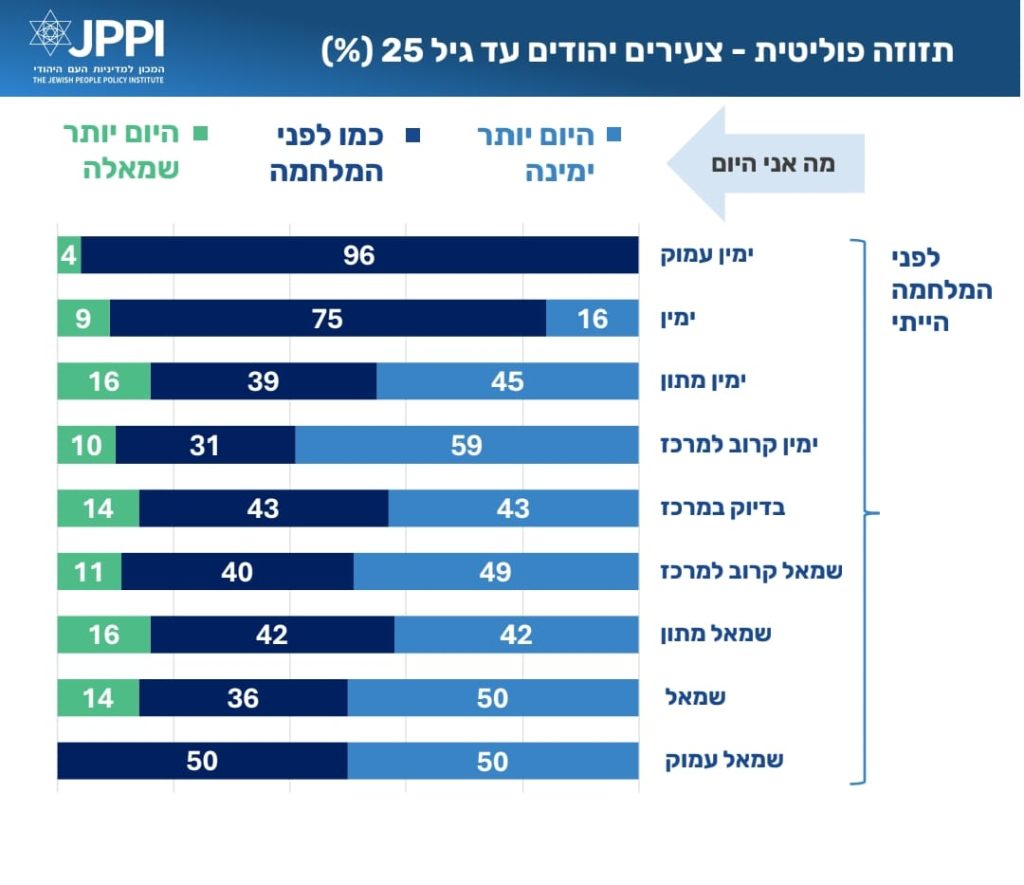
Following questions about changes in their level of religiosity, respondents were also asked about changes in their political self-definition. The data shows that since the beginning of the war, there has been a clear political shift to the right among Jews.
Among all Jews, the proportion of those who say they have moved to identify as "deep right" rose from 11% to 19%, and the proportion who identify as "right" rose from 24% to 28%. The increase stems from a shift to the right of those who identified as "moderate right" or "center" before the war.
The shift to the right is also evident among young Jews, in almost every political affiliation group. Almost half (45%) of those who say that before the war they would have defined themselves as "moderate right" and a majority (59%) of those who say they were "right-of-center" indicate that they have moved to the right on the political scale.
Even among those who identified as "center" or "moderate left," a significant proportion reported a shift to the right - 43% from the center and half (49%) from the center-left.
Even among those who identified as left or deep left, about half (50%) of respondents reported a shift to the right.
There is stability in the Arab public, and there have been almost no changes - the center, the left, and the right have more or less maintained their share.
Director General of the Jewish People Policy Institute, Dr. Shuki Friedman: "The data reflects what we felt on the ground - many in Israel, and even more so among the young, feel that the war connected them more to Jewish tradition and identity - not necessarily in a halakhic way, but in a way that was emphatically expressed in their lives as well as in various aspects of the public sphere.".
""When Sasson Shaulov's hit 'Tamid Ahoveh Auti', which is a religious song composed by a rabbi, receives tens of millions of plays on YouTube, it expresses the spirit of the times. At the same time, Israelis, especially young people, have moved to the right. Post-war Israel is more traditional and right-wing. At this stage, it is not known whether this is a passing fad, or whether the change will be profound and long-term."'
The data was analyzed and weighted by voting and religiosity to represent the position of the adult population in Israel. Shmuel Rosner and Noach Slepkov compile the JPPI index for Israeli society. Statistical consulting: Prof. David Steinberg.