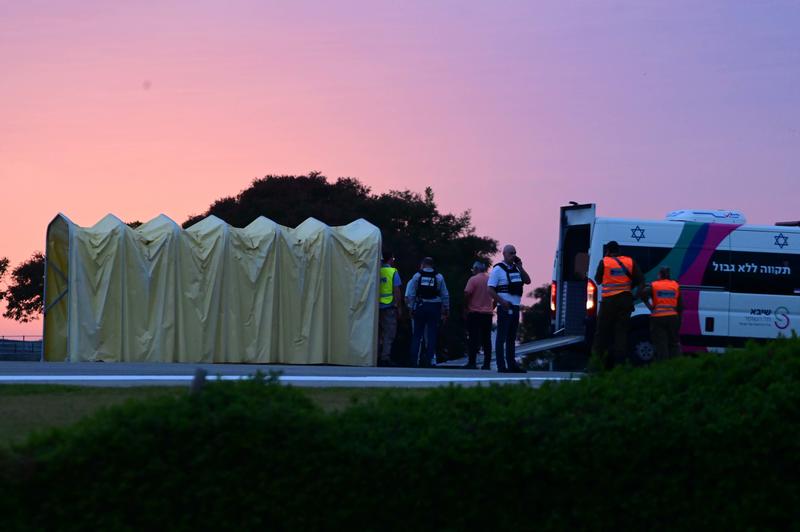
The Health Ministry and hospitals are already preparing today (Thursday) to receive the abductees who will return from Hamas captivity - and are afraid of damage that could be caused to them at the last minute and of contracting winter diseases.
The hospitals expected to receive the survivors of the captivity are Sheba, Ichilov, and Beilinson - with Soroka and Barzilai prepared as short-term targets for absorption in cases of emergency.
According to a report in Kan News, the Ministry of Health fears that the prolonged hunger and poor conditions in captivity have damaged the immune system and made the captives more susceptible to infectious diseases, and therefore all care teams will be vaccinated against the flu and coronavirus.
In light of the difficult documentation of those abducted from captivity, the Ministry of Health instructed the receiving departments to increase monitoring measures - that is, prolonged connection to a monitor, resuscitation carts, ventilators, and strictness in taking laboratory tests in a more detailed manner.
Intensive care units were also instructed to be prepared to treat the returnees if necessary.
Another concern is refeeding syndrome, which can cause severe damage after a prolonged period of starvation.
In recent weeks, the Ministry of Health has handed over to the Red Cross a protocol for refeeding in field conditions, conditions that are appropriate for the Strip, in the hope that they will not endanger the abductees.
The preparations also include mental health and welfare teams who will accompany the returnees and their family members.
The Director General of the Ministry of Health, Moshe Bar Siman Tov, said this morning in a conversation with reporters: "What makes this event complex and challenging for us - this is of course the positive thing about it - is the size of the return, of twenty live abductees and another 28 casualties, who we hope will be returned in the shortest possible time.".
""It's a complex logistical operation, but the system will of course deal with it. Alongside this, of course, is the impact of a very long captivity, two years or more, in such difficult conditions. We not only prepared and retrained the system, we tested ourselves and the system on what we need to be more prepared for this time.".
The returnees in hospitals will follow the same protocol that was introduced in previous rounds, along with adjustments and refinements.
Immediately upon admission, there will be an initial medical assessment to see if there is anything that requires urgent and immediate treatment, after which time will be given to the family - and the less urgent medical issues will be secondary in priority.
In terms of the distribution of the survivors of captivity between the hospitals - the Ministry of Health explains that several criteria will be taken into account, including, of course, the joint stay of family members - they are expecting the arrival of the two pairs of brothers, Gali and Ziv Berman, and David and Ariel Konoyo - the joint stay of abductees who were held captive together in the recent period, as well as requests from family members.
The health system is also preparing for the arrival of the deceased hostages, who will be admitted to the National Institute of Forensic Medicine. The institute's role will be to identify the deceased and determine the circumstances of their deaths.
In the first and quickest stage, identification will be carried out using bite marks (teeth), CT scans and DNA tests. In the next stage, the institute's personnel will try to determine the circumstances of the deaths of the kidnapped victims who will be returned.
 Join the Haredim 10 Facebook page >>
 Join the X page of Haredim 10 >>
 Want more news, videos and stories? Join the Haredim 10 WhatsApp channel >>