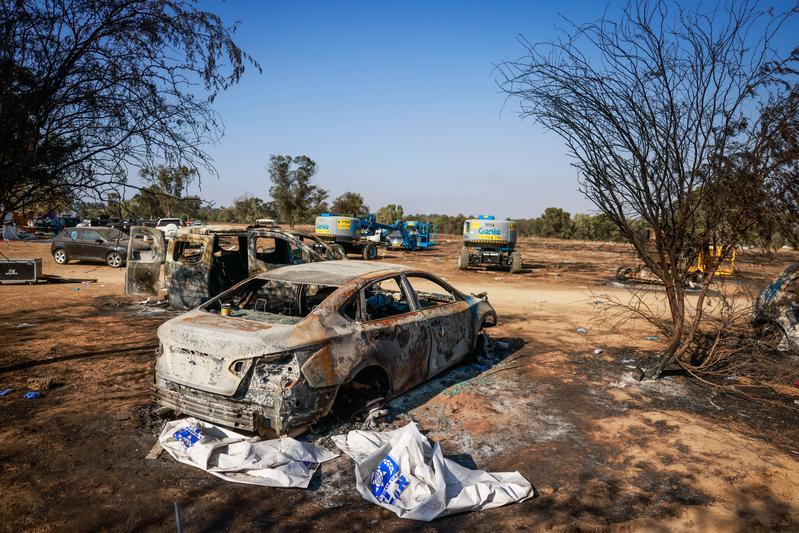
An ambulance driver who volunteers with the rescue forces, in his 30s, married with children and living in a moshav near Kiryat Gat, was recently recognized by the National Insurance Institute (NII) as a high-level post-traumatic stress disorder victim, after being exposed to the horrors of October 7.
Renewal, education, employment, culture: Why is it worth moving to Jerusalem? • Informative
According to his affidavit, he was called from his home to serve as an ambulance driver for MDA following distress calls in the city of Ashkelon. Upon his arrival in Ashkelon, he assisted a woman giving birth and victims of missile fire and evacuated them to the city's Barzilai Hospital.
 Want more news, videos and stories? Join the Haredim 10 WhatsApp channel >>
According to his testimony, at the hospital he entered the morgue, where he began to understand the dimensions of the grave disaster.
From there, he was called to the scene of the Nuba party near Kibbutz Re'im along with four other ZAKA volunteers, with the goal of recovering bodies from the party area.
According to his testimony, on the way, the ambulance crew encountered many bodies scattered on the road, and removed them to the side of the road, an act that deeply affected him.
""The very fact that we left bodies behind and continued traveling left me with a very heavy mental burden, as usually every body receives the appropriate care by way of extraction, treatment, and immediate burial," the prosecutor noted in his affidavit.
At the Bari Junction, which they arrived at immediately afterwards, the ambulance personnel saw piles of bodies and the incessant sound of gunfire.
""When we arrived at the party in Baraim, a strong smell of burnt flesh filled our nostrils and, again, dozens of bodies scattered everywhere. We collected the bodies into bags and loaded them into trucks," the prosecutor testified.
""After many hours of body retrieval work, around 4:00 in the morning, we returned to Migonit at the Bari Junction where we saw soldiers collecting bodies. We asked the soldiers to stop and we continued collecting the bodies. At some point I remember a phone ringing from one of the bodies. I remember there was a deathly silence, literally, we all stopped for a few moments helplessly, imagining the worried family member who must be on the other side of the line and not getting an answer.".
The prosecutor continued to testify: "We continued for many hours removing bodies, wrapping them in bags and loading them into a truck. I remember working like a robot, intent on completing the difficult task before me. Due to the large number of bodies, it was very difficult to identify them.".
He said that in the following days he continued the work of evacuating bodies in the village of Gaza, sometimes under heavy fire.
""As a ZAKA volunteer, I have witnessed difficult scenes more than once, but the events of October 7 were horrific and difficult, both in the condition of the bodies, their extent, and in terms of the smells and sights that do not give rest.".
Following the events, the plaintiff began to suffer from symptoms of acute trauma – difficulty sleeping, nightmares, negative thoughts, and feelings of guilt. He said he identified several victims in posts on Telegram and in the media, a fact that contributed to his mental distress.
Due to his condition, he sought mental health treatment and underwent 32 therapy sessions, which did not significantly improve his condition. As a result of his deteriorating mental condition, his parental, marital and family functioning was severely impaired, and he tended to withdraw, become overly irritable and emotionally detached.
At this point, the plaintiff turned to Attorney Shiran Cohen to assist him in exercising his medical rights.
Attorney Cohen contacted the National Insurance Institute, requesting that the plaintiff be recognized as a victim of hostilities suffering from post-traumatic stress disorder. Her request was accepted, and a medical committee convened in his case to determine his level of disability.
In this context, Attorney Cohen submitted to the committee numerous documents attesting to Marsha's difficult mental state, including an affidavit from the Israeli Center for Hostility Victims, which supported recognizing him as a post-traumatic stress disorder victim.
According to the center's affidavit, the plaintiff "is overwhelmed with feelings of guilt for not doing more, for not documenting and scanning the area properly, and for not understanding the magnitude of the disaster in real time.""
The committee was also presented with an opinion from an expert psychiatrist, who stated that "despite [the plaintiff's] previous experience with ZAKA, the experience this time was much more difficult. In the period that followed, he was in shock and unable to function." As the expert noted in his opinion, the plaintiff "lives in emotional detachment in terms of interpersonal relationships, but seeks strong sensory experiences.""
The Amach association, to which the plaintiff went for mental health treatment, also submitted a supporting opinion, stating that he "comes to treatment consistently, and the need for long-term psychotherapy is evident that will help him process the overwhelming memories, deal with reality, and find meaning for his life."'
The medical committee on behalf of the National Security Council noted in its decision that the plaintiff shows clear signs of mental impairment, including a low threshold for arousal and disturbances in concentration and thinking. He also suffers from post-traumatic stress disorder (PTSD) with significant impairment in parental, marital, family and social functioning."
In light of this, the committee decided to determine for the plaintiff a temporary disability at a rate of 40% for one year after the massacre, and a disability at a rate of 30% throughout the year 2025, disabilities that entitle him, according to Attorney Cohen, to fixed monthly benefits.
According to Attorney Shiran Cohen, when the temporary disability period ends, the medical committee is expected to convene again, where his mental condition will be assessed and his permanent disability will be determined, the amount of which will certainly be expressed in a benefit of at least thousands of shekels per month.