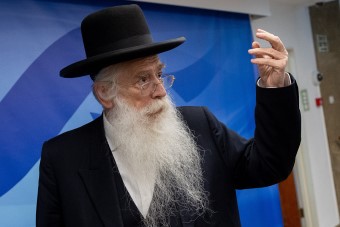
Yesterday, on the evening of the 10th of Tevet, I signed the contract for the term of office of Minister of Jerusalem and Israeli Tradition.
The appointment as a minister should not upset a Jew who is part of the Haredi Jewish community. This is despite the fact that it has already been clarified (as will be explained below) that serving as a minister, according to the system and methods of Agudat Yisrael, from the moment this question was raised, it was decided in the highest spiritual echelons that it was permissible and possible.
And for this reason, I am not the first minister in the history of Agudath Yisrael in the Land of Israel. The first to hold this title was Rabbi Yitzhak Meir Levin, zt"l, President of Agudath Yisrael World, who served as Minister of Welfare for over 4 years, in the interim government and the first three governments.
 Want more news, videos and stories? Join the Haredim 10 WhatsApp channel >>
And yet, why is a ministerial position not exciting, because even something that was agreed upon and permitted by the rabbis and rabbis, it is still necessary to examine whether it is possible to act and influence without the title of 'minister'. Because as long as there is a possibility of being useful without this title, but also as a deputy minister, there is no point in tightening the connection between Haredi Judaism and the institutions of government, and there is a point in expressing the separation between the communities.
•
As early as 1937, a decade before the establishment of the state, when the question was raised that the British might give the possibility of establishing a Jewish state, the heads and leaders of Agudath Israel discussed our attitude towards a Jewish government, if it were to be established - whether to oppose or join. From the documents stored in the archives of the Agudath Israel-Jerusalem Center, we learn that at the direction of Maran Maharitz Duszynski, the late leader of faithful Judaism in the Ara Kadisha, Rabbi Moshe Blau, the late one, placed the question on the desk of Maran Gaon Rabbi Chaim Ozer Grodzanski, the late one, president of the Council of Torah Sages, in the month of Kislev, 1937.
His full response, which survived in his handwriting, answers the question posed to him by Rabbi Moshe Blau and his teacher Rabbi Yaakov Rosenheim, whether one is obligated to participate in the government or whether there is no obligation, and to this comes his clear and clear response: ""If there is truly absolute information that the Mandatory government is prepared to implement the partition and Jewish administration, it is appropriate to participate!""
This was, therefore, the decision of the highest levels of Agudat Israel, which clearly ruled on the obligation imposed on Agudat Israel to participate in the government and the coalition in order to try to save the rights of the Haredi public in the State of Israel.
We hear an echo of this in the newspaper "HaMevasser" from Sivan 18, 5790, which contains a report on the Agudat Yisrael conference in the US and quotes from the speech of our teacher, Rabbi Yaakov Rosenheim - and this is what he said: ""Agudat Yisrael was faced with the obligation to clarify its relations with the State of Israel. There was a very practical question, whether to join the government, to be an equal partner in the coalition, or to stand outside, to participate in the opposition. We forwarded the question to the Council of Torah Scholars, which is the highest institution of the movement, and after discussions and consultations, they decided and announced the decision that representatives of Agudat Yisrael should join the government.
""Twelve years ago"" (In 1937) Rabbi Rosenheim continues and says: ""We discussed the possibility of establishing a Jewish state, and the problem of the participation of ultra-Orthodox Judaism in this state... I then received an instruction from the great man of our generation, Rabbi Chaim Ozer Grodzinski, that Agudat Israel should work in full cooperation with all religious circles... At that time, the Jewish Agency promised Agudat Israel that it would accept its four fundamental demands, and they were indeed accepted by the State of Israel."" (That is, following the acceptance of the four basic demands, which were later called the status quo document, it was decided that we would enter the government).
•
Agudath Yisrael's position regarding the tenure of its members as ministers was heard again before the state's declaration in the appearance of the delegation of heads of the World Agudath Yisrael in the winter of 1958 before the UN Committee on Palestine. The distinguished delegation included our teacher, Rabbi Yaakov Rosenheim, z"l - New York, my grandfather Rabbi Moshe Porush, z"l - Jerusalem, and Mr. Harry Goodman, z"l - England.
It was in the winter of 1958, when the UN sought to inquire about the positions of the political organizations in Israel. Since Agudat Israel was at that time the political organization of Haredi Judaism, it was required to express its position, and for this purpose the heads of Agudat Israel appeared before the UN committee. These were the words of our teacher Rabbi Rosenheim when he appeared at the UN at the head of the Agudat Israel delegation, before the establishment of the state:
""In light of our religious beliefs that prevent us from taking responsibility for specific actions of the government that are not in accordance with the laws of the Jewish Torah, we must be cautious in accepting specific portfolios. We believe that the Immigration Authority and the Welfare Authority can be managed by Agudat Yisrael ministers without conflicts of conscience. In the future, we will be prepared to enter the government as ministers without specific portfolios, while participating in general ministerial work and representing the views of the Jewish religious tradition across all government activities.".
•
Since Rabbi Yitzhak Meir Levin retired from his government position at the end of 1972, until the formation of the coalition and government in 1977, the appointment of a minister from the Agudath Yisrael circles was not on the agenda. In 1977, when the matter was again on the agenda, the Gedolei Yisrael were not comfortable with the representatives of loyal Judaism serving as ministers in the government, because they believed that it was possible to act through the positions of committee chairmen. In 1974, the Council of Torah Gedolei HaTora decided that a representative from the Agudath Yisrael could serve as deputy minister, and it was even published in HaMoedia at the time.
In Elul 5775, the Council of Torah Scholars decided that, given the legal situation, a member of Agudat Yisrael should be approved to serve as a minister in the government.
•
As mentioned, if there is the ability to obtain essential needs without being a minister, it should be preferred to do so, without being a minister, even if there is consent and permission.
Therefore, in 1996, when I began serving as Deputy Minister of Construction and Housing, I acted in the capacity of a minister, and indeed I was privileged, in God, to act in great and significant ways for the welfare of Haredi Jewry, and to create important changes in relation to housing and housing for all citizens, including faithful Jews and the settlement circles in the regions of our Holy Land. The reality at that time was that I did not need to serve as a minister to do what I was privileged to do.
Even today, after the elections held two months ago, my desire and intention was that I would not be a minister and would serve as a deputy minister in a ministry where the minister would be an Agudat Yisrael member. However, since in the coalition agreement with Agudat Yisrael it was agreed that someone from Agudat Yisrael would be responsible for implementing the conclusions of the State Investigation Committee to investigate the Meron disaster, and an ultimate demand was made for the person responsible for this to be a minister, then despite my desire to act as a deputy minister, I was left with no choice but to serve as a minister, and as decided by the Elders of Israel before the establishment of the state, and as decided by the Council of Elders of Torah in 2015, and as decided by the Council of Elders of Torah and Ministers of Torah and Hasidism last month, I am serving as Minister of Jerusalem and Jewish Tradition.
•
I enter upon my lofty role with mixed emotions, with reverence and humility, with the hope and expectation that I will be able to fulfill the will of those who sent me for the sake and glory of faithful Judaism, that I will be able to carry out the role without a hitch or obstacle, that no mishap will escape from under my control, that I will be worthy of sanctifying the name of Heaven and that the name of Heaven will be loved by me.
The merit of our holy city and our glory, and the merit of the divine Tanna, Rabbi Shimon bar Yochai, will have a good influence on our behalf so that we can meet the important task, with grace and praise.