1.
It may seem strange, but when I heard the terrible announcement live on the radio, what went through my mind was, what poor people who are not in the middle of a car ride like me, and who did not receive preparation of something like ten minutes - the initial report of the collapse, then the prayers, and the CPR, and the confession - but are now snatching the news with a bang. In four words. Rabbi Chaim Kanievsky has passed away.
Many of them even in the middle of a Purim feast in Jerusalem, with happy music in the background, and deliveries of dishes and meat and wine. Some of them are even perfumed now. They receive this box in this stomach from drunkenness (on Sunday at the funeral I met two such friends. "It stopped all the drunkenness at once," they both said).
 Want more news, videos and stories? Join the Haredim 10 WhatsApp channel >>
Looking back, it seems to me that all these thoughts about others were just to distract me from the great shock. But that's the thing. There wasn't much to distract me from. Because a little while later the dramatic broadcast on the religious stations stopped. Shabbat descended on the Rashbam Valley.
2.
Think about it: At any other time, we would have received an endless wave of radio stations and websites. Not to mention WhatsApp groups and newsgroups. Hours upon hours of reports and commentary. What exactly did the rabbi die of? Which paramedic arrived first and what did he see? What about the funeral? What are the police assessments? What is happening at home now? What are they saying in the political system?
Endless text from the moment of death until the scroll is closed.
But apparently Heaven wanted us to experience these moments differently. We received the basic information, which is essentially the whole story: Rabbi Chaim Kanievsky has passed away. That's it. That's the end of the news. Now bring in the Sabbath and think about it alone. There's nowhere to run. Sit at the Sabbath meals, talk about it with the children, each in his own home, without the help of interpreters.
It was challenging, this silence. I admit. I was afraid of being left alone. A minute before the Sabbath, long after the religious radio stations had gone silent, I turned on Channel 2 and still managed to hear the announcer reading the moving message of mourning from the opposition leader, Benjamin Netanyahu.
It is interesting to know who wrote this precise text for him, so quickly and so beautifully: "The people of Israel lost a great scholar who was a central link in the chain of passing on the Torah from generation to generation.
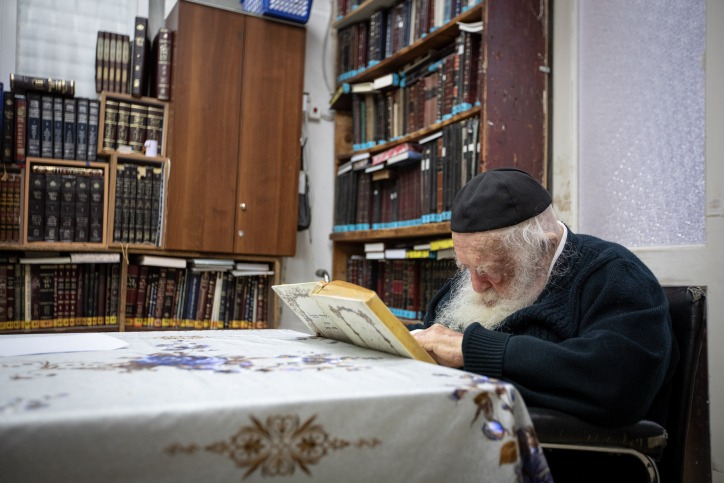
Rabbi Kanievsky's house in Bnei Brak served as a center of pilgrimage for our people from all walks of life. They drank thirstily from his mouth, sought his blessings and advice, and drew spiritual strength from his unique Torah authority. The image of the elderly rabbi constantly studying his Talmud inspired the hearts of those around him. He took advantage of every free moment to study, and this was expressed in his vast knowledge of the written and oral Torah.
Rabbi Kanievsky passed away in the midst of the holiday of Purim, shortly before the beginning of Shabbat Tzo. In this week's parashah we read: "A fire will be kept burning continually on the altar, it will never be extinguished." The eternal fire of love for Israel and the Torah of Israel that was kindled by Rabbi Kanievsky, may God bless him forever and ever.".
3.
For the Haredi sector, if we can generalize, it was very important this week to mediate the image of Rabbi Chaim Kanievsky to seculars. I pretty much gave up on that in advance. It's an impossible task. After all, it's hardly possible to mediate his image to the Haredi public.
Who was he really? What is the secret of his influence? What can we take from his image for our lives?
I don't have clear answers to all these questions. One thing is clear: all the learned panels that discussed in the studios the question of who the heir is, and where ultra-Orthodox politics will go in the era after Rabbi Kanievsky, were ridiculous. Not because they didn't say the right things. Not necessarily. But because the discussion itself is deviant from reality.
First of all, because Rabbi Chaim Kanievsky, for what he was, truly has no heir.
How did Rabbi Gershon Edelstein say in his eulogy? "The Gemara tells us that there was a great man who passed away, and when they eulogized him, they said, 'Woe to the Land of Israel that lacks a great man.' Woe to the Land of Israel that lacks a great man. It is not written that he was the only great man in the Land of Israel. And yet it is written that if one is missing, the influence of the whole Land of Israel is lacking. But here with us, it is not a great man, there are other great men like him, he was the only great man in the Land of Israel. Now there is no great man in all of the Land of Israel and in the entire world.".
And the second matter we discussed throughout the broadcasts, Haredi politics after his death: Rabbi Chaim Kanievsky was not a political leader. In fact, he was not a leader at all. So what was he? As mentioned, it is difficult to define.
The Chazon Ish, his great-uncle, called him in a letter "Mara Dechula Talmuda" (master of the entire Talmud). And that was in 1951, in his early twenties before he got married. Since then, another seventy years of endless study and perseverance have passed. Day after day, eight pages after eight more pages. How would the Chazon Ish define him today? "Sir of the Torah"? Sounds minimalist to me.
4.
What I'm trying to say here is that we don't have the tools to understand exactly what we've lost. Rabbi Chaim didn't really belong to our generation or our world of concepts. This was very evident in the video clips that have come out of his home in recent years.
Someone spoke to him - usually interrupted him - tried to get a reply or a statement from him, or introduce him to an important critic. And although Rabbi Chaim answered with a word, or with less than a word (God willing), it was easy to see that he was now in other worlds. In a different atmosphere. There was no fresh air here, no dialogue between a rabbi and a student.
Many people posted pictures of themselves with Rabbi Chaim in his humble room this week. I don't have a picture with him. And it's not that I didn't have the opportunity to enter the sanctuary inside. But I was afraid.
From what? Exactly from that. From that thing that the phrase "holy within" expresses. After all, it's not just a cliché here. It's a description of a place and a description of a situation. Today, of course, I regret that I didn't overcome this awe, but that's what I felt all these years.
And speaking of awe: Beyond the initial shock, and beyond the sorrow over the great loss, my feeling is also one of fear. Until last Friday, Rabbi Chaim Kanievsky lived in our generation. This fact has a special influence on everything that happens here. A spiritual Iron Dome for the entire generation. And this influence has ceased. We have lost it. The great Land of Israel is missing.
By the way, this may sound a bit childish, but I personally expected the funeral to have a pillar of fire above the bed, like in the stories about the "Amuda Danura" in "So Our Sages Did." In fact, it is very possible that there was. We simply did not get to see, with our own eyes, anything beyond a long black car surrounded by dozens of YSM police officers.
5.
So, as I said, I gave up on making this miraculous character accessible to the general public, and I'm still trying to explain it to myself.
But in conclusion, here's someone who did it not bad at all. His name is Major Rabbi Ofir Briner, and he is the military rabbi of the 25th Wing Air Force Base near Mitzpe Ramon.
This is what he wrote on Sunday morning in a special letter to the soldiers at the base:
""We all heard on the news about the passing of the great generation Rabbi Chaim Kanievsky. Hundreds of thousands of people are attending the funeral, which is still taking place at this moment. But what does this have to do with me, the soldier, the officer, or the opponent in Wing 25? Apparently, a cultural abyss separates us from Bnei Brak. Even the traffic jams of the huge funeral don't reach here...
But it really concerns each and every one of us. Because there truly is an extremely powerful spiritual 'law of intertwined tools' between the souls of all of us, for better and for worse, even if we don't feel it.
If there is a man who, despite being recognized by everyone as the greatest of his generation, treated each of the hundreds of people who came to meet him every day with respect - then thanks to such a man, we all respect others a little more, and especially those who, according to imaginary norms, are 'considered less' than us.
And if there is such a genius who, since childhood, has studied the entire Torah and remembered every word of it better than a search engine, and continues to study every year an amount of text that even most academics do not study in their entire lives (and this is no exaggeration) - then thanks to such a person, we are all a little wiser and a little more connected to the immense heritage of Jewish Torah that has sustained us for some 3,330 years.
And if there is an old rabbi in Bnei Brak, who, although he could easily have been very rich, stayed very far away from money and lived a simple life in a small two-room apartment with sparse furniture - then thanks to such a person, each of us is a little less money-hungry.
"And if there is a person who shunned publicity and abhorred descriptions and honorifics - then thanks to such a person, we are all a little more humble and do things because it is the right thing to do and not because it will bring us honor.".
6.
And this moving eulogy, which was not given at the Bnei Baraki Beit Midrash, but was sent to the men of the 25th Air Force Wing Base, concluded thus: "So despite the cultural chasm, we are connected, whether we like it or not, to the great man who was buried today. And we should be happy that his thousands of students continue his legacy and that our people have such spiritual giants.".
And we here in Wing 25, consciously and unconsciously, will also draw from his great spirit and continue to live many shared values in our lives, in our role in defending the State of Israel. And it is our right to also protect our brothers, the people of Bnei Brak (Rabbi Kanievsky, the late, loved and appreciated members of the military and security forces and strengthened their hands). We are all united in our souls, because truly, 'we are all one living human tissue.' May his great soul be bundled in the bundle of life, and from it we will all receive an increase in life.".
• The column is published in the newspaper 'Bisheva''