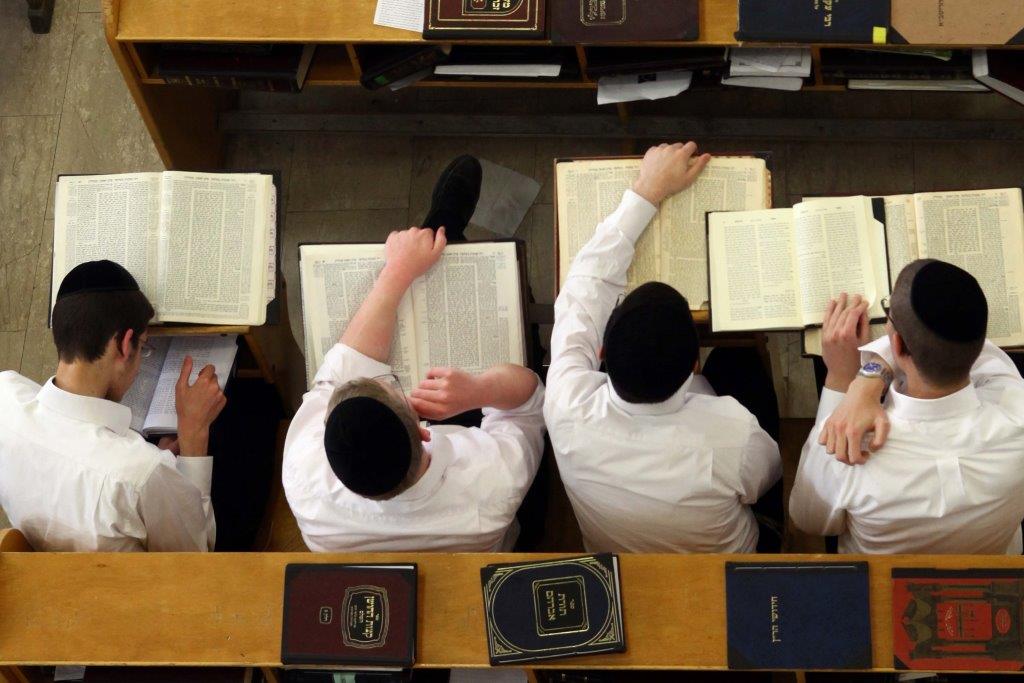
In the wider world, these days are days of rest and vacation, but the internal clock of the Jewish calendar sounds different.
Regular income from National Insurance? Check your eligibility for a monthly pension today
Tu B'Av symbolizes the shortening of the days and the lengthening of the nights. At night, people return to their homes. As the night becomes longer, a person has more time that is appropriate to dedicate to Torah study. Tu B'Av carries with it a message about the need to increase the time for Torah study.
 Want more news, videos and stories? Join the Haredim 10 WhatsApp channel >>
Regular income from National Insurance? Check your eligibility for a monthly pension today
Our sages likened the connection of a Jew with the Torah to a fish that cannot live outside of water. Thus, "the Torah is our life" – it is the source of life and spiritual strength for a Jew. Studying Torah is not a pastime for leisure hours or an enrichment class. It is a vital necessity, like air to breathe, like bread and water.
What is she broadcasting?
It is clear to every person that the body cannot exist without food provided to it on a regular basis. In the absence of food, the body weakens and loses its vitality. And the soul? Doesn't it need regular food? Can the divine soul that resides within us be content with a life of work and errands, consumption of news and entertainment?
A life without Torah leaves the soul hungry and thirsty, and when the soul is in pain – it is not good for us. We do not always know how to decipher the soul's cries of distress.
Sometimes it seems to a person that the dissatisfaction he feels stems from his overly routine work, his standard of living, his car that hasn't been replaced in two years. He attacks these goals, only to find that his soul has not yet been satisfied.
Parents are familiar with the phenomenon that sometimes a small child behaves nervously, bullies his siblings, makes noise, and so on.
""He's hungry," the parents say to each other. "No, I don't want to eat!" the child shouts, but the parents know that after he eats and is full, he will calm down.
The soul within us also radiates restlessness and discontent when it is hungry, and it becomes hungry when we keep it busy all day with worldly affairs and deprive it of its spiritual nourishment. The Torah is the food of the soul, and through it it connects to the divine source from which it was carved.
A Jew is required to engage in Torah "when you lie down and when you rise" – in the morning and in the evening. Our sages say that if a person does not have free time, he should study at least "one chapter in the morning and one chapter in the evening" – some study in the morning and some study in the evening.
But ongoing, daily study is essential and necessary.
The natural look
Tu B'Av calls on all of us to devote more attention to Torah study. Nowadays, there are wonderful reference books that allow even beginners to study Torah. Of course, the best thing is to join a regular Torah class, which has a double advantage – learning from a teacher and a regular framework that encourages the person to persevere.
The commitment to Torah study is a fundamental component of our Jewish identity. The people of Israel were called the "people of the book," because in every community and community, throughout all generations, it was a natural sight to see the craftsmen, merchants, and dignitaries of the city sitting and studying in the Beit Midrash in the evening.
This connection to the Torah enriches us, injects spiritual oxygen into our veins and gives our thirsty soul the pure water it longs for.