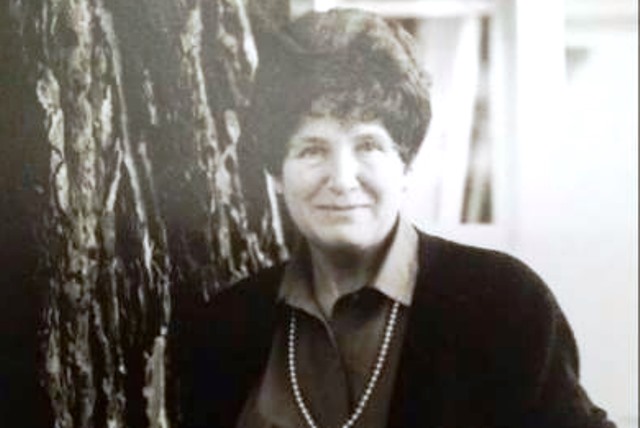
The day before, on the eve of the fast of Tisha B'Av 5777, my grandmother ('Mami', in French), Mrs. Colette Heune, may God have mercy on her, passed away.
She passed away in France with my father at her bedside, and the funeral was held on the night of Tisha B'Av in Jerusalem.
Mami Colt was a righteous woman, the kind you don't meet today. She was free from all lies, flattery, and deceit. Honest and fearing God in an unimaginable way.
 Want more news, videos and stories? Join the Haredim 10 WhatsApp channel >>
People of the past.
For years, she and her grandfather ('Peppy' in French), the righteous man who distinguished himself for a long life, ran a nursing home and cared for the elderly residents as if they were their parents.
She was a woman of rare strength and intelligence, but also of innocent and sincere faith. When her name and Pepi's name were mentioned by any of their acquaintances, it was always with blessings and with the words - such righteous people, so special.
Not long before her passing, my father, who will live, and I talked to Mami about her experiences during the difficult days of the Holocaust.
Over several hours of conversation, I managed to put some of its origins on the pages, so that the wonderful story of these great people, even if only partially, will remain with us.
Here is the first part of the descriptions we heard.
Zigzags in the car
September 1939 and the Nazis are racing from conquest to conquest across Europe. Austria and Poland are already in their hands and Hitler has begun to direct the killing machine towards France. In 1940 Germany invaded France, collapsing the French army's defensive line known as the 'Maginot Line' through a brilliant bypass operation, and reaching as far as Paris.
France was now divided into German-occupied territory in the north and west, Italian-occupied territory in the southeast, and an area known as 'Vichy France' ruled by a government of collaborators with Germany led by Philippe Pétain. In the northern part, which was ruled by the Germans, was a small village called 'Niederweiss'.
As the Germans approached, the village head ordered the residents to quickly leave the place. At that time, the village had 150 residents, half of whom were Jews.
Among the Jews also lived the Seraf family, consisting of the father, mother, and two children – Colette and Alphonse (Eliezer). In the meantime, the father had been drafted into the army, and the only male in the family was little Alphonse, then 12 years old.
This Alphonse was a lively and mischievous boy. In the early days of the runaway, Alphonse traded the car they had for a motorcycle. The mother was angry, and Colette remembers well that Alphonse, who reluctantly returned the car, made sure to drive in zigzags all the time to scare the passengers as if there wasn't a world war raging outside...
After hasty stops at various sites, the small family arrived at a village called 'Lusek Leszto.' In this village, the Seraf family hid in the depths of a wine cellar with other Jewish and non-Jewish families.
The fear was so great that one of the Jewish women, who prayed constantly, began to join the Christian families in her prayers, hoping that salvation might be in their hands... The Seraf family, however, remained steadfast in their convictions, and the grandmother, Colette's mother, took care to preserve the physical and spiritual integrity of her children.
• How did you manage with the food?
Colt: Mother A.H. was careful not to eat meat that was not kosher. For seven years, from 1938 to 1945, not a piece of meat entered her mouth and she ate only natural foods.
After a few days in the wine cellar, its inhabitants realized that their lives were in danger. The Germans continued to rain bombs from the air, and they decided to abandon this makeshift shelter. They traveled to a village called Lomiza, where the inhabitants were surprised to discover that they were Jews.
""Just like in fairy tales, they felt us, checking over and over again that we didn't have horns. They simply didn't believe us, ordinary people, belonging to the Jewish people," she said.
The first period passed peacefully for them thanks to their brother Alphonse, who found a job as a baker, and after a short period, during 1940, the father, who managed to be discharged from the army, also joined. He managed to find work at Lord's cheese farm, whom he knew from the village of Niederwis, and later the business was taken over by him.
Alphonse, who was already a grown boy, arranged a small synagogue in one of the rooms, and the family would pray there.
After a year in Le Meuse, the family moved to the town of Winona Sauvier, and from there back to Le Laoupt. France was already occupied and the Nazis were openly roaming the streets of the city. All Jews had to be at home by 8 o'clock, and after they presented their documents at the town hall and it was determined that they were Jews, they were also forced to wear the infamous yellow patch.
Colette said that she was one of the few girls in the town, which was mostly populated by older people, and from time to time she would tear the patch off her garment and walk the streets. The local residents all knew her and called her the Little Jewess, but for the time being they did not turn her in. At that time, they had no idea about the trains to Auschwitz, and about the extermination machine that was rapidly exterminating the Jewish people in Europe.
Pierre Fleury
The imagined peaceful life in 'Leopatia' did not last long.
The sharp jaws of the Nazi beast began to make their way towards the small towns of France, only the Germans, like the Germans, knew how to do it well, quietly, efficiently, without unnecessary background noise.
At that time, the city rabbi was a learned and righteous scholar named Rabbi Eli Bloch - who was a good friend of the father of the family. They both had another friend who was not a member of the Bnei Brit named Pierre Fleury - a priest who always wore brown clothes, a Righteous Among the Nations to whom quite a few Jewish lives were attributed.
Flori was originally from Romania and served as the spiritual father of the gypsy group in the area. The rabbi and Flori worked together, and Flori rescued Jews from the concentration camps that the Germans had set up around the city. The survivors, including children, were hidden in the grandparents' house.
• Do you remember the names of survivors?
A little. There was Rabbi Zerach Spiegel, David Amsalem. Louis Berkowitz. There were also girls. Sarah, the lovely six-year-old Dina. And more. I remember meals where twelve children would sit around the table, and the grandfather, who was connected to the underground organizations, would get milk for them in strange ways.
One day, Flory approached the rabbi and grandfather and informed them that the Nazis were going to raid the city that night. The family hid in the field in front of the house during the night, but the Nazis did not appear.
In the morning, the family debated whether to stay in the city, and finally decided to leave for a farm that was far from the city. A few minutes after they left, Nazi trucks appeared in a huge cloud of dust and gathered all the Jews in the city, to a place where they would never return.
The end of Rabbi Eli Bloch was also sad. His wife went out into the street to the public telephone for an urgent matter, and one of the residents recognized her. She was arrested with her daughter and sent to a concentration camp. Rabbi Eli Bloch was arrested immediately after them and tortured for hours by the Nazis who tried to find out about the rescue activities he had undertaken. May God raise their blood.
Colette and her brother arrived at the farmhouse on foot, but the landlady only agreed to let them stay for two days. "After that, you must leave," the farmer told Colette.
It was 1943 and Colette was only about 14 years old. Despite this, she chose to put on the costume of a woman kneeling in childbirth and, with great tension, passed through the city again to Eutoptia. She knew that everyone there knew her, and the local residents, who wanted to flatter the Nazis operating in the city, would be happy to surrender to them.
In Laupatia, Collet boarded the train, where she encountered an SS officer who asked for her documents. Collet paled, and the realization dawned on her that her courageous journey from the farm through her hometown had come to an end here on the train - but then an old man appeared out of nowhere. "Maybe it was Elijah the prophet," says Collet - and in a confident voice he announced to the officer that this was his wife.
The officer looked at him and asked for his documents, and after they were found to be in order, he went on his way without saying a word. To this day, Colette cannot understand why he didn't ask for her documents as well, or where the unknown old man came from.
The train took her to the town of Aubiny and she found refuge in the house of the farmer's sister from Leuoptia. However, shortly afterwards, the inhabitants of Leuoptia recognized her and called out, "Here is the 'little Jewess' from Leuoptia." The rumor spread, reaching the ears of the landlady where Colette was hiding.
Without further ado, the woman simply informed her that she had to leave the house. She was not willing to risk hiding a Jew.

Sewing angels
Colette found herself in a strait and decided to travel to a village called 'Slorodzvord' where she knew her brother Alphonse was hiding. She asked the landlady for a bicycle, and she agreed to bring it to her 'as long as you leave the house,' and Colette set out on the long journey to the village in a convoy of gentile riders. This journey was not without obstacles either. At one of the bends in the road, there was a checkpoint where Nazi soldiers stood and asked the riders to identify themselves.
Just like on the train, an old man appeared behind her riding his bicycle and announced to the guards that she was his daughter. The guards let her continue riding, but the terror that filled her heart left its mark on her: Colette's body was covered in wounds that appeared all at once and only disappeared after many days. After passing through the checkpoint, the old man approached the young girl and offered her shelter in his home. He told her that he and his wife were childless and that he would be happy to adopt her as a daughter. Colette refused, and after a day at his home, she continued on her way to the village where her brother Alphonse was staying.
The enormous stress and dangers she was exposed to at any given moment affected her health, and she arrived in the village suffering from a high fever of 40 degrees. The landlady where Alphonse was hiding was not impressed by the poor girl's physical condition and ordered her to start working.
""That night I sewed 40 sheets that had particularly large holes. I had never sewn anything like that before and I had no idea how to do it. Since the job was done, I believe to this day that it was angels who sewed for me," she said.