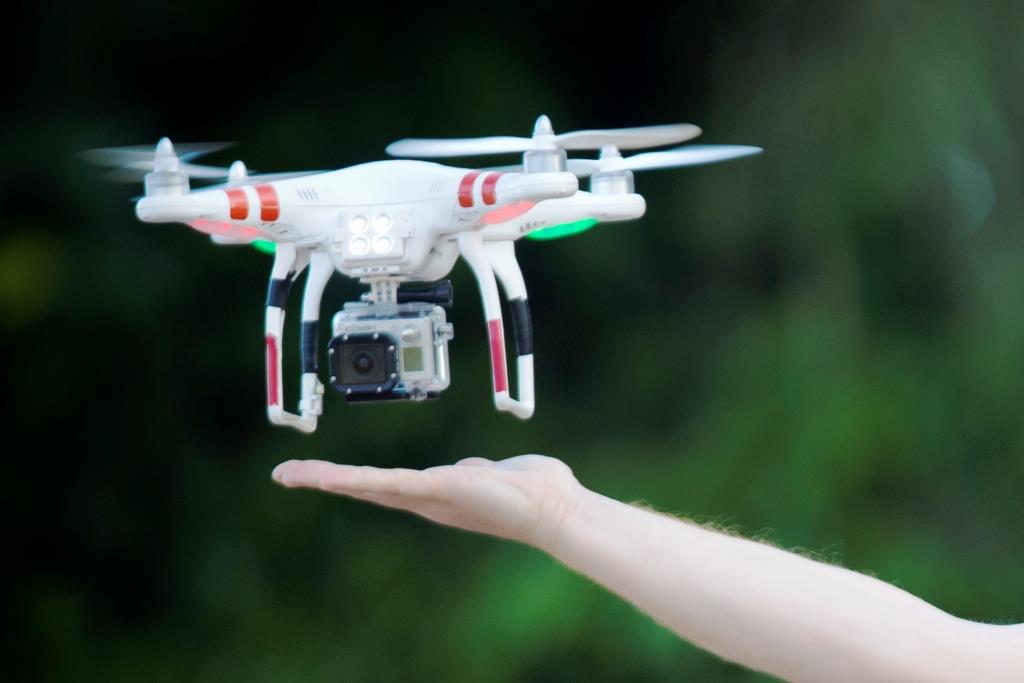
As part of the innovation vision led by Minister of Transportation Miri Regev, the national drone project is moving up a level and advancing from technological experiments to a practical examination of continuous drone operation for commercial and public use.
In the coming months, future models of drone services in the fields of logistics, healthcare, and municipal services will be examined, with the aim of preparing the infrastructure for a commercial market that will be launched in the coming years.
 Want more news, videos and stories? Join the Haredim 10 WhatsApp channel >>
After five years of intensive activity that included thousands of flights, safety tests, building a regulatory infrastructure, and developing advanced airspace management systems, the Ministry of Transportation announces a new and significant phase in the national drone project.
For the first time, the experiment is not content with examining flight and communication capabilities, but rather examines how a real drone market will operate: connecting operators, continuous coordination, daily operations, creating work processes, and a practical understanding of the environment required to transform air services into commercial ones.
The national drone project will soon enter a new phase, moving from spot demonstrations to a realistic, continuous operation in the field. The health system will examine scenarios that will enable regular aerial activity in the future, such as transferring blood donations from Hadassah Ein Kerem to Herzog in Jerusalem above traffic congestion, or receiving deliveries at Ziv Hospital in Safed as part of advanced medical support in the periphery. This is in order to examine how stable, fast, and equitable medical transportation routes can be built.
A broad set of experiments will be launched in the municipal space to test innovative work processes. Among other things, in the town of Rahat, capabilities for identifying threats in real time will be tested, in Yeruham, aerial security patrols will be operated to provide a wide area picture, in Kfar Saba, a rapid response to reports arriving at the municipal center will be tested, in Ra'anana, municipal drone surveillance will be activated, and in the Sharon region, a system will be activated to detect unauthorized drones.
A future model of air food delivery will be tested in Hayarkon Park in collaboration with the Benedict restaurant chain. These and many more will constitute field trials that create a full simulation of a future service, which will later be offered to the general public.
In the field of logistics, trials will begin that will simulate commercial operations. Shloha and Benedict will experiment with fixed delivery routes, the Rami Levy chain will test integrating drones into the retail supply chain, and off the coast of Israel, a model for transporting equipment to gas rigs and ships will be tested as an alternative to expensive and complex manned vessels. The goal of the trials will be to study in depth the potential for reducing costs and improving speed and efficiency.
At the same time, the technological infrastructure at the core of the project will be examined. The drones will deal with communication and GPS interference, changing weather conditions and high safety requirements, including flying in active aviation areas. Artificial intelligence systems will provide capabilities such as anomaly detection, real-time situation analysis and detection of uncooperative aircraft. These processes will make it possible to understand how the technologies will be integrated into organized services in the future.
The national project's budget will be approximately 17 million shekels and will be dedicated to developing the systems, expanding testing capabilities, examining the connection and implementation processes, and collecting real-world data that will support the regulatory work of the Civil Aviation Authority.
Minister of Transportation Miri Regev: "Israel is one of the leading countries in the world in the development and implementation of innovative aviation technologies - and our role is to maintain our position at the forefront of technology and regulation. The accelerated promotion of the national drone project is part of the 'Connecting Israel' vision - also in the air dimension. The project is a clear expression of the innovation revolution that we are leading - in the air, at sea and on land. Expanding the project to include commercial services, including complex regulatory and safety aspects in areas where global experience is still in its infancy, places Israel at the forefront of global innovation, and provides a significant advantage to Israeli industry and the entire economy.".
Minister of Innovation, Science and Technology, Gila Gamliel: "The national drone initiative marks a new stage in which Israel is not only talking about a technological future but is actually making it a reality. We are entering an era in which innovation is becoming an everyday tool, from delivering medical tests and life-saving equipment in the periphery, through improving urban management to creating faster, greener and more efficient logistics processes. This is a profound infrastructural change that combines advanced technological capabilities, smart regulation and responsible space operations. Our vision is to lay the foundations for a world in which unmanned aerial vehicles will naturally and safely integrate into civil airspace and open the door to new industries, economic opportunities and services that were impossible until today. This is a national responsibility that requires cooperation between government ministries, industry and local authorities, and we are determined to lead it with the benefit of citizens in mind, reducing gaps and establishing Israel's position at the forefront of global innovation. From our perspective, this is "This is not just a technological experiment, it is the beginning of a civil revolution that will change life here in everyday life.".
Ministry of Transportation Director General Moshe Ben-Zaken: "Israel is taking off into a new transportation era. The expansion of the national drone initiative is a significant leap forward, marking the transition from experimental solutions to services of real value to the general public. This is another step in planning a diverse, smart, clean and efficient transportation future. The ability to operate drone services as part of an integrated transportation system creates transportation, operational and economic benefits - and places Israel at the forefront of global innovation. We will continue to promote advanced regulation and collaborations that will enable the safe and accessible implementation of new technologies for the public.".
Innovation Authority CEO Dror Bean: "We are at a stage that brings Israel closer to the next generation of transportation and air services. This is a stage in which industry and the state are learning together what a managed and safe airspace will look like and how companies join the infrastructure and operate within it in a continuous and controlled process. We see significant potential in a variety of applications such as early detection of fires, identification of safety hazards on construction sites, securing essential facilities and real-time traffic monitoring, alongside advanced logistics solutions that will shorten delivery times and improve its efficiency. All of this will be possible thanks to an advanced technological infrastructure and enabling regulation. To date, we have carried out demonstrations, and now we are practicing full-scale work that simulates continuous operation. This is an experiment that prepares the ground for real operation, and teaches us how to integrate the infrastructure with private companies, hospitals and authorities on the way to creating a new airspace for Israel.""