About 14 years ago, I came to save the defunct newspaper "Sha'a Tova." Some time earlier, a young and naive investor entered the faltering newspaper, thinking of reviving the bar, and to that end, he recruited me to the job.
More on the topic:
The Selection: The 25 Most Influential Media in Haredi Journalism 2021
 Want more news, videos and stories? Join the Haredim 10 WhatsApp channel >>
The Rebbe of Politics: The Man Who Invented Haredi Political Commentary
Foreshadowing and saying: The editor-in-chief who, after 10 years, can afford to smile
Knowledge and opinion have made the political commentator a sought-after interviewee.
On one of the first days of my arrival, the newspaper's producer, Aharon Kliger, entered the editorial offices in Bnei Brak, along with a young yeshiva student who was one of the magazine's writers. From the very first article he submitted, it was clear that he had a special talent.
But he also had a notable drawback that made me sad: he acted as if there were no sacred deadlines in the world. Quite a few of my gray hairs are a memory of those days, when he would arrive with the articles he was assigned to do, a minute before the last minute.
About two years after we parted ways at the same newspaper, which has since ceased to exist, I recruited him as a staff editor for the website "In the Rooms of the Haredim" that I founded. He created juicy headlines, most of which featured the word "shaking," but even then you could see his fondness for what I call "rounding corners.".
I particularly remember a title for a gallery and a video that covered a trip by a 'Rebbe' with businessmen to the grave of the 'Wonder Counselor': "'God, we love you,' the businessmen sang with the Rebbe in Bulgaria.".
I, whose hearing was poor at the time, asked him: Is that really the song they sang?
And he answered me playfully: And if they didn't sing, then they could sing...
Because of these two qualities, I thought he had a bright future as a writer, but I didn't expect him to ever be able to function as a magazine or newspaper editor.
But, there are surprises in life. Because that's exactly what happened.
Aryeh Erlich, the magazine editor of the weekly magazine "Mishpacha", joined the newspaper's writing team 12 years ago, at the age of 22. Alongside articles and interviews, he served as a political commentator, and 7 years ago he began publishing a weekly column in the magazine, with a unique style that has become his hallmark, published over a double page spread.
A little over a year and a half ago, with the retirement of editor Yehuda Rothstein, Erlich was promoted from the position of deputy editor to the position of editor of the magazine, which some consider the most important newspaper in the printed press of the Haredi public, both due to the scope of exposure and influence, and also because it appeals, unlike niche dailies, to all circles of Haredi Judaism.
During his years working at Mishpacha, Ehrlich published, alongside columns of political commentary, the first personal interviews of their kind and profiles of dozens of rebbes and Torah gurus, including the Rebbe Yosef, the Satmar Rebbes, the Gabd "Eda" and more. Some of the interviews caused uproar among Chassidics. For years, he has been publishing huge articles about Chassidic courts in the holiday issues of Mishpacha magazine.
He probably inherited his love for the media from his father, Rabbi Ido Erlich-Weber, a gracious speaker who edited the popular Torah bulletin "Shemo Ve Tahi Nefshekhem" for many years, and presented Torah programs in media outlets.
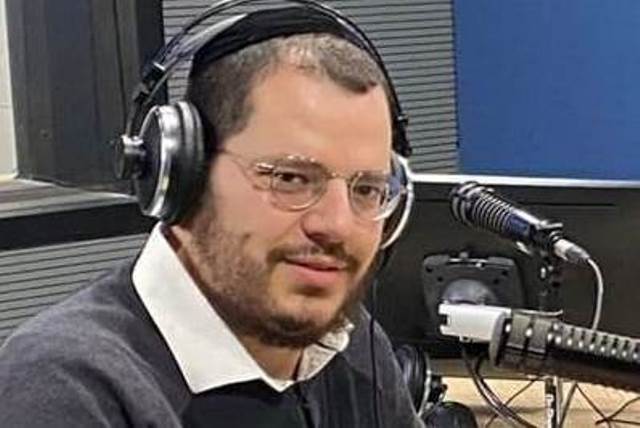
This is perhaps also what led him to the microphone in the Kol Hai radio studio 10 years ago, when he broadcast a personal program for two years - "Sugrim Shevau" (Closing the Week), together with his colleague Shimon Breitkopf. Later, together with Yossi Elitov, he hosted the program "Thursday in Two" on Kol Hai, and starting in 2018, for almost four years, the two have hosted the program "Alitov and Erlich", which airs every Thursday at 7:00 PM on Network B.
Erlich is a frequent guest on radio and television programs, where he appears as a political commentator or an explainer on Haredi issues.
He publishes opinion pieces about the Haredi public and on issues of 'religion and state' in various media outlets. Of particular note are the opinion columns he publishes once a week in 'Yediot Aharonot' - which are promoted on the front page of the newspaper and attract many comments.
Erlich, who also holds the title of author after writing three books, was among the first Haredi journalists to introduce Twitter into the Haredi media discourse. This happened after he realized that as an employee of a weekly newspaper, Twitter was an effective platform for him to express opinions and try to lead a media agenda.
Today, with 44,000 followers, and "Erlich on Twitter" almost a byword, he is particularly active. He expresses opinions on every news topic, writes insights, and on Fridays even publishes Torah refinements on the weekly Torah portion for his audience.