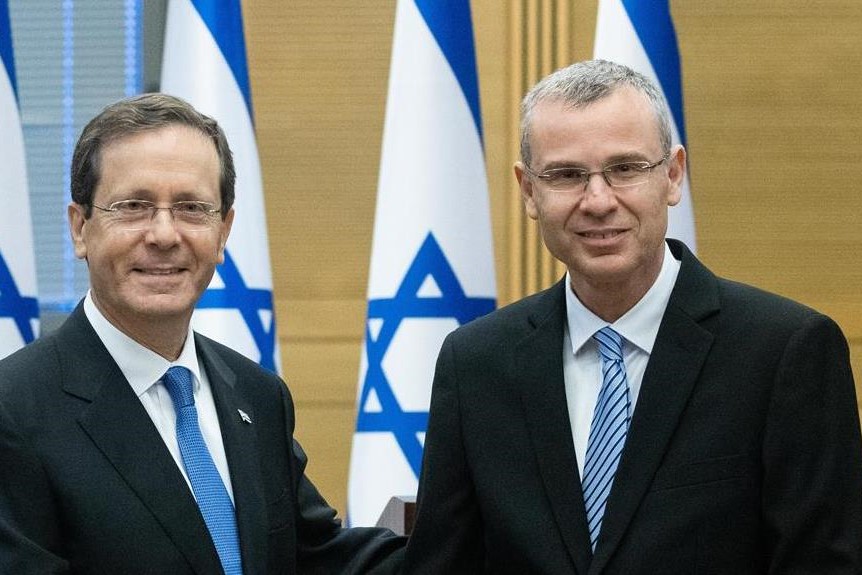
President Yitzhak Herzog and Minister of Justice Yariv Levin have decided to implement a special amnesty plan for those in debt for fines, including in the planning and construction sectors, who have found themselves in a difficult financial situation due to the war and are having difficulty paying their debts during this difficult period of crisis. As part of the plan, relief will be granted in fines for regular and reserve soldiers in the IDF and the security forces, bereaved families and families of those kidnapped, as well as for families of evacuees and those whose homes were damaged in the war - who have found themselves in financial distress due to the war. The plan was born from the understanding that since the outbreak of the 'Iron Swords' War on Simchat Torah, many residents of the country have been dealing with employment and livelihood difficulties - in addition to the heavy costs that the war has exacted from the country's citizens on the front and in the home front. The plan does not prevent applications from being submitted outside of the special plan, so anyone who finds themselves in financial distress will be able to apply for relief according to the normal rules for amnesty applications. The special amnesty outline will also include the unique context of the planning and construction sector, which will emphasize the difficulty in meeting the payment of fines imposed on those who built for residential purposes in localities where there is a significant planning challenge. This outline was formulated in response to requests that arose during the President's visits to bereaved families in the Druze community and Bedouin society, and additional requests to the Minister of Justice, and in response to an appeal by the spiritual leader of the Druze community, Sheikh Mu'af Tarif, to the President of the State, who referred to the difficulty of the women and men of the community fighting in the campaign to cope with paying heavy fines at this time. This outline is intended to express the appreciation of the President of the State and the Minister of Justice to those who serve the state, and to those who risk their lives for the defense of the state, as well as to those who contribute or have contributed a unique contribution to its security, and to those who have lost their most precious thing in the heavy campaign. President of the State Yitzhak Herzog: "These are difficult days. The mourning, grief, and upheaval that we have been going through since the barbaric terrorist attack by the Hamas monsters and the consequences of the campaign that it forced upon us, are mixed with determination, national strength, and faith in the righteousness of the path – to restore security to all citizens of Israel and return the kidnapped home. In these challenging moments – Israeli society has revealed and is revealing itself in all its glory, in cohesion, in solidarity, in boundless mutual guarantee, on the front and in the rear, in all the diverse Israeli communities and throughout the country. The standards that this people are setting at this time are imaginary, and the state and its institutions must meet them in the fullest sense of the word. The launch of the new amnesty outline is based, among other things, precisely on these foundations of solidarity in our difficult time. The institution of amnesty has always been a way to reflect society’s values and needs, and to act beyond the law, in an extrajudicial manner, with those who need it. This reaching out is always needed and necessary, and in unique times, such as war, even more so. The amnesty outline reflects a binding Israeli and ethical convention that I, as President, am proud to express on behalf of the entire people: We must pay attention and direct our heart's attention and supporting hand to those who were harmed by this campaign in the deepest sense of the word, and to those who have mobilized and are mobilizing with all their might for the security of the people and the state. The amnesty outline launched today is one aspect of reaching out on the part of society and the state, and I hope that more and more branches of the state will act in this spirit. Another important aspect of the amnesty plan is the recognition of the Druze community, which expresses appreciation for its contribution to the state in all aspects and to the defense of the state in particular, alongside gratitude to all populations serving in the IDF and the security forces - of all faiths, religions and lifestyles, including minorities in Israel - honors the entire State of Israel and points to the Israeli covenant of life." Justice Minister Yariv Levin: "The amnesty plan is another aspect of the unity and social solidarity that are so necessary for us as a people these days. The plan expresses gratitude to those who serve, the fallen and wounded IDF soldiers, and the murdered and victims of the massacre, and proves the state's commitment to IDF fighters, who fight fiercely to defend the homeland on all fronts. The outline also includes special gratitude to the Druze community, whose members serve in the IDF and protect the country, and to members of the security forces from all minorities. I would like to thank the Honorable President of the State and his team, the Pardons Department at the Ministry of Justice headed by Attorney Limor Goldenberg Hadad, and all partners in this important work.".

 Join the Haredim 10 Facebook page >>
 Join the X page of Haredim 10 >>
 Want more news, videos and stories? Join the Haredim 10 WhatsApp channel >>