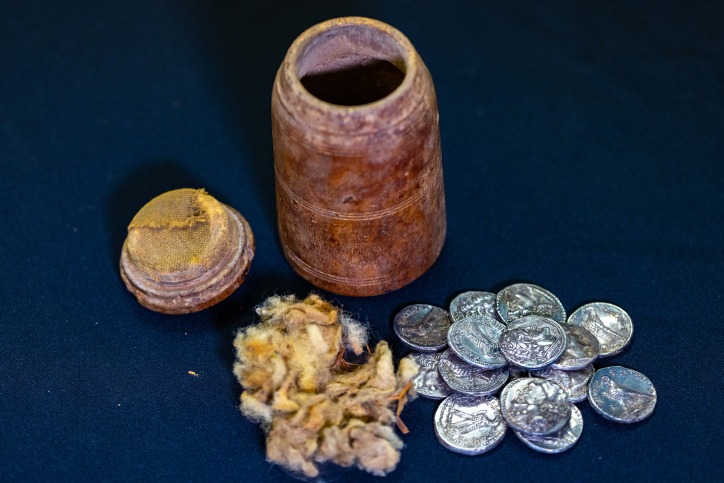
As part of the Judean Desert Caves Excavation and Survey Project managed by the Israel Antiquities Authority and the Civil Administration's Archaeology Department, a salvage excavation was conducted in the Al-Murabet Caves from March to May 2022. Among the many finds, an ancient wooden box made with a lathe, unparalleled in the state's treasures, was discovered in a crack inside a cave. After the lid of the container was opened, it turned out that its upper part was filled with compacted soil and small stones that were pressed to the brim. Under this layer of soil, a large piece of woolen cloth dyed purple was found. The piece of cloth covered 15 silver coins that were arranged in the lower part of the box, and pieces of sheep's wool were placed between them. The hoard, which was cleaned by the Antiquities Authority's artifacts handling department, includes a uniform group of silver tetradrachm coins, minted by Ptolemy VI, king of Egypt. This king reigned over Egypt at the same time as his uncle - Antiochus IV ("Epiphanes"), who reigned over the Seleucid kingdom, including A.I. The three earliest coins in the hoard were minted in 176/5 BC, while the latest coin in the hoard dates to 171/170 BC. On one of the coins was found a handwritten engraving of the name "Shalmai" in Aramaic script. According to Dr. Eitan Klein, the treasure researcher on behalf of the Israel Antiquities Authority, together with Dr. Gabriela Bichovsky, a coin expert at the Antiquities Authority, "It is interesting to imagine who the man was who fled to the cave and hid his personal property there with the intention of returning. It seems that due to the events of the period, the man was killed in battle and did not return to retrieve his property. He waited for us for almost 2,200 years. "This is a unique, unparalleled find, which constitutes the first and clear archaeological evidence that the caves of the Judean Desert served as a scene of activity for Jewish rebels or refugees in the days preceding the Maccabean revolt or at the beginning of the revolt.".
Note: Women appear in the video.
According to Dr. Klein, the books of Maccabees describe several significant dramatic events of that time, which could have sent people hiding their possessions in the wilderness until the wrath passed. One explanation could be the plundering of the temple vessels by Antiochus IV and the destruction of the walls of Jerusalem in the years preceding the Hasmonean revolt. Another explanation could be the religious edicts he imposed on the Jewish people in 167 BCE. The book of 1 Maccabees tells of a group of Jews who fled to hideouts in the desert because of religious decrees imposed on the Jews: "Then many who sought justice and judgment went down to the desert to live there, they and their sons and their wives and their goods, for the evils were great upon them. And it was told to the king's men and the army that were in Jerusalem in the City of David that some who had transgressed the king's commandments had gone down to hideouts in the desert. And they pursued many of them and overtook them and encamped against them and made war on them on the Sabbath day... and they died with their wives and their sons and their goods, about a thousand souls" (1 Maccabees 2:29-33). According to Amir Ganor, director of the archaeological excavation in the cave on behalf of the Israel Antiquities Authority: "The survey and excavation project that the Israel Antiquities Authority has been conducting in the Judean Desert for the past six years is proving itself, and as a result of it we have managed to save thousands of archaeological finds from destruction and looting of antiquities, including fragments of biblical scrolls, arrowheads from the Bar Kokhba revolt, and more.".
Photo: Yaniv Berman and Shai Halevi, Israel Antiquities Authority
[gallery]

 Join the Haredim 10 Facebook page >>
 Join the X page of Haredim 10 >>
 Want more news, videos and stories? Join the Haredim 10 WhatsApp channel >>