The number of verified people continues to break records: Prof. Ran Blitzer, head of the Cabinet of Experts, spoke today (Tuesday) with Golan Yochpaz and Anat Davidov on 103FM, and addressed the claim that has become widespread in the media and the public that the omicron wave, in which severe illness is not high, marks the end of the coronavirus pandemic - and said: "Absolutely not, every day there are enough opportunities for the creation of new strains.".
Where are the coronavirus tests performed? What test is done and when? All the information
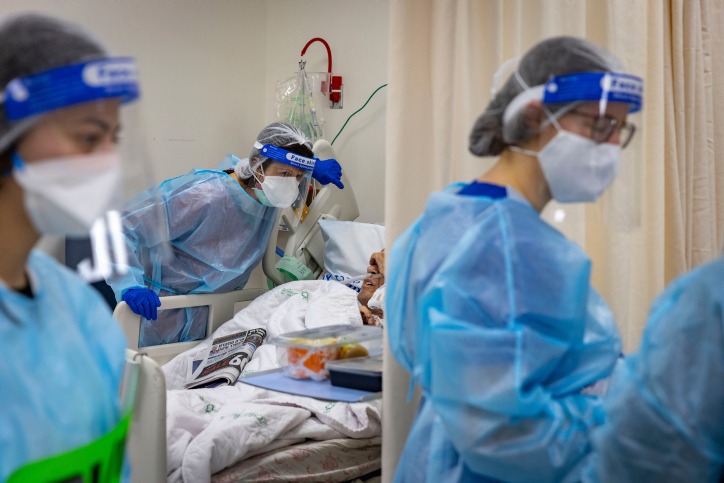
At the beginning of the conversation, he addressed the dissonance between the difficult situation in the emergency rooms and the Corona controversies, and the global feeling that we are on the way out of the pandemic: "There is a gap between where everyone wants to be in a few weeks and where we are now. Some of the differences stem from the fact that the various countries of the world are three to four weeks ahead of Israel in the development of the disease. "The reason for this is that we bought ourselves a month of delay in the spread of Omicron in advance. If most countries have passed the rising part of the wave and are in the moderation phase, we are at the peak, in everything related to the hospitalization system and the seriously ill, we are still before the peak and we are in for complex days." Later, he was asked whether the state was wrong in taking the steps - and he replied: "No, it is impossible to say that we were wrong and on the contrary, it was one of the rightest decisions made. Those weeks that we bought at the beginning allowed us to prepare so that the situation is currently much less bad than the potential. The first thing was the purchase of medicines that were given to thousands of patients. This is a life-saving treatment that prevents 90 percent of the severe disease. The second thing is the completion of the vaccination campaign for both children and the fourth vaccine given to the high-risk population. "Insufficiency is a problematic term because people imagine the events in Italy in April. I think that unfortunately it is a softer thing. There is a gradual process of decreasing the capacity for quality care in the wards and in the community," he said, referring to the fear of insufficiency in hospitals. "In the past, there was talk that from 500 seriously ill patients, the quality of care begins to decline, and we are now at 800. During this period, the capacity of the system and treatment improved, and there was also significant preparation. The patients who are arriving now, the seriously ill patients, are different patients from those who arrived in the Delta wave and previous waves, because while Omicron does produce severe morbidity, it is less critical morbidity that is manifested in ventilation and in patients with a deteriorated pulmonary condition. "The load is heavy and there is a loss in the quality of care, but the challenge is mainly on the internal medicine and geriatric departments, rather than on the intensive care and ECMO departments as we saw in the previous round." Regarding the cancellation of the students' isolation starting this Thursday, he expressed opposition: "The cabinet of experts was not consulted before the decision to change the approach. I must say that my concern about making the decision at this time stems from a potential negative change in the scope of infections and a significant increase in infections in nursing homes. "I would reject it for two reasons, because we are waiting for information coming from the world regarding the incidence of PIMS syndrome, and in the coming week the information that will teach us about the risk should accumulate.".
Where do you stand regarding the fourth vaccine for the entire population?
""The hesitation stems from the fact that, on the one hand, the initial results of the Ministry of Health indicate that the effective vaccine significantly reduces severe morbidity for people infected with Omicron, so this is definitely desirable. There is no dramatic concern that would make us want to not allow those who wish to be vaccinated to do so, but the strong recommendation to vaccinate right now, in my understanding, should still be for people in at-risk populations for whom Omicron poses a significant danger. In the general population, the risk of severe illness is lower." On the World Health Organization's assessment that we are seeing the beginning of the end of the pandemic: "I think we are at the beginning of the end of the Omicron wave. As long as Omicron is the dominant strain in the world, the current wave will not change, we will not see another huge Omicron wave in the foreseeable future. "We know that as long as millions of people in the world are infected every day, there are enough opportunities for the creation of new variants. There have been at least three such events in the last two years, and there is no reason to assume that this will be the last. We can hope that this will be the last.".

 Join the Haredim 10 Facebook page >>
 Join the X page of Haredim 10 >>
 Want more news, videos and stories? Join the Haredim 10 WhatsApp channel >>



