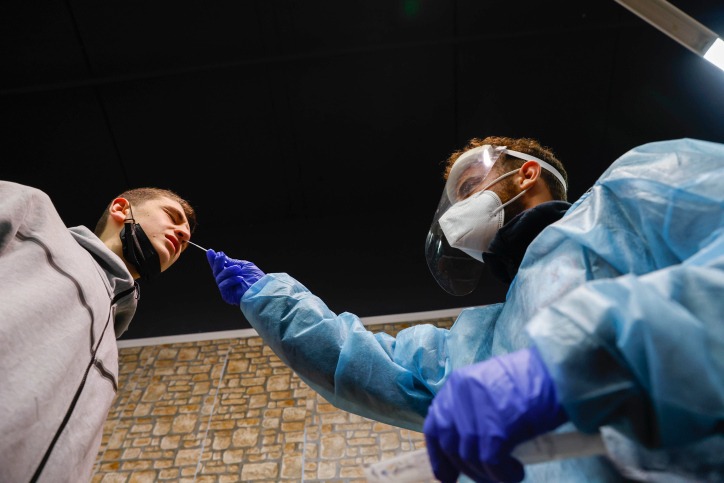
The Ministry of Health announced today (Wednesday) a change in the outline of coronavirus testing, under which vaccinated people will be tested with antigen at home, while those aged 60+ and at-risk populations will perform PCR tests.
Did you divide? For thousands of years we dreamed of Jerusalem, so now we want to dirty it?
On Saturday: The mother rested, the child pulled the trigger – and was hospitalized in serious condition
Are you crazy? Is your child unprotected? One in every 150 children who contracted the virus was hospitalized
Dr. Orly Greenfeld, medical director of the Information Headquarters for the Fight against the Coronavirus, spoke with Anat Davidov on the program 'Where is the Money' on 103FM - and explained the circumstances for the change. "These changes are like the decisions that have been made recently, during a pandemic that is constantly changing, with a lot of dynamism in the form of the pandemic. Both in what we see on the ground, in terms of morbidity and ultimately in the decisions. We understand that we are in a wave with a very rapid outbreak, morbidity that is rising very much, and along with that also some kind of limitation on the number of PCR tests we have in the country to verify the patients." According to her, "We need to distribute the tests differently. There is also a lot of personal responsibility here for each and every one. But I want to point out that in the end, there is no change compared to what has been the case up until now in 'who needs to go into isolation and who doesn't,' and it is very important to understand this. Anyone who is vaccinated or recovering needs to get tested, and if it is negative, they do not need to go into isolation. "In terms of isolation - those who are not vaccinated, take a test and go into isolation. Those who are vaccinated take a test, if it is negative, they do not go into isolation. Now the question is which test - if you are without risk factors or under the age of 60, then you can - if you are vaccinated - do an antigen test that is at home or at one of the antigen stations that are scattered throughout the country." Referring to the reliability of the tests, she said: "There is no doubt that the most reliable test is the PCR test, but the antigen test also detects both the Omicron variant and the Delta variant. It is less sensitive. There are certain cases where we can see that people came out negative, but they are actually not negative. "Usually we see this in people in whom the virus is less expressed in the body, more at a low level, and then it detects it less. That does not mean that they are not confirmed, they can really still be carriers of the virus, but the test will not detect them. Usually these are people who will be asymptomatic. "We think that maybe they will also be less contagious, so there is some kind of taking a certain risk here, but it is a calculated risk, because ultimately we have to manage this pandemic with increasing morbidity and a certain shortage of tests. That is why we say, we prefer to first identify those who are at risk. And we say - even if you tested negative and you are symptomatic and you are vaccinated, stay home, don't go around." She added: "I don't want people to go around with a cough, with a fever, even when they test negative. If you are exposed, even if you test negative in PCR, you will still be kept in quarantine for a week or two afterwards. Don't be with people who are at risk, keep wearing a mask all the time. We know that even a test done immediately after exposure or a day after exposure, even a PCR test, we cannot say in 100% 'you are negative and you will not be contagious,' so we really need responsibility here. We are now in a pandemic.".
""We have no information about the fourth vaccine""
Dr. Greenfeld then addressed the sharp spike in morbidity: "This is certainly similar to the predictions we made a few days ago. Every three days the number doubles, and now we are at almost 12,000, which means that within a week we will be at 50,000 or more. This means that ultimately there will also be more hospitalizations, more burden on the system. "We know that even when the morbidity is mild, it sometimes has long-term effects and complications, all of which we want to prevent. At the same time, we want to identify as quickly as possible the patients who could deteriorate into a serious illness, who could deteriorate into hospitalization." The medical director of the information headquarters for the fight against the virus also said: "Every virus has a certain peak and begins to decline naturally, but we don't know when the peak will be. We don't want it to cost too much by the time we reach the peak, in terms of a lot of patients, seriously ill patients, a burden on hospitals, and people who are at home. Even if we're not talking about those in isolation, 56,000 active patients today are at home in isolation because they are sick. "We don't want a herd vaccine and we don't want to release people and we don't want everyone to be sick. We do want to continue living as usual as possible. We want them to continue their studies and continue to work, and for people to continue to live, and that is, to live alongside the coronavirus. But not to live in a way that allows everyone to get sick, because there are consequences for this disease. There are long-term consequences, there are consequences of a burden on the health system, we want to prevent all of these things.".
According to her, "We say, 'We are not doing a lockdown,' but we are taking all kinds of isolation measures, of testing to locate as many patients as possible who need to stay home and not expose others. So we are definitely making efforts, doing all kinds of tests. But at the same time, we are trying to see how we can steer between living alongside the coronavirus, but not allowing it to break out in a way that we will no longer have control over." Dr. Greenfeld referred to the public's response to the fourth vaccine: "We have over 74,000 people over the age of 60 who have been vaccinated with the fourth vaccine. We already have tens of thousands of others who have already made an appointment. The fourth vaccine has a very high response rate among the population over the age of 60. We have no information about the fourth vaccine, we are the first in the world, and again making a decision with risk management when we understand that the vaccine, on the one hand, apparently has no side effects for the fourth vaccine, just as there have been no side effects for vaccines so far. "We see the seriously ill patients, we see the medical teams that we don't want to get infected and infect others. Therefore, with the decrease in vaccine effectiveness after a few months of the third vaccine, it is right in certain situations to recommend the fourth vaccine.".

 Join the Haredim 10 Facebook page >>
 Join the X page of Haredim 10 >>
 Want more news, videos and stories? Join the Haredim 10 WhatsApp channel >>
