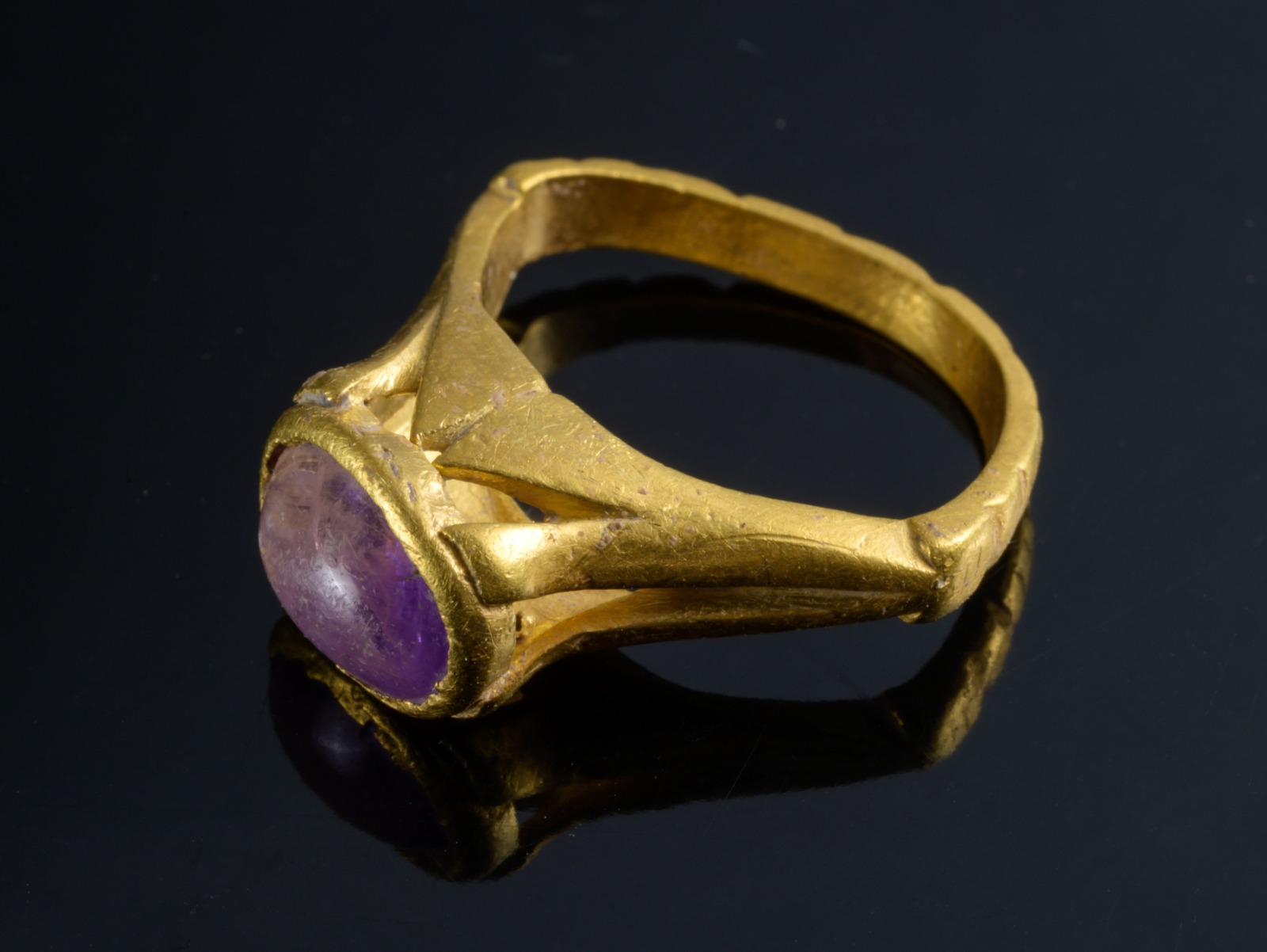
In the huge excavation being conducted by the Israel Antiquities Authority in Yavne, at the initiative of the Israel Lands Authority and in cooperation with the Yavne Municipality, in preparation for the expansion of the city, a spectacular gold ring was recently uncovered, with an inlay of a purple stone.
Home Front Command in a major exercise: Are you ready for an emergency? This is how you will do it
Alarming: 751% of those who died from the coronavirus under the age of 60 were not vaccinated
Employers can receive a financial incentive of up to NIS 22,250. How? Enter
An examination of the ring by Dr. Yotam Asher at the analytical laboratory at the Israel Antiquities Authority revealed that the stone is composed largely of silica - a material that many gemstones are made of. This examination ruled out the possibility that the purple inlay was made of simple glass. The ring weighs 5.11 grams. Dr. Amir Golani, an expert in ancient jewelry at the Israel Antiquities Authority who examined the find, said: "The person who owned the ring was a wealthy person, and wearing the jewelry indicated his status and wealth. Such rings could have been worn by both men and women." Golani adds: "The ring is set with a semi-precious stone called amethyst. This stone is mentioned in the Bible as the amethyst - one of the 12 breastplate stones that were used by the High Priest in the Temple. Many properties were associated with this gemstone, including preventing the side effect of drunkenness - the hangover." This property attributed to the stone is particularly interesting, given the context in which the ring was discovered - a site where a huge wine winery operated, the largest in the known world from the Byzantine period. "Did the person who wore the ring want to avoid getting drunk due to drinking too much wine? We will probably never know that," says Dr. Eli Haddad, who is leading the excavation together with Liat Nadav-Ziv and Dr. Yohanan (John) Seligman from the Israel Antiquities Authority. "Nevertheless, it is interesting to know that the ring was found near the winery, about 150 meters away, where excavations revealed "Ours are the remains of a long warehouse, which was used to store wine jars (amphorae). Some of the jars were found upside down, and it is possible that this was a warehouse stocked with empty jars before they were taken to the wine presses to be filled with wine. It is possible that the magnificent ring belonged to the owner of the magnificent warehouse, a foreman on site, or simply a visitor who had the misfortune of being there, and the precious ring fell out of their hands, until it was finally discovered by us." There is some debate among researchers regarding the dating of the ring. It was found in a fill that probably dates to the end of the Byzantine period - the beginning of the early Islamic period - the 7th century AD, but it is possible that the ring, due to its beauty and prestige, "rolled" from hand to hand for centuries. Gold rings set with amethyst are known in the Roman world, and it is possible that the ring belonged to a member of the upper class who lived in the city as early as the 3rd century AD. [Gallery]

 Join the Haredim 10 Facebook page >>
 Join the X page of Haredim 10 >>
 Want more news, videos and stories? Join the Haredim 10 WhatsApp channel >>