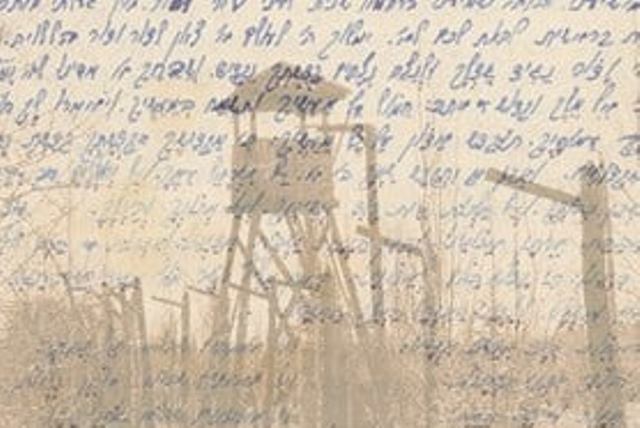
On Yom Kippur in 1951, my father, Rabbi Moshe Greenberg, of blessed memory, prayed all the Yom Kippur prayers. All of them, except for one that is considered the most serious and important prayer – Kol Nidrei. He was twenty years old and a prisoner in a Soviet labor camp in Siberia. His 'crime' was that he tried to escape from Russia. He dreamed of leaving Russia and reaching the Land of Israel. But he was caught and sentenced to 25 years of hard labor. He was separated from his parents and two sisters. His brother was already imprisoned in another camp for a similar "crime." There were about 1,000 people in my father’s camp, and they were all working on building a power plant. About twenty of the prisoners were Jewish. As the summer was coming to an end, the Jewish prisoners began to plan how they would celebrate the upcoming holidays. They knew that they would have neither a shofar, nor a Torah scroll, nor tallit, but they hoped that they could find a siddur. My father located an "outsider," an engineer who worked in the camp on various projects. He thought this engineer might be Jewish. He waited for a suitable moment to approach the engineer. "Kaensto mir oshf tsev tsev?" ("Maybe you can help me?") he whispered to the man in Yiddish. At that time, most Russian Jews spoke Yiddish fluently. He saw a glimmer of understanding in the engineer's eyes. "Could you bring me a prayer mat for the Jewish prisoners here?" my father asked him. The engineer hesitated. Such an action would put both their lives at risk. Nevertheless, he agreed to try. Several days passed. "Any developments?" my father asked. "I have good news and bad news for you," the engineer replied. Despite the great difficulty involved, he located a mat for the High Holidays, but it was the only mat belonging to his partner's father, and when his daughter asked him to give it up, he was furious. Maybe she had told him what she wanted it for, or maybe not. But my father did not give up. Perhaps, he suggested, the man would lend him the book and he would copy it and return it in time for Rosh Hashanah? The engineer smuggled the Machzor into the camp and gave it to my father. To copy it, my father built a large wooden box and crawled inside for several hours each day. There, hidden from view, he copied all the prayers. Only one page was missing – it was the page for the "Kol Nidrei" prayer, the first prayer said on Yom Kippur. My father returned the book and autumn arrived. From letters received, the Jewish prisoners learned when the dates of the holidays would apply, and when Rosh Hashanah came, they bribed the guards – probably with cigarettes – to allow them to remain in the camp and conduct the prayer ceremonies. With the handwritten Machzor, my father served as cantor, reading aloud while the others repeated after him in low but solemn voices. Seven days later they met again for the Kol Nidrei prayers, but despite their efforts, none of the participants were able to remember all the words of the prayer. After almost seven years in prison, following the death of Joseph Stalin, my father was released along with all the political prisoners. The only item my father took with him when he was released was the mashrut. He returned to his family who lived in the suburbs of Moscow and later married. In 1967, when I was a baby, 15 years after his release from prison, my family received the long-awaited permission to immigrate to Israel. The mashrut immigrated to Israel with us. My father, who lived in Bnei Brak, did not like to remember those difficult and painful years in Siberia. But on the rare occasions when I heard him talk about that period, he declared with tears in his eyes that he had never participated in prayers as meaningful as those he had participated in during his imprisonment.
•
In 1973, he visited the Lubavitcher Rebbe in New York and gave him the Machzor as a gift. A few years ago, I visited the Rebbe’s library and found my father’s Machzor. I looked at the book, which was covered in old pages and the letters written with such haste and respect and determination. I took a photo of it – with a photocopier. On Yom Kippur this year, when I lead the prayer at the Chabad Center in Solon, Ohio, I will bring with me a copy of my father’s Machzor from which the Kol Nidrei prayer is still missing. My father was unable to say "Kol Nidrei" during his years in prison. This year, I will ask my community, and all of us, to say this prayer for him and for anyone else who does not have the opportunity to do so. • Rabbi Zosha Greenberg is the rabbi and spiritual leader of the Chabad House in Solon, Ohio

 Join the Haredim 10 Facebook page >>
 Join the X page of Haredim 10 >>
 Want more news, videos and stories? Join the Haredim 10 WhatsApp channel >>