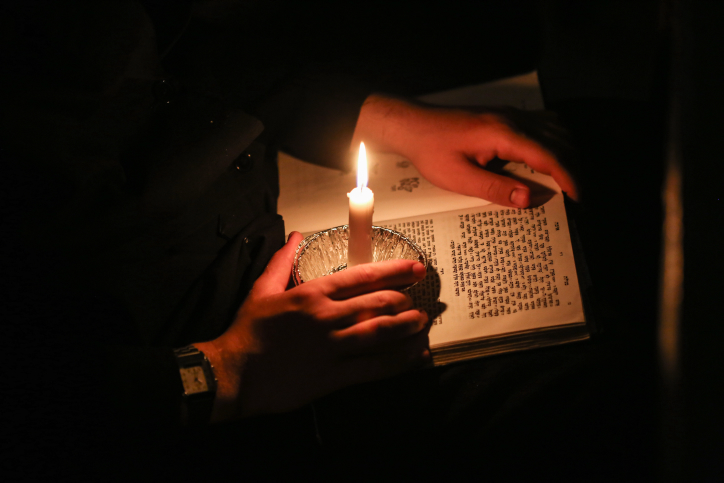
One of the reasons for the alienation that many in the general public feel towards the days of mourning for "Bein HaMezrit," which culminate on Tisha B'Av, stems from the fact that these days fall in the midst of summer vacation.
 Want more news, videos and stories? Join the Haredim 10 WhatsApp channel >>
Therefore, they are not embedded through the education system.
Although the state education system provides very little information about the Jewish holidays in general, there is still some educational activity around them, and the student absorbs their importance. However, the days of "Bein HaMazirit" in general and Tisha B'Av in particular are not taught at all in the system, and it is no wonder that these days mean nothing to the products of this education system.
The Story of Jewish Suffering
If you ask an average young Israeli how important it is to commemorate Holocaust Remembrance Day, you can assume that the answer will be clear and unequivocal. Will it still be important to commemorate it in a hundred or two hundred years? This question will also probably be answered in the affirmative.
Every Jew understands that the Jewish people must forever remember what the Nazi oppressor did to them.
And shouldn't the Jewish people celebrate the day that drains into it all the sorrow and pain of Jewish history? The terrible Holocaust is just one chapter, albeit a terrible and horrifying one, in the story of the unimaginable suffering of the Jewish people, embodied in Tisha B'Av.
The Mishnah lists five calamities that befell the people of Israel on Tisha B'Av: Our ancestors (in the wilderness generation) were forbidden to enter the Land of Israel. The First Temple was destroyed. The Second Temple was destroyed. The city of Betar was captured. Jerusalem was plowed up after the destruction.
Over the generations, other unfortunate events have occurred on Tisha B’Av, and the most difficult of all – the expulsion from Spain. This happened 529 years ago, when King Ferdinand of Spain decreed that no Jewish foot would remain on Spanish soil until August 2 (1492). That day – Tisha B’Av – was.
To this difficult list, we can add another disaster today – the destruction of the Gaza Strip communities, following an unfortunate decision by the Israeli government. This destruction and the expulsion of ten thousand Jews from their homes was also scheduled, ironically, for Tisha B'Av.
Tisha B'Av thus commemorates Jewish suffering for generations. You don't have to be a devout Jew to understand its importance. It was supposed to be a pivotal day in the assimilation of Jewish history and our collective memory as a people.
When the media wants
This is not only an educational failure, but a major miss by the media. Every year, on Holocaust Remembrance Day, the media demonstrates its power to shape consciousness and pass on memory from generation to generation. The extensive articles, the special broadcasts, the mournful songs – are an example of the ability to cultivate awareness and prevent forgetting.
Imagine if on Tisha B'Av the entire media were wrapped in mourning and united with the long-standing Jewish grief. What an impact that would have had on all of us.
Mourning for the destruction and exile also fosters the expectation of true redemption, which will give meaning and significance to the incomprehensible suffering of the Jewish people. That is why the Sages linked the two: "Everyone who mourns for Jerusalem is rewarded and sees her joy" - from the memory of the destruction, the great redemption will soon emerge in our time.