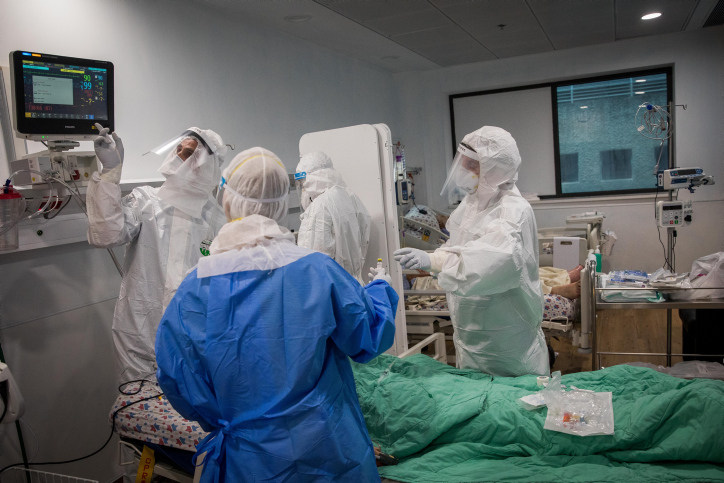
In these days, when the entire world is dealing with the new pandemic, the Jewish people's special attitude towards human life is clearly expressed. Comparing the policies adopted in medical centers in Israel with those in other developed countries, brings us to the realization of how much we should thank the Creator that we live here and not somewhere else.
The dry reports on deaths from the virus repeatedly state that the deceased suffered from underlying illnesses.
But what exactly are these 'underlying diseases'? It is natural for older people to carry 'underlying diseases' with them, such as diabetes, heart failure, joint problems, and the like.
But in everyday life they are considered healthy, active, functioning. Maybe they go to the doctor more, so what? They enjoy a good life, and can live many more years and be content with their offspring.
This is actually the great danger inherent in this virus, that while young and healthy people will usually recover from it without the need for special treatment, the general population, such as the elderly and those with underlying diseases, may develop complications that could worsen their condition to the point of being life-threatening.
The sanctity of life in Judaism
And here we hear voices around the world saying, some bluntly and some more subtly, that this is the nature of the world: elderly people die from various diseases. Some from the flu, some from pneumonia, some from heart attacks, some from strokes, kidney failure and many other diseases. And now they are dying from the coronavirus. The dead will die and life will go on.
Based on this approach, some countries have decided not to connect patients over a certain age to ventilators. There are shocking reports of elderly people being left in their beds without food, and they are starving. Medical teams are putting themselves in the role of God and determining who will live and who will die.
Here, thank God, this terrible attitude does not exist. We look with admiration at the medical teams who fight like lions for the life of every patient, no matter their age or their 'background illnesses'.
There is no doubt that this approach is derived from the concept of the sanctity of life in Judaism. The sources deal extensively with dilemmas in which logic is supposed to argue that the life of a particular person should be preferred over the life of another.
And Judaism establishes a sharp and clear position – the sanctity of life is absolute and not subject to rational considerations.
Non-negotiable
Logic could argue that the life of a young person is 'worth' more than the life of a ninety-year-old. First, life is still ahead of him. He has small children. His contribution to society is supposed to be greater. And many other reasons could be listed.
But all these arguments are completely irrelevant, because the sanctity of human life is not measured by qualitative indicators, but is absolute.
The Torah states: "You shall not take a soul for a soul," because human life is not negotiable. In human terms, one person's life may seem miserable compared to another's, but what do we know about the true nature of life?.
Therefore, we must do everything to save lives, and not consider any considerations of benefit. We are pleased that this is the policy followed in Israel, and there is no doubt that it makes a real contribution to the high recovery rate, which other countries can envy.
 Join the Haredim 10 Facebook page >>
 Join the X page of Haredim 10 >>
 Want more news, videos and stories? Join the Haredim 10 WhatsApp channel >>