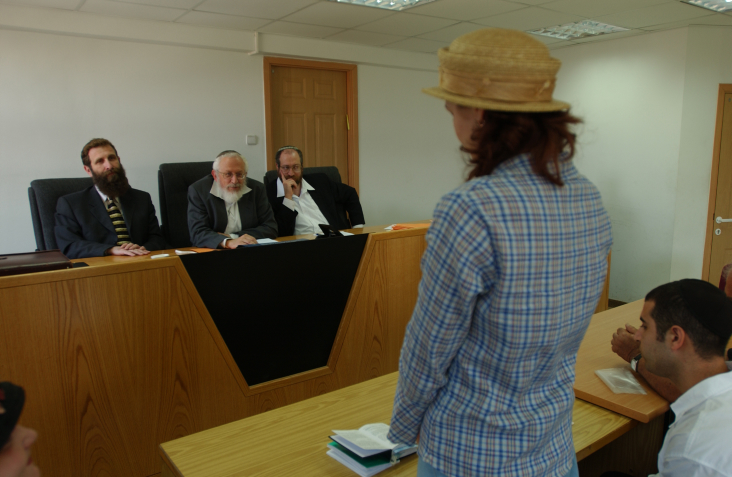
The administration of the Rabbinical Courts publishes today (Tuesday) the annual summary of the activity of the Rabbinical Courts in 2018 - a fascinating document about Israeli society and the sociological processes in family life.
In 2018, there was an increase in the number of couples who divorced in Israel through rabbinical courts: 11,145 couples divorced compared to 10,661 couples who divorced in 2017. In other words, a 51% increase in the number of couples who divorced in Israel.
A local breakdown shows that 733 couples divorced in Jerusalem this year, a decrease of 71% compared to last year. In contrast, there was a noticeable increase of 161% in the number of couples divorcing in Tel Aviv, where 750 couples divorced, even though Tel Aviv's population is significantly smaller than Jerusalem's.
The lowest number of divorce cases was recorded in Even Yehuda, where only 18 couples divorced, in Alpi Menashe 20, and in Ma'alot 19.
And what is happening in the ultra-Orthodox cities?
In Bnei Brak, 181 couples divorced in 2018, compared to 151 in 2017.
In Elad, 61 couples divorced this year, compared to 47 the previous year - a jump of 301%.
In Modi'in Elite, there was a 2013 decrease in the number of divorces: 35 couples in the past year, compared to 44 couples in 2017.
In Betar Elite, there was a drastic decrease in the number of divorcees: 31 couples divorced this year compared to 61 the previous year - a decrease of 491%.
In 2018, 95,825 cases were opened in rabbinical courts, compared to 95,000 the previous year.
In 2018, no fewer than 101,075 cases were closed in the rabbinical courts, compared to approximately 95,000 cases that were closed the previous year.
The summary of the data shows that in 2018, 4,102 files were opened for divorce claims and 8,626 files for joint requests for approval of divorce agreements.
7,857 applications were opened to resolve a dispute between spouses. Nearly 3,000 cases were filed for alimony, about 1,500 for the division of property, and nearly 2,000 for child support and custody.
Approximately 1,000 cases dealt with the issue of paternity recognition. In addition, 3,127 inheritance cases and requests for the execution of a will were opened in the rabbinical courts.
Approximately 3,500 cases were filed on the subject of clear Judaism.
There is a continuing trend toward reducing the number of agunot: the special unit of the Rabbinical Courts' administration on the issue of resolving agunots succeeded in obtaining divorces for 149 women whose husbands disappeared in Israel and abroad. The reduction in the phenomenon of agunots is reflected in a 25% decrease in the number of referrals to the Agunots Division of the Rabbinical Courts' administration.
In 2018, the Agunot Division invested tireless efforts to reduce the phenomenon and enlisted the help of three private investigation companies to locate divorce refusers in Israel and abroad.
In 2018, the courts acted decisively to deal with the phenomenon of divorce refusal: this year, they issued 156 restraining orders, including orders to delay leaving the country, prevent the management of a bank account, deny a driver's license, prevent appointment to a public office, and more. It should be noted that 117 restraining orders were imposed against 26 men who refused a divorce, as well as 39 restraining orders against 8 women who refused a divorce. In 2018, three prison orders were issued for divorce refusers.
This year, 56 petitions were filed with the High Court of Justice against the decisions of the rabbinical courts. All petitions were rejected and not a single petition was accepted.
 Join the Haredim 10 Facebook page >>
 Join the X page of Haredim 10 >>
 Want more news, videos and stories? Join the Haredim 10 WhatsApp channel >>