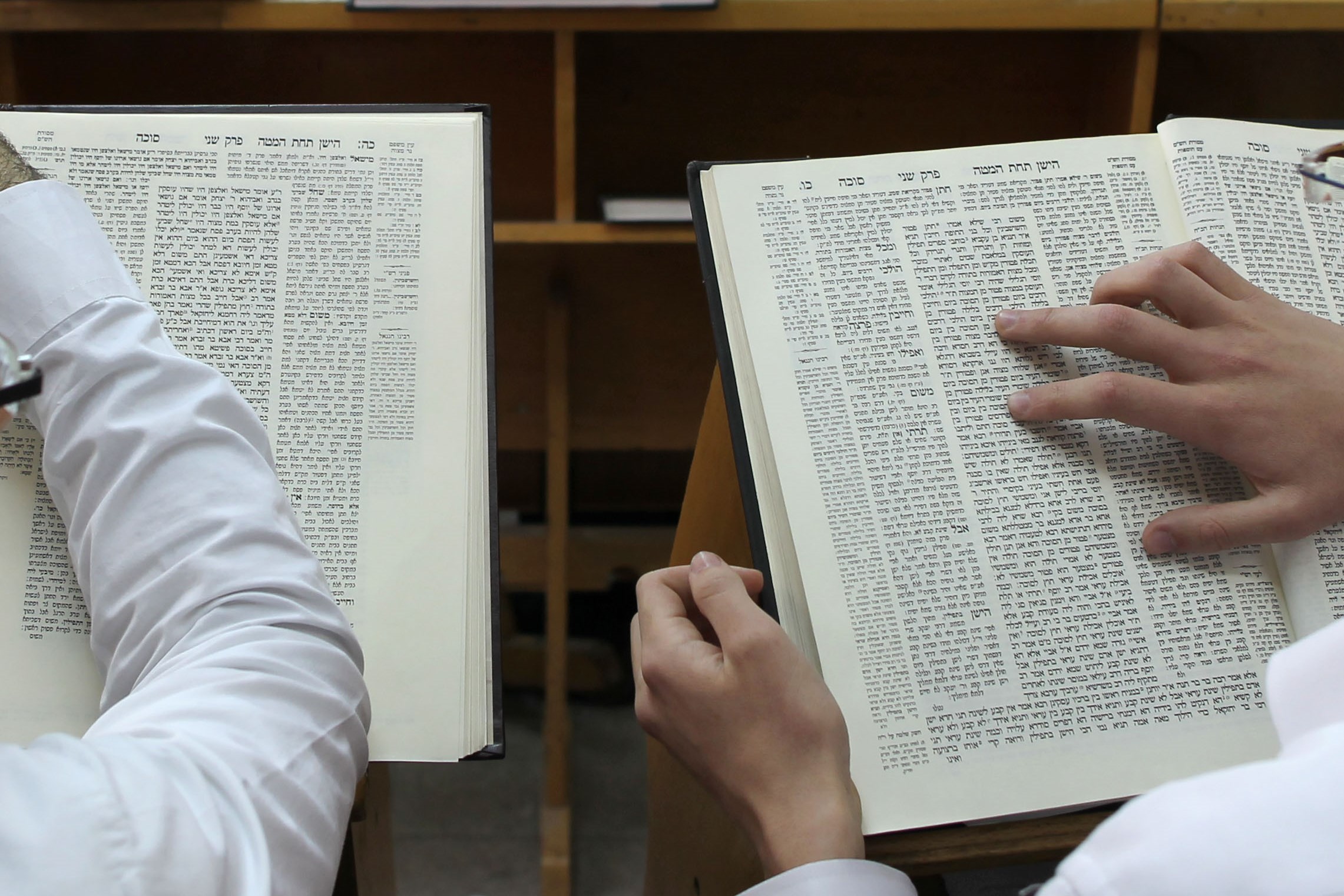
I don't know you, Didi Shor. But, like many, I've glanced at short excerpts that have been circulated from your research on the yeshiva world, and I think I get the idea.
First, let me clarify: I have no anger towards you. I assume you work for a living, which is fine; I also imagine that in order to make a living you need to be able to do your job well, to bring in items that will garner high ratings, and this item, about yeshivas and apartments, definitely brought in ratings.
What does hurt me, and I just want to express my pain: I read in the various groups the reflections written by people who spoke with you, who tried to understand what led you to the findings presented on Amnon Levy's 'True Faces' program, and I realized that you truly, sincerely and honestly believe what was presented on the program; that you truly believe, after the in-depth research you conducted, that a Lithuanian guy is studying to get an apartment.
I assume that you, or other researchers, came to the yeshiva and talked to the guys. And yes, I believe that's really what they said. The question is, do they represent the Lithuanian yeshiva world?
•
Let's go back eighty-ninety years, to the great city of Volkovyst in Lithuania, where a woman named Deborah lived and dreamed of a life of Torah for her son. When she heard about the yeshiva of Maran 'HaCafetz Chaim', she decided that this was exactly the place where Shalom, her beloved son, would study.
Together, mother and son set out on a journey, on the way to the world of Torah. She wanted to see with her own eyes that everything was arranged for the better. The road was very difficult. The bumps shook the cart. The mother, who was about to give birth, did not feel well. From time to time, her son looked at her with searching eyes, amazed at the sight of her immense determination. This journey, he would later say, left its mark with determination on the tablet of his heart. The dedication of a Jewish mother for her son's Torah studies.
This was his first journey on the path of the Torah. In his 94 years of life, he never stopped walking on this path for a moment. Despite the difficulties, despite the occasional bumps and bruises. This man, Didi, is my grandfather, the late Rabbi Shalom Galai. For years he used to tell me this story. I remember myself as a little girl looking at him with thoughtful eyes and dreaming of my journey with my son, on the path to the world of the Torah.
No, Didi, no one guaranteed apartments back then for Torah study. When he studied in the wee hours of the night, until his last day on earth, somewhere in a small apartment in Haifa's Halissa, no one paid for it. He studied because he understood what Torah was.
So it is true that out of respect for the Torah, and out of a way that was created, out of tacit agreement, somehow it came about that in the Lithuanian world, parents customarily give an apartment to their son-in-law, a Torah scholar. But is that why he sits and studies?
Did my two children, who studied the pages of the Gemara while studying in yeshiva, do it 'for the money'? No way. They did it because it was their mother's dream, since her childhood.
Does my son, who grew up to be the father of three sweet children, sit and study his Talmud every day, from morning until night, for the money? And if he went into the business world, wouldn't he earn more? And his wife, who supports their family with daily manual labor in a shop she built with her own ten fingers, does her devotion to his study stem from some financial consideration?
A stranger will not understand this.
•
""Live, give him something to eat right away," the Chafetz Chaim would ask the maid who worked in his house, pointing to my grandfather. He was anxious about every moment of abrogation of the Torah. For my grandfather, every such sentence was a milestone. A side of the spirit on the journey of life. A life of Torah.
This is the baggage he also gave to me, his granddaughter. We grew up on this.
Every child I gave birth to, I would take it in a stroller and bring it to my grandfather's house. He never used to sit with us and keep us company. He would say 'Shalom', ask how we were, and then go back to hunching over the Gemara with its tattered pages.
And I would place the baby stroller next to Grandpa's chair so he could soak in it. So that the atmosphere of the Torah would enter his soul. And no, not so that one day he would get an apartment. Believe me, there are better businesses in the world.
In the world you came from, Didi, it is customary to go out on business or on a mission about a year after the wedding. In the Lithuanian world, where I came from, it is customary to cling to the yellowing pages until old age and return. Only those who have not succeeded throw up their hands in despair and go out into the world of work. The pure aspiration is to win, to manage to make a living somehow, to reduce oneself, to be content with little, and to win the right to study Talmud for the rest of one's life. Despite the pressures. Despite the difficulties.
This is so different from what you described in your research, if I understood it correctly.
What a shame you didn't get to interview young men whose only ambition is Torah for Torah's sake. Many of them have no idea exactly how they will manage financially, and they leave this pursuit in the hands of their parents.
•
I remember how, immediately after my grandfather's funeral, a woman approached us, all sobbing. "As a little girl, I was in the throes of those days," she poured out her heart. "My father would always tell us about Rabbi Sholem's Torah study. More than once it happened that we would return from a family wedding. And as in a Hasidic family, it would be after the 'Mitzvah Tanz' dance and very late at night. Father would then take us to the balcony window, instructing us to look into the Galai family's apartment. There, through the window, the light was on in the hallway. At the table, as usual, your grandfather was sitting, bent over the Gemara. He did not stir or move. Only once in a while was there any movement visible. When he turned another page. In those moments, we, the little ones, knew what Torah was.".
Because indeed, it was difficult to see him when he was not studying. The Gemara became a part of him. And from his childhood. Once, when he arrived at the great synagogue in Halissa, the door was locked. And as was natural, he crawled through the high window with great difficulty, jumped to the floor of the synagogue and sat down to study. Thus the sun found him sitting on his Talmud, inside the locked place, and he was puzzled as to how he got inside.
He was surprised, but understood.
Because he knew, as everyone knew: nothing in the world would succeed in blocking Rabbi Sholem's path to the place of his Talmud.
•
Believe it or not, people like this still live among us. People whose entire essence is Torah. I see them all around me, where I live, in Modi'in Illit. Houses with peeling walls, their furniture long since worn out, but the Torah is soaked in souls. Yes, it is possible that this apartment was given to my father as a gift from his father-in-law. But was that why he sat and studied in his early years? If that is indeed what you claim, how do you explain his continued diligence despite the hardships and poverty?
I would suggest you, Didi, go on a journey. Visit homes in Kiryat Sefer, in the hills, go to more yeshivahs that you may not have tried to visit, catch quiet guys who will give you answers that are completely different from the ones you received.
But, on the other hand, I don't suggest it to you. I know that none of these people will cooperate with your plan. So in the meantime, I volunteered to be here for all those who chose the resounding silence.
 Join the Haredim 10 Facebook page >>
 Join the X page of Haredim 10 >>
 Want more news, videos and stories? Join the Haredim 10 WhatsApp channel >>