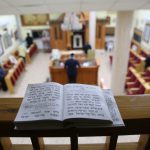
Tisha B'Av.
Destruction that became a slogan.
Tisha B'Av face, Tisha B'Av shoes, Tisha B'Av heat. And nothing about the matter itself – 'Tisha B'Av'.
We grew up, we grew old. The stories of the destruction remained somewhere in our childhood years, in kindergartens and in stories of the dead. The siege of Jerusalem is long behind us. Only Lent and the fast are still lingering in our minds.
We all know when the 'Three Weeks' occur and we all know the customs of the 'Nine Days' and even the 'Week in which it occurs.' We all have a version of Dinkuta that we grew up with and thanks to which we matured. Even advertising companies, somewhat ironically, allocate advertising space these days to dairy companies. How naive.
It is likely that if you don't have children of the right age, you haven't heard about Kamtza and Bar Kamtza this year, and you have no idea what the current minyan is for the destruction. Incidentally, this information, even with the help of a kindergarten child, is difficult to obtain.
Maybe that makes a little sense. Being happy is easy, you can always enjoy a good meal, and aim for the commandment 'and be joyful on your holidays.' But being sad, to put it mildly, is not the most pleasant feeling. Make no mistake, for the most part we are much sadder than happy. We invest less energy in sadness than in joy. But we have a harder time creating sadness by force for something that seems distant to us. There is nothing we can do, joy is joy.
*
In the courts of the Hasidim, there is a story about the "angel." One of the disciples of the Baal Shem Tov, many wondered about the nickname that was attached to him, until one of the Rebbes followed him and saw him on the night of Tisha B'Av. As soon as the word "weep" was heard, he placed his head between his knees and did not raise it all that night, and there were rivers and rivers of pure tears flowing under his seat until the end of the fast. This story justified his nickname as an angel.
In the courts of Lithuania, and in the yeshiva world, this wonderful story is not so popular. The reason is simple: angels do not cry. In order to cry, one must first be a 'human being.'.
And here's exactly the point:
We all cry. Crying does not elevate. Just as laughter and other expressions of emotion do not elevate.
The small point that makes the difference is the reason.
The elevation of the Hasidic abraham, and his rise in spiritual rank to 'angel', was not given to him because he cried for a day, everyone knows how to cry. Yes, even twenty-four hours in a row. His virtue focuses on the reason for the crying and the essence of it. To cry for such a long time, over the destruction of the House, and over the sorrow of the Divine Presence, is a virtue that does not belong to humans but to angels.
*
And on Tisha B'Av, we are all required to be angels.
We are all obligated on this day to step out of our inner selves and the personal reasons that can cause us to cry, and to direct those emotions, which exist in humans anyway, to a completely different place. To the place of the sorrow of the Shekhinah. To weep over the destruction of the House, to grieve over the exile of the Shekhinah, and to shake every chamber of our hearts with the sorrow of the destruction of Jerusalem, the cradle of the entire earth.
Here, this day already takes on a completely different meaning. It is not required, then, to be sorry and hurt. It is not required to be sad. We have already made the preparations for the lack of joy for three weeks in His mercy and compassion. On this day, the duty is to channel, to channel the great sadness, the self-sorrow that we have imposed on ourselves with the lack of pleasures and joy, towards the sorrow of the Shekhinah. We are required to grieve the pain of the Creator, and to feel truly and sincerely, a real heartache over the destruction and lack of glory of Jerusalem, without whose buildings it sits.
When we understand, when we grieve, when we feel the destruction of Jerusalem, the one that happened in the past, and the one that is happening in the present. Only then will we be able to take part in the joy of the city as it is soon rebuilt and prepared in our day. Only those who have experienced the bereavement and pain in their own flesh will be able to feel the joy and comfort.
And in the building of Zion we will rest.
Menachem Mann is an ultra-Orthodox writer and publicist: [email protected]
 Join the Haredim 10 Facebook page >>
 Join the X page of Haredim 10 >>
 Want more news, videos and stories? Join the Haredim 10 WhatsApp channel >>