
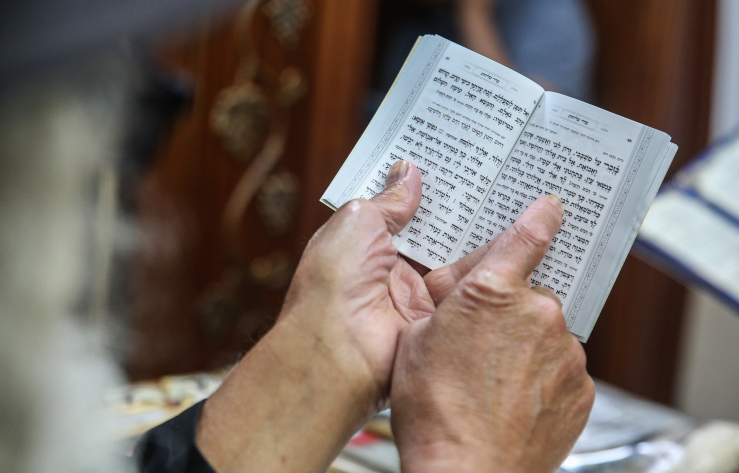
After the passing of the late Rabbi Hirsch - the leader of Western European Jewry, and one of the greatest figures of the Jewish nation in recent centuries - news broke that the rabbi, as rabbi of Moravia and Nikolsburg, had canceled the 'Kol Nidrei' prayer on Yom Kippur night.
This story has received many echoes for decades, and quite a few pens have been written about it: Is it possible that the great fighter against the Reform created such a significant change in the Holy Day prayer and abolished this very Jewish prayer?
An article by Rabbi Professor Mordechai Breuer, great-grandson of Rabbi Hirsch, published in the issue of 'HaMa'yan', sheds light on the picture that so many have grappled with.
Breuer quotes the testimony of Gratz (a well-known Jewish historian, who spent several years in the Rabbinical House in his youth) in his diary about Rabbi Hirsch: "I had to stand up to the struggle regarding all the vows he canceled, of course on my own initiative, and he made many enemies for himself in doing so.".
Gratz adds that he found an unfriendly atmosphere in Hamburg towards Rabbi Hirsch in ultra-Orthodox circles, and he attributes this, among other things, to the fact that at that time it was known in Hamburg that the Rabbi had abolished the recitation of "Kol Nidrei" - something that everyone opposed.
Reform spokesmen seized on these rumors as if they were the fruit of a great harvest. They claimed that their most zealous rival, the Rashar, was adopting a system of religious reform, and therefore there was no fundamental difference between Reform Judaism and Neo-Orthodoxy.
In the atmosphere of intense polemics of those days surrounding Reform Judaism, such rumors were enough to justify such generalizations in the eyes of the leaders of the Reform movement.
One of Rabbi Hirsch's associates published in 1861 (1861) in the newspaper Ben Hananiyot a series of denials of the malicious rumors that this newspaper had spread about the Rabbi, and wrote regarding each vow: "I know nothing about his follies. In any case, it is a lie that the Rabbi ever disliked each vow.".
Rabbi Lehman of Mainz also wrote that Rabbi Hirsch did not abolish the saying of 'Kol Nidrei'.
Another compromise to the story suggests the following concept: It was a custom in Nickelsburg that the rabbi would deliver a sermon before reciting "Kol Nidrei," but Rabbi Hirsch wanted to change the order - with the goal of having the rabbi deliver a sermon after Kol Nidrei.
The reason for this was that, according to the old custom, it was common for the recitation of 'Kol Nidrei' to be delayed until nightfall, contrary to the halacha that does not permit vows to be made at night.
One of the old householders rebelled against the rabbi, caused a scandal in the synagogue, and was rude to him. The rabbi left the synagogue, and that householder was fined one hundred gold pieces and forbidden from praying in that synagogue for a whole year. Part of this story was also told in the biography written by Mrs. Hava Koskal, 'Who is Eli?'.
Undoubtedly
But then, after presenting the evidence, Rabbi Professor Breuer unequivocally claims that the story did indeed happen: "Nevertheless, the fact of the annulment of the recitation of all vows in Oldenburg is beyond doubt.".
Why then did Rabbi Hirsch cancel the saying of 'Kol Nidrei'?
Breuer explains that there were only halachic reasons for this. Breuer finds the basis for his statement in the old Philispon General Jewish Journal, where the following sentence is written in the commentary: "Although last year all vows were omitted For reasons of halakhic law...""
In other words, all vows were indeed canceled in the city of Oldenburg for one year, but these were halachic reasons underlying the action.
What were the reasons for the law?
This is not a halakhic list, but I will briefly note that Breuer explains that the saying "all vows" was not accepted in all Jewish communities, due to the fear that the peoples of the lands would be careless about their vows and oaths, relying on their cancellation in advance.
And indeed, Rabbi Aharon HaCohen of Lonil states in the book 'Erchot Chaim' that "a large part of his rabbis would have completely abolished this prayer in their place, and the people of the land would have thought that all their vows were null and void and would have acted frivolously with boycotts and vows.".
Rabbi Hirsch, as the rabbi of the city of Oldenburg, sought to do a "great deed" and educate his congregation not to take this serious offense lightly.
Rabbi Hirsch viewed 'Kol Nidrei' as a halakhic act, not a 'custom of Israel,' and as a halakhic action, he foresaw its problematic consequences in those days.
Because of the Reformers
So what happened at the end of the day? Why was Kol Nidrei returned?
In those years, Ashkenazi Judaism was on the verge of escalating the public struggle over the Reform, and the leaders of the Haredi community in Hamburg and Amsterdam opposed the drastic step of the Rashar, and he accepted it. In other words, 'Kol Nidrei' was left out because of the fear that it would be interpreted as a step in favor of the Reform.
Four years later, the Rabbi joined the rabbis who opposed the complete abolition of 'Kol Nidrei' for reasons other than halachic, but a hint of the 'Oldenburg Affair' is found in Breuer's words to the Reformers: "You have almost made every remedy and every correction stink in the eyes of those who walk in integrity, every new month, even though they will be disgusted by its foundational holiness, out of concern lest it emanate from a source as sleazy as your advice.".
What does the Chief Justice say here?
Even a correction that is fundamentally holy, such as the cancellation of "all vows" for reasons of halakhic law, did not succeed because, with your reformist actions, you blocked the way for any correction, even a holy one, which would be suspected of coming from your lawlessness.
 Join the Haredim 10 Facebook page >>
 Join the X page of Haredim 10 >>
 Want more news, videos and stories? Join the Haredim 10 WhatsApp channel >>
