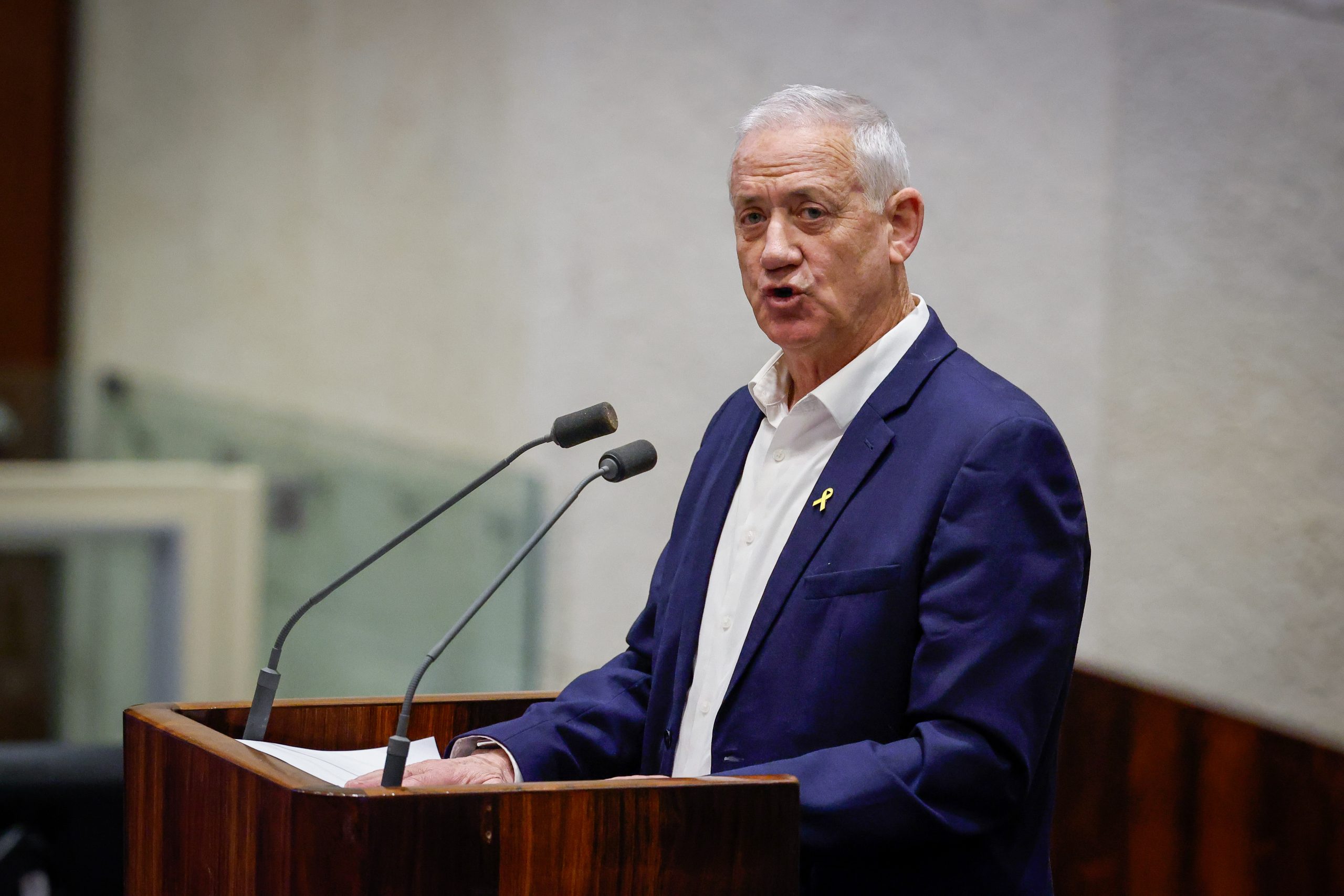
Blue and White Chairman Benny Gantz spoke at the annual conference of the Jewish People Policy Institute in Jerusalem.
In his words: "The fact that most Israelis agree on most of the issues on the agenda, with an emphasis on security issues and also on regime issues – but are so far apart in terms of the feelings they express towards the "other" – inspires hope. Because we have a good, broad common ground, a change in the public atmosphere that starts from the top can also correct the emotional aspects.".
On the other hand, the fact that there is also a downward trend in the issue of agreements on various issues is disturbing. Because we feel hatred and distance from various parts of society, and with the encouragement of the leadership and social networks, we are also extremizing our positions.
In the last decade, maybe even the last twenty years, the question of the elections was who would be the prime minister and which bloc would win. I argue that on October 7th, and perhaps even before that, with the coup d'état, something happened in Israel.
We are entering a decade that will have two major challenges:
The first is the security challenge.
The agreement being formed with Iran is only the beginning of a comprehensive struggle to destroy the nuclear project and a strategic change in the balance in the Middle East. As Chief of Staff, I ordered the first anti-aircraft missile operation in Syria, and I am certain today that the Chief of Staff is preparing the army for the day when Israel will be required to move to anti-aircraft missile operations in Iran as well, in the face of an attempt to restore the nuclear project and ballistic missiles.
Israel must maintain its freedom of action and its qualitative advantage, and this is the most important thing to insist on in any agreement and at any cost. Today's attack on Dahiyya is an important declaration of intent and must not be the last. As long as Hezbollah attacks and is not disarmed, Beirut is a key target. Hezbollah is in Dahiyya and there is a need to act. It will not be quick and there will be a price for that. But this is part of the lesson of the October seven - not to let the threats to our settlement be rebuilt. We will be required to engage in meaningful dialogue with the current American administration and the one that will succeed it. We will have to finish the work with Hamas and prevent Hezbollah from strengthening and returning to southern Lebanon. We will also have opportunities for normalization with Saudi Arabia, Indonesia, and also with Lebanon and Syria.
Historic opportunities that the current government missed due to coalition considerations. The second challenge is to integrate all parts of Israeli society into the state. And let's put it more directly – to integrate the ultra-Orthodox and Arabs in service, in employment, in society. I always say that Israel needs to be a "state of all its tribes." For this to happen, each of the tribes needs to contribute, and each of the tribes needs to receive the foundation from the state.
We, the decision-makers, have the responsibility. The next government must be a broad Zionist government. Such a government will also be strong enough to do what most Israelis still agree on. It will be strong enough to make tough decisions on the issue of conscription, and unpopular decisions. It will not miss strategic opportunities because of fears of sectoral groups and on the other hand, by virtue of being a broad government – it will significantly reduce the polarization between the camps. It will be a government of change.
In the last decade, elections focused on who would be prime minister and which bloc would "win" - in the next decade, elections should be about the composition of the government and breaking up the blocs.
I will reiterate my position that Netanyahu should end his term for three reasons: responsibility for the October coup, his partisan policies, and the long time he has been in office.
But if a narrow minority government is formed, dependent on the Arab parties and Meretz, just to replace Netanyahu, it will fail in the two major challenges that I mentioned.
Of course, another government of the Likud, the Haredim, and Ben Gvir will lead to a worsening of the situation. We have no choice. The next elections must lead to the establishment of a broad, Zionist government. It doesn't matter who the largest party is, it matters whether there is a party large enough to impose such a government.
If one bloc wins, the country will lose. I truly fear for the future of the Jewish people. This is a good enough reason for me to fight and do everything I can to succeed in this mission.
And nothing will distract me from it. Not commentators or tweeters. This is the most important battle for the country in the coming years. I intend to attack it together with many others – as I have done all my life.
 Join the Haredim 10 Facebook page >>
 Join the X page of Haredim 10 >>
 Want more news, videos and stories? Join the Haredim 10 WhatsApp channel >>