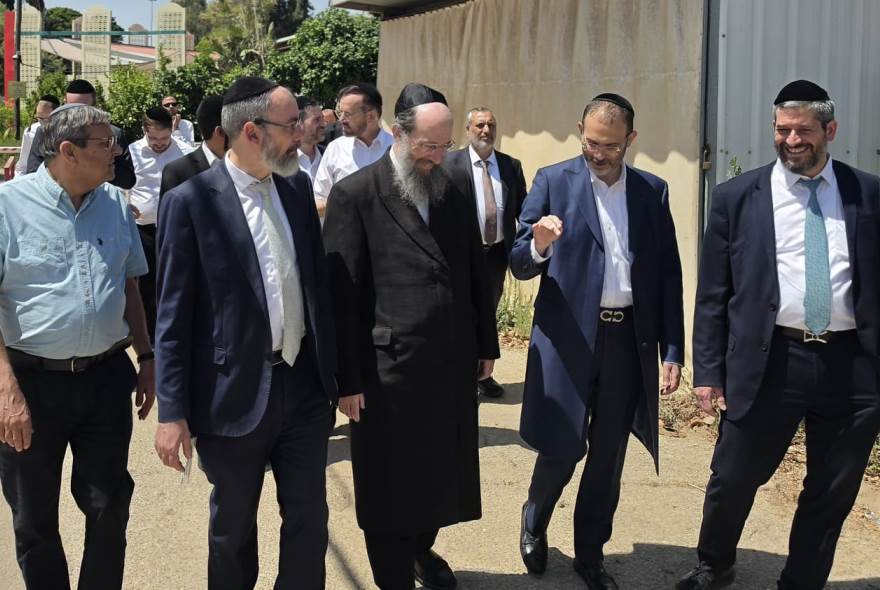
Senior officials from the Education Administration and employees of the Education Department in the Bnei Brak Municipality conducted a professional and comprehensive tour of the Farah Israel Network's community village in Rosh HaAyin, with the aim of getting to know the village's unique activity model, the therapeutic and rehabilitation services provided to residents, and Farah Israel's broad work concept in the field of special education, rehabilitation, and treatment.
The tour was attended by department managers, supervisors, coordinators, therapists, assistants and helpers from the Education Department in the Bnei Brak Municipality, who came to get a first-hand impression of the activities taking place in Kfar Farah, which constitutes one of the network's comprehensive and unique frameworks.
The tour was accompanied and led on behalf of the network by Rabbi Shabtai Eisenstadt, who opened the visit with a broad overview of Farah Israel's national activities, which extend from north to south and include educational, treatment and rehabilitation frameworks for children, students and adults with special needs.
The visit began in the village's training room, where the participants received a systematic overview of Farah Israel as a national network, the scope of its activities, the therapeutic-educational continuum, and the various services provided within the network's frameworks. The village manager, Ms. Yafit Bargig, then presented the unique activities of the community village in Rosh HaAyin, the organizational structure of the place, the professional work concept, and the daily routine of life for the residents.
The Farah Israel Community Village in Rosh HaAyin serves as a warm, professional and respectful home for residents who need a broad therapeutic and rehabilitation package. The activities in the village combine housing, treatment, employment, leisure activities, medical support, paramedical assistance, emotional and social work, and the constant promotion of independence, functional abilities and quality of life. The residents live in pavilions and apartments that are tailored to their needs, with a personal package being built for each group and each resident according to their level of functioning, therapeutic needs and professional goals.
After the initial overview, the participants went on a professional tour of the village led by Rabbi Yehuda, the director of the village's treatment and medical department. During the tour, the guests visited the rehabilitation and treatment departments, the clinic, the employment spaces and the activity rooms, and were exposed up close to the daily work done with the residents. The participants saw the places where the residents receive treatments, participate in activities, work, progress and acquire life skills, while being closely accompanied by professional and dedicated teams.

The tour allowed participants to gain a firsthand impression of the village's unique model: a combination of a protected and inclusive residential setting with a professional treatment system, rehabilitation activities, adapted employment, and community life. The guests observed closely the internal division of the village into pavilions and various settings, the personalization provided to each resident, and the way in which a respectful, stable, and progressive lifestyle is built for them.
At the end of the tour, the participants returned to the training room, where a professional summary of the visit was held. During the summary, representatives of the Bnei Brak municipality expressed their great impression of the scope of the activity, the level of professionalism of the teams, the respectful atmosphere in the village, and the ability of Farah Israel to provide residents with a broad envelope that sees the whole person, not only their therapeutic needs, but also their desires, abilities, dignity, and daily life.
During the visit, the long-standing cooperation between the Bnei Brak Municipality and the Farah Israel network was also emphasized. For over a decade, Farah Israel has operated a wide array of after-school programs and summer camps for the municipality in Bnei Brak, serving approximately 5,000 children in hundreds of settings. The activity takes place in both regular educational institutions and special education settings, and it reflects an ongoing professional relationship, based on trust, accumulated experience, and deep familiarity with the needs of the city's education system.
The CEO of the Farah Israel Network, Rabbi Moshe Stein, emphasized the great responsibility placed on those involved in education, especially in early childhood and the early years. Rabbi Stein emphasized that professional, sensitive, and correct investment in a child at an early stage does not amount to a specific response to an educational or therapeutic need, but may affect the course of his entire life. According to him, precisely at a young age, when the mind is still being built and abilities are developing, every personal approach, every correct diagnosis, every tailored treatment, and every reinforcement given in time, can open new doors for the child and give him strength that will accompany him for years to come.

The CEO added and strengthened the hands of the education staff in the Bnei Brak municipality, who deal with young souls and with the sensitivity required to see each child for their needs, strengths and uniqueness. He noted that the extensive activity of Farah Israel, spread across a variety of frameworks across the country, is built from the same concept, not to wait for the difficulty to deepen, but to anticipate a response, invest in the young, build a professional envelope and give each child the tools to progress, grow and reach, with God's help, the best place for them.
Participating in the tour on behalf of the Bnei Brak Municipality were: Rabbi Moshe Rosenthal, Director of the Education Administration; Rabbi Shmuel Dadon, Director of the Licensing Department; Rabbi Aharon Salz, Director of the Daycare and Early Childhood Department; Rabbi Yehuda Levy, Deputy Director of the Education Administration and Director of the Special Education Department; Rabbi Shimon Keshash, Director of the Elementary and Pre-Elementary and 360 Department; Rabbi Eldad Ashouri, Director of the Youth Department; and Rabbi Yosef Setel, Deputy Director of the Education Department and Director of the Kindergarten Department.
The Farah Israel network noted that the tour was meaningful and useful, and that it strengthened the professional acquaintance between the parties. According to the organizers, the participants left the visit with important insights both regarding Farah Israel's national activities and regarding the unique model of the community village in Rosh HaAyin, which combines professionalism, sensitivity, dedication and a broad view of the residents' needs.
 Join the Haredim 10 Facebook page >>
 Join the X page of Haredim 10 >>
 Want more news, videos and stories? Join the Haredim 10 WhatsApp channel >>