The Planning and Economics Division at the Tax Authority published a study today (Wednesday) on realizing eligibility for a work grant.
A work grant - or, in its original name, a negative income tax - is paid to low-wage workers who meet criteria set out in legislation. Its purpose is to reduce the incidence of poverty among working people and increase labor force participation.
In order to exercise eligibility for a work grant, an online application must be submitted through the Tax Authority website. Over the years, the realization rate has been approximately 701% of the eligible population, despite many efforts made by the Tax Authority to increase public awareness of the grant.
The study published today seeks to identify characteristics that may predict the submission of grant applications, based on data for eligibility years - years in which the income that entitles to a work grant was received - 2013-2023.
According to the study, the main characteristic that influences willingness to exercise eligibility is a successful past experience with applying for a grant.
In the years 2014-2023, the utilization rate among those who had previously received a grant once was 77%, and among those who had not previously received a grant - only 42%. People who had previously received a grant three or more times exercised their eligibility for grants in subsequent years in more than 90% of the cases.
Another characteristic that affects willingness to exercise entitlement is the amount of the grant. For example, in the 2023 eligibility year, the exercise rate was 841% among women and 761% among men when the grant amount was higher than 5,000 shekels. In contrast, when the grant amount was lower than 500 shekels, the exercise rate was 431% among women and 391% among men.
In general, the realization rate among women is higher than among men, throughout all years surveyed and for all grant amounts examined, but the gap is narrowing over the years. While the realization rate among women increased from 72.4% in 2013 to 75.4% in 2023, the realization rate among men increased from 53.3% in 2013 to 60.9% in 2023.
The study indicates that the degree of peripherality - size, distance from the center of the country - of the settlement has little effect on the realization rate.
However, the religious characteristics of the locality have a major impact on the implementation rate. Implementation rates in localities with a Haredi majority stand at 82%-87% throughout the years surveyed.
In contrast, in localities with a non-Haredi Jewish majority, the realization rate ranges from approximately 65% to approximately 69%, in Arab localities the realization rate ranges from approximately 55% to approximately 67%, and in Druze localities the realization rate ranges from approximately 56% to approximately 72%.
The gap that existed in the past between the realization rate in the Jewish population and the realization rate in the non-Jewish population has narrowed to the point of disappearing.
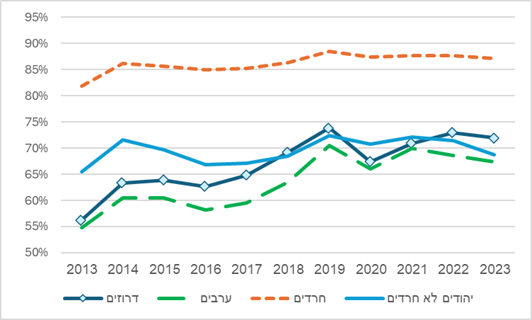
Exhaustion rates of eligibility for work grant by primary religion in the years 2013-2023
 Join the Haredim 10 Facebook page >>
 Join the X page of Haredim 10 >>
 Want more news, videos and stories? Join the Haredim 10 WhatsApp channel >>