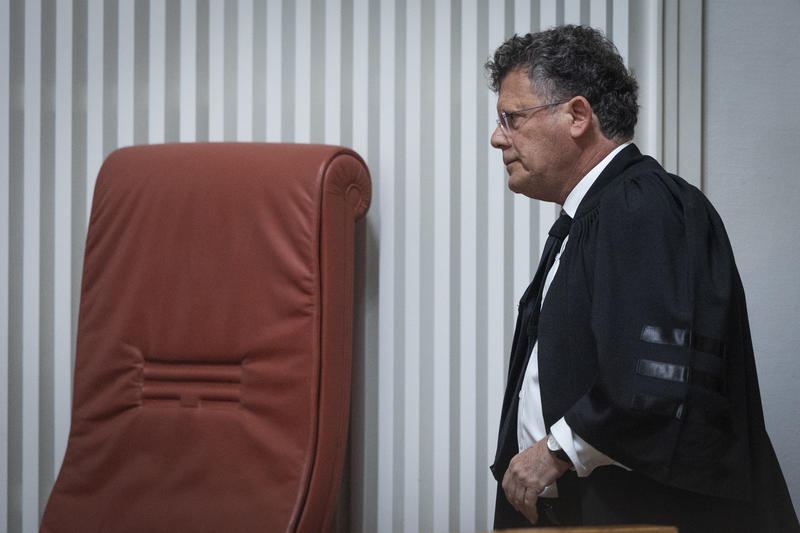
The Ombudsman for Judges, retired Judge Asher Kola, today (Wednesday) justified the complaints filed against Supreme Court judges for conducting an intensive judicial process and issuing decisions on Saturday regarding anti-government protests.
The Commissioner's decision deals with the tension between the sanctity of the Sabbath and its observance in a Jewish and democratic state and the need to provide immediate remedies to exercise freedom of expression and protest even in times of war.
The Commissioner determined in his decision that complaints filed against the Supreme Court justices - Yitzhak Amit, Khaled Kabob and Yechiel Meir Kasher - for issuing judicial decisions on Saturday, were found to be justified in all matters relating to the timing of the decisions and the manner in which they were handled on Friday and Saturday.
The complaints, filed by various parties, including rabbis, elected officials, and public associations, referred to the conduct of the panel of judges in a case that dealt with a petition to authorize demonstrations, and in particular the issuance of three judicial decisions during the Sabbath.
The complainants claimed that this was a "complete desecration of the Sabbath and an attack on the Jewish image of the state," and that there was no real urgency that justified judicial activity on the Sabbath, in violation of the Working Hours and Rest Law and the Judicial Procedure Regulations.
On the other hand, the judges requested in their response to dismiss the complaints outright. In their response, they explained that they were forced to act on Saturday in light of the Home Front Command's demand to submit a response only on that day, and because there was concern about "pikuach nefesh" and the safety of the protesters and police officers in the field. The judges emphasized that this was a clear judicial decision that was under the sole discretion of the judges sitting in the court.
After examining the allegations, the Commissioner determined that he was authorized to investigate the complaints since the issue involved "the manner in which the court is administered," a subject in which the Commissioner had intervened in the past, and as already anchored in the opinion of the first Commissioner, retired Judge T. Strasberg-Cohen. Commissioner Goldberg also explicitly addressed the issue of court activity on Shabbat in his decisions and published position.
In his decision, Kola mentioned the constitutional status of the Sabbath, which is enshrined in the Basic Law: Israel the Nation-State, and even quoted former President Aharon Barak's famous ruling in the Horev Street affair: "The Sabbath embodies the essence of the character of Judaism.".
""The expectation from the Supreme Court justices hearing a petition of this type is that they will wrap themselves in both their 'Jewish robe' and their 'democratic robe,'" Commissioner Kola wrote in his decision. "The Supreme Court has an increased duty to respect the sanctity of the Sabbath and to act within the framework of the exceptions with restraint and extreme caution. In our case, there was no urgency in issuing decisions during the Sabbath, and it was appropriate and possible to find alternative judicial solutions.".
The Commissioner emphasized that the panel's conduct constituted a serious violation of the proper administration of justice - and concluded his ruling with a quote from Ahad Ha'am on the importance of the Sabbath to the Jewish people: "It can be said without any exaggeration that more than Israel kept the Sabbath, the Sabbath kept them, and if it were not for it that restored their "soul" and renewed their spiritual life each week, the hardships of the 'days of action' would have pulled them further and further downward, until they would have finally descended to the last filth of 'sinfulness' and moral and intellectual degradation...".
 Join the Haredim 10 Facebook page >>
 Join the X page of Haredim 10 >>
 Want more news, videos and stories? Join the Haredim 10 WhatsApp channel >>