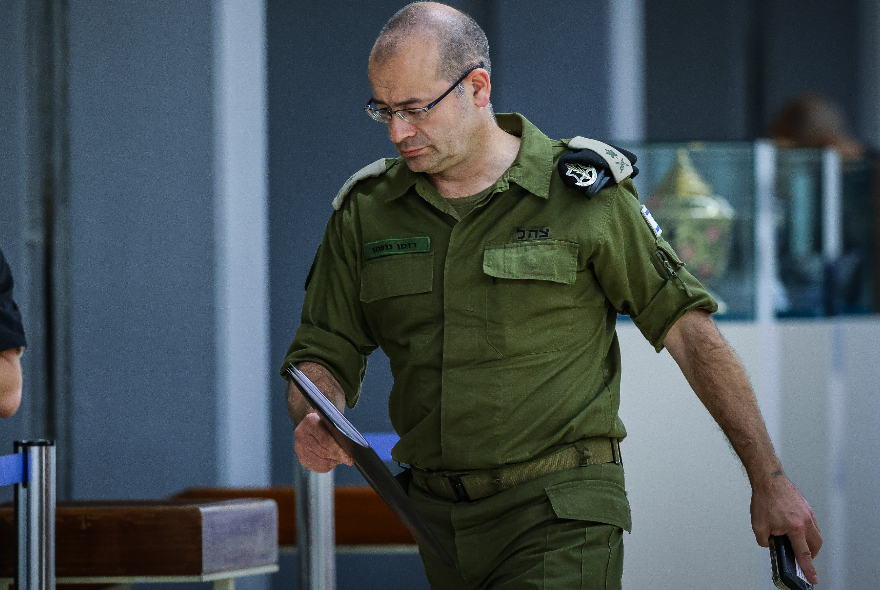
In a document he submitted to the High Court of Justice today (Friday), Prime Minister Benjamin Netanyahu rejected the petitions seeking to invalidate the appointment of Major General Roman Gofman to the position of head of the Mossad.
Netanyahu uses strong language in his response to the petitions, placing his operational authority and security assessment above the judicial review of the High Court of Justice, and claiming that this is a fateful decision that the court does not have the tools to evaluate.
""There is good reason to assume that the reasonableness of my decision is dozens of times better than the reasonableness of anyone else, and the honorable court in general," the prime minister wrote.
He said he knows Goffman firsthand and is convinced that he is the most talented candidate for the mission in time of war.
Netanyahu emphasized that no flaw was found in Goffman's examination of his qualities. "Goffman did not have any moral flaws in his decades of military service. And even if a flaw were found in the purity of his qualities, the Prime Minister would have been entitled to evaluate the flaw against his advantages, against the background of the country's needs and challenges, and only then make the best decision for Israel's security. But not of any kind or part of it. Goffman's qualities were combed with iron combs and found to be pure.".
The Prime Minister added and harshly criticized the petitioners, attributing to them a "lack of self-awareness and lack of security responsibility.".
Netanyahu claimed that some of the motives behind the petitions are political and foreign, and that the petitioners are in effect seeking to deprive the people of the democratic authority that the government has entrusted to determine the identity of the people who will implement security policy.
Netanyahu emphasized in his response: "The legal and democratic mandate to steer the security of the state and its citizens was imposed by the public on the Prime Minister, and only in his hands. In the end, the current process – as well as the aspects of the advisory committee's review – does not at all deal, and did not pretend to deal, with security and strategic considerations. In any case, there is no possibility, even theoretically, to propose within the framework of this process a different 'balance' against a set of considerations that is not at all laid out before us.".
Major General Roman Goffman also responded to the High Court of Justice today, through his attorney, Attorney Ohad Shalem, to petitions seeking to invalidate his appointment as head of the Mossad - claiming that this is an invalid attempt to replace the discretion of the political echelon with judicial discretion.
In his response, backed by the position of the Chief of Staff, Goffman emphasizes his illustrious military service over three decades and his combat on October 7, in which he was seriously injured after attempting to engage terrorists without an explicit order.
According to a report on Channel 14, in the dramatic document, Goffman attacks the petitioners and claims that submitting the petitions alongside media campaigns constitutes an attempt to change the system of government in Israel.
Goffman presents his operational record, and in particular his heroism on the morning of October 7, as a crushing answer to the petitioners' claims against his moral integrity.
Attorney Ohad Shalem wrote on behalf of the major general: "By submitting the petitions and accompanying media campaigns, the petitioners are attempting to replace the democratic system of government, and in particular to replace the discretion of the elected prime minister in entrusting the management of state security to the honorable court.".
A large part of the response is dedicated to the events of October 7. Goffman notes that even though he had no official role in the southern sector that morning, he did not hesitate, arrived at the scene, took command and was seriously wounded in battle against terrorists: "This is not a coincidence, but a direct continuation of the same responsibility, courage and deep commitment that characterized his activities throughout his years of service. Major General Goffman is a role model and example. No less!".
Goffman bases his response on the "Zini ruling" – a legal precedent in which the High Court of Justice refrained from interfering in the appointment of senior officers on similar grounds. Goffman's message is clear: the court is not the body authorized to manage state security or determine who is worthy of commanding the security forces.
 Join the Haredim 10 Facebook page >>
 Join the X page of Haredim 10 >>
 Want more news, videos and stories? Join the Haredim 10 WhatsApp channel >>